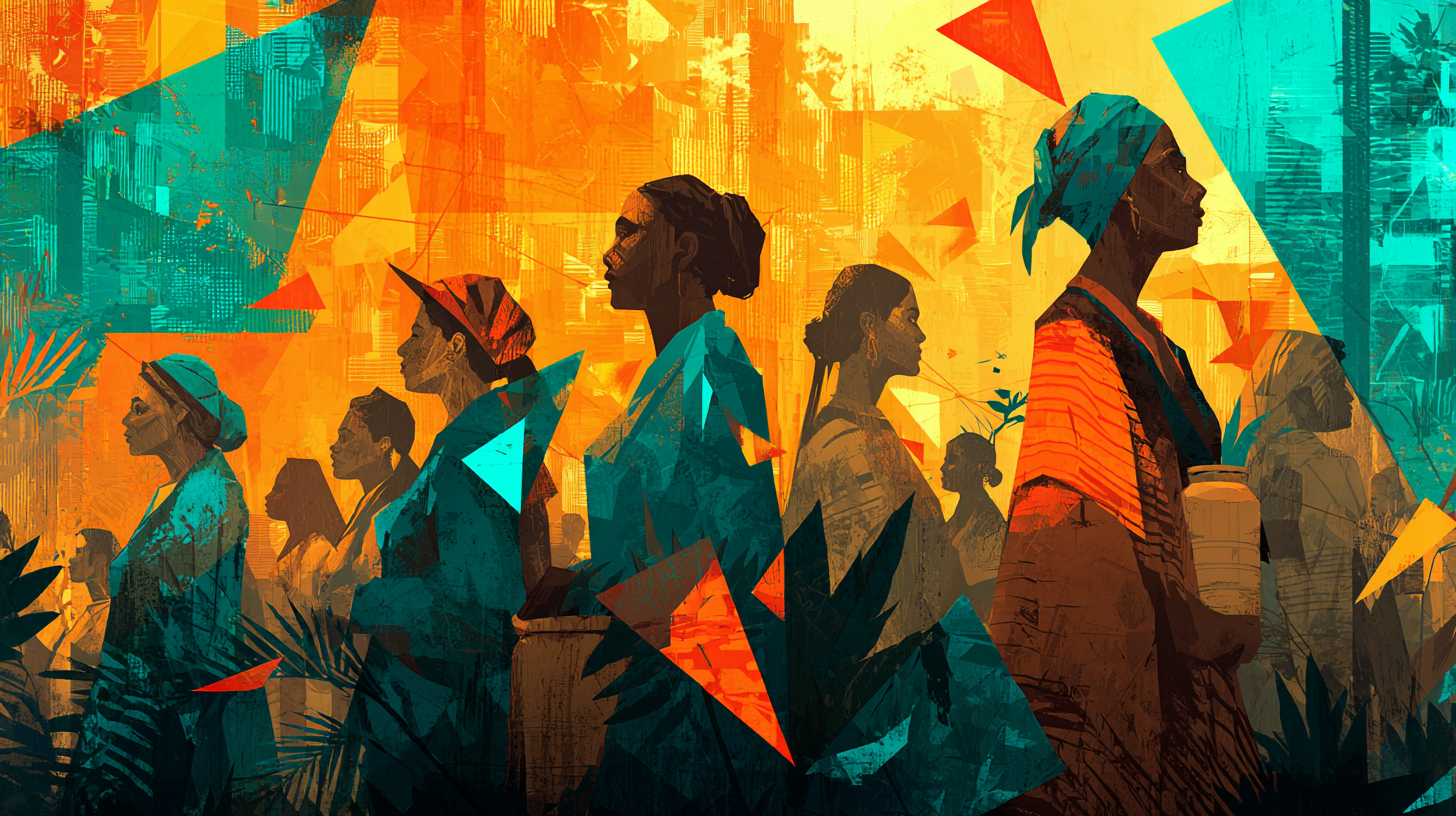
On May 31, 2026, Abelardo de la Espriella obtained 43.7% of the votes in the first round of the Colombian presidential elections. That night, as results were confirmed on screens scattered across the country, thousands of Colombian women were somewhere specific, gathered with their mothers, with friends, in Calarcá, in Bogotá, in newsrooms, in family homes. Days later, AcidReport launched a Facebook poll with a direct question. What would you lose if he wins? Responses came from women with names, with histories, with precise geographies. This article is built from their words. They were not waiting for an abstract result. They were waiting to find out whether what they have would remain theirs. And what they answered was not ideological. It was topographical.
The Spectacle Without a Programme
There is a way of doing politics that requires no content. It requires volume, physical presence, the ability to occupy media space with gestures that generate reaction. De la Espriella reached the second round without an articulated government programme on women’s rights, without proposals on sexual education, without any mention of teenage pregnancy or reproductive health. What he left instead was something else, a television episode in which four presenters, including a woman, asked him to show his buttocks to thousands of viewers. He did. He had openly declared his opposition to voluntary termination of pregnancy. He had attacked female journalists live on air. The body, in his campaign, functioned as argument; his own, exhibited as a symbol of a virility without object; that of others, as territory to be reclaimed.
What is striking is not only the absence of proposals but the coherence of that absence. A candidate who does not speak about sexual and reproductive rights does not ignore them out of carelessness, he ignores them because their suppression is the programme. There is no need to write it down. The omission is the policy. His government plan contains no measure on public family planning, no commitment to sexual education in schools, no mention of gender violence as a structural problem of the State. What does appear, stated in interviews and at campaign events, is explicit opposition to Constitutional Court ruling C-055/22, which decriminalised abortion up to week 24 in 2022. For De la Espriella, that ruling is an error that can be corrected. For the women who responded to the poll, it is a conquest that can be lost.
This is not a Colombian novelty. It is a recognisable pattern in Latin American politics over the past fifteen years, that of the leader who builds his authority on negation, who defines his project by what he will destroy rather than what he will build. Bolsonaro in Brazil, Milei in Argentina, Bukele in El Salvador, each with their local variants, share the same political grammar, virility as programme, the leader’s body as metaphor for the state they promise, strong, without fissures, without concessions to those they consider weakness. What is specific to the Colombian case is the response it generated. Because when Colombian women were asked what they would lose, they did not respond with slogans. They responded with inventories.
The Inventory of the Real
A woman in Calarcá, Quindío, answered that she would lose the legacy of her great-grandmother Leonor Palacio, the first woman to exercise the female vote in that municipality. Another, wherever she lives outside Colombia, said she would lose the desire to return, even though she cannot. An economist, a political scientist, a journalist gathered in a room could not believe that more than ten million people had voted for that candidate. A mother spoke of the water, the mountain, the forest, the trees, the animals that inhabit them. Not as metaphor. As enumeration of what constitutes her daily happiness, her future and her daughter’s.
With 100% of polling stations counted, Abelardo de la Espriella obtained 10,118,924 votes in the first round of 31 May 2026, corresponding to 43.77% of valid votes. Iván Cepeda came second with 9,451,732 votes, 40.88%. (Registraduría Nacional, official results first round 2026)
What emerges from these testimonies is not fear of the future. It is something more precise and more unsettling, the recognition that something was built, that this something has a name and an address, and that it can be undone. A Colombian Muslim woman who has worn the hijab for fifteen years described what she would lose with an exactness that no political analyst would have formulated better. The peace of mind of walking down the street with her veil on, of working in it, of exercising her rights as a citizen, of accessing education and healthcare without her religious identity being read as a threat. It is not an abstraction. It is the journey between her home and her workplace.
It is worth pausing on that testimony because it contains several registers at once. There is a register of physical safety, the right to move through public space without being singled out. There is a professional register, the right to work without clothing being grounds for exclusion. There is an institutional register, access to public services without discrimination. And there is an identity register, fifteen years building a way of being in the world that a change of government could turn into a vulnerability. All of that in a single response, from a single woman, to a Facebook question. The density of what is at stake does not fit in campaign headlines. It fits, instead, in the inventory of someone who knows exactly what she has.
Faith as Material Wealth
There are two types of responses among those that arrived. The first name objects, bodies, places, specific rights. The second name something harder to map but equally concrete, faith. One woman said she would lose the pride of being Colombian, which she had recovered under the government of change. Another said she would lose faith in the youth, in communication, in argument, in encounter. A third said she would lose faith in the humanity of Colombia.
This deserves attention. When someone says they would lose faith in their country, they are not expressing a diffuse emotion. They are saying that something was returned to them, that this something was real, and that its loss would also be real. Faith, in this context, functions as an indicator of belonging. These women felt, for a determined period, that Colombia belonged to them in a way that had not been possible before. That they could inhabit it without asking permission. The possibility of losing that is not sentimental. It is political in the strictest sense of the word, it concerns who can occupy common space and under what conditions.
Colombia’s Constitutional Court decriminalised abortion up to the 24th week of gestation in February 2022, through ruling C-055/22, recognising voluntary termination of pregnancy as a fundamental right. (Constitutional Court, Ruling C-055/22)
One woman described what she would lose if the public health system stopped guaranteeing family planning. She did not speak of reproductive ideology. She spoke of the concrete possibility of accessing contraception through the system she contributes to. It is the difference between a right and a privilege. Rights exist when the State guarantees them, privileges exist when one can afford them. What is at stake on June 21 is not a philosophical dispute about the role of the State in private life. It is the question of whether Colombian women will continue to have access to services that exist today, or whether that access will depend, as before, on how much money they have in their pocket.
Another woman formulated it from a different but equally precise perspective. She would lose the certainty that many will be better off or at least the same. She would lose hope in pedagogy, in argument. There is a particular lucidity in that phrase. She does not merely fear losing concrete rights, she fears losing the very possibility that argument might function as a political instrument. That reasons might serve for something. That explaining might be worth the effort. It is the exhaustion of someone who has tried to convince and sees that the machinery of spectacle outweighs the precision of facts.
What the Noise Does Not Contain
In the comments of the poll, the other shore also appeared. One voice defended the candidate arguing that his ideas offer more than the adversary’s, that socialism is misery, that what matters is ideas and not people. Another voice laughed. There were comments that were deleted. What is notable is not that these voices exist, but what they do not contain. None enumerated what they would gain. None made an inventory of what De la Espriella would build. They defended the candidate without being able to name, with the same surgical precision as his opponents, what would exist thanks to him that does not exist today.
This asymmetry is not anecdotal. It is structural. A politics that defines itself through negation does not generate inventories of what it will build, because it has not thought in those terms. It generates promises of demolition. And demolitions, unlike constructions, do not require detailed blueprints. It suffices to know what must be torn down. The Ministry of Cultures, Arts and Knowledge. Ruling C-055/22. Sexual and reproductive health programmes. The peace process. Each of these institutions or achievements has enemies who know its name. What they do not have are defenders capable of articulating, with equal precision, what world they would build in its place.
There is something more in that silence on the opposing side that deserves to be named. When a voice in the comments says that socialist ideas bring misery, it is using an abstraction to respond to a concrete inventory. It is the oldest mechanism of reactionary politics, raising the debate to the level of principles to avoid answering at the level of facts. Nobody asked whether socialism works in the abstract. They asked what a Muslim woman would lose if he wins. The answer arrived in terms of journeys, identity documents, medical appointments. Ideological noise cannot respond to that because it does not operate in the same register.
On June 21, Colombia votes again. What is at stake is not, as is often said, the future of the country. What is at stake is whether what already exists, what was built through decades of struggle and a few years of public policy, will continue to exist. The páramo. The hijab in the street. The right to decide over one’s own body. The legacy of the great-grandmother who voted first. The women who responded to the poll were not campaigning. They were making memory of the real, which is the only form of resistance that cannot be confiscated…
G.S.
Sources
- First round results 2026 presidential elections
- Ruling C-055/22, Constitutional Court of Colombia
- Government plan Abelardo de la Espriella 2026-2030
- Testimonies collected by AcidReport, Facebook poll, June 2026