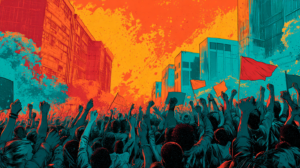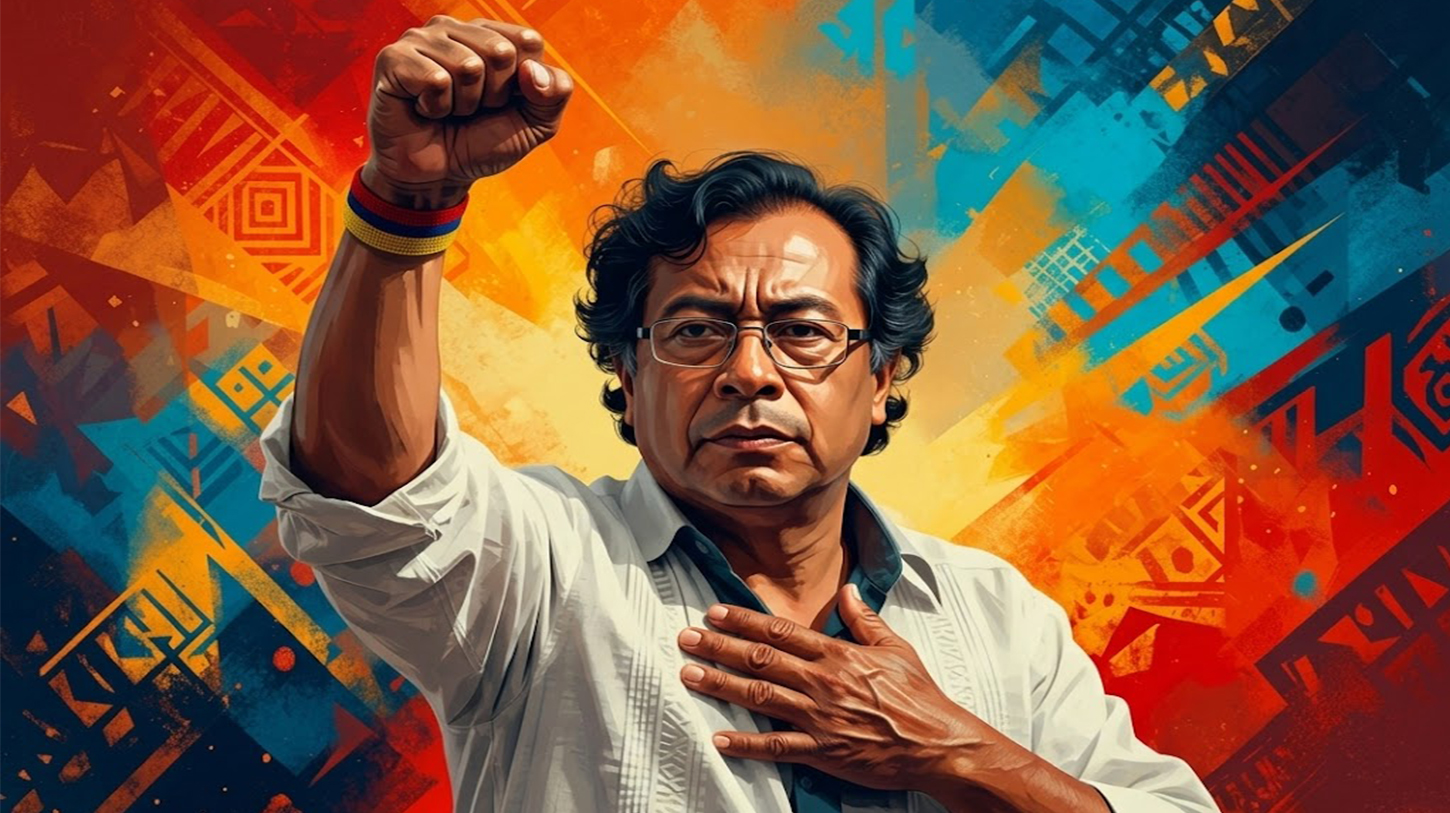
On 20 July 2026, in the working class district of Ciudad Bolívar, in southern Bogotá, President Gustavo Petro delivered the final public speech of his term, and turned it into something other than an accounting of his record. In ninety minutes he handed over three objects heavy with history, repeated an electoral fraud accusation that no Colombian media outlet or authority has been able to confirm, and called on his supporters to a civil disobedience campaign he had already been announcing since late June. The gesture was not improvised. It was the culmination of a logic that ran through his four years in government, that of a power which thinks of itself not as an institutional function but as the continuation of an unfinished insurgency. Petro said his farewell was, in his own words, “for now”.
Staging the exit
Petro chose Ciudad Bolívar for reasons he explained himself. He built social housing there when he was mayor of Bogotá, between 2012 and 2015, and wanted to close his presidency in the same territory where he had begun building his political capital two decades earlier. The military parade, moved there for the first time, served as a prelude to an event part of the Colombian press described as loaded with militant symbolism. Three objects, three decisions.
Simón Bolívar’s sword, which Petro displayed at his 2022 inauguration and kept on show at the Casa de Nariño throughout his term, returns to the Casa Museo Quinta de Bolívar. The president insisted that the sword “cannot be sheathed until there is justice in Colombia” and that the people will guard it. The cassock of Camilo Torres Restrepo, the priest and sociologist Petro presents as a forerunner of liberation theology, is placed under the custody of the National University’s Faculty of Heritage, inside the National Museum. The speech leaves out a detail the press documents precisely, Torres did not simply “go to the mountains to fight”, he left the priesthood to join the National Liberation Army in 1965 and died in combat the following year. The omission is not an oversight, it is a rhetorical choice, invoking the guerrilla without naming it allows the sacrifice to be summoned without carrying the word that still divides part of the Colombian electorate.
The third object, the hat of Carlos Pizarro Leongómez, former M-19 commander assassinated in the middle of a presidential campaign in 1990, passes into the hands of his daughter, Senator María José Pizarro. Petro described it as “a symbol of peace” tied to the 1991 Constitution, which was itself born in part from that guerrilla’s demobilisation. None of the three objects formally belongs to the Colombian state. All three belong to the narrative Petro built about himself, that of an heir to an insurgency turned electoral project. What presents itself as an act of heritage generosity is, read more coldly, an operation of legacy, the public fixing of which political lineage he wants to leave behind before another lineage, that of Abelardo de la Espriella, occupies the Casa de Nariño on 7 August.
Petro announced that Bolívar’s sword would return to the Casa Museo Quinta de Bolívar, that Camilo Torres Restrepo’s cassock would be placed under the custody of the National University’s Faculty of Heritage inside the National Museum, and that Carlos Pizarro’s hat had been handed to Senator María José Pizarro, decisions confirmed by the Presidency of the Republic on 20 July 2026 itself.
The logic of the term
None of this is new for Petro, and that is precisely the problem with treating it as an isolated excess at the end of a government. Before becoming president he fought with the M-19 during the nineteen eighties, then served as mayor of Bogotá between 2012 and 2015, with an administrative removal from office along the way in December 2013, ordered by the then inspector general, reversed months later by a court ruling that let him finish his term. Petro himself recalls that episode in the 20 July speech as proof that “the people gave it back to me”, without mentioning that it was a tribunal, not a mobilisation, that did so. The omission fits the pattern, every time institutional power constrains him, Petro appeals to the people as an authority above the institutions that same people elected, even when the actual outcome was, more often than not, an ordinary court ruling.
The same pattern shapes his relationship with Washington throughout the term. In January 2026, after Nicolás Maduro’s capture by American forces, Petro declared he was ready to “take up arms” should the United States attack Colombia, breaking a commitment to non violence dating back to the 1989 peace pact with the M-19 itself. Weeks later Trump invited him to the White House, a shift in tone as abrupt as the confrontation that preceded it. Between the two episodes, the State Department, with Marco Rubio at its head, cut security assistance to Colombia and stated publicly that its disagreement was with the current president, not with Colombia’s institutions. Petro turned each of these frictions into public discourse, the military threat, the aid cut, the drug decertification, always presented as evidence of a foreign power hostile to a popular project, never as ordinary diplomatic friction between two governments with different interests.
The figures Petro displayed on 20 July about his own record, falling monetary poverty, declining infant mortality, rising university coverage, had already been documented in these pages when DANE confirmed, in 2025, the lowest level of monetary poverty recorded in the country’s statistical series, driven by the sustained rise in the minimum wage rather than by direct subsidies. The figure is real, and AcidReport reported it before Petro turned it into a farewell argument. What 20 July adds is not the data, it is its function, turning a verifiable record of governance into a moral guarantee against an electoral defeat that Colombia’s institutions have not, so far, called into question.
Something comparable happens with the security forces. Petro claimed credit for raising patrol officers’ pay and promoting thousands of sub-lieutenants, and told soldiers and police never to point their weapons at the people, an instruction that sounds like elementary democratic doctrine coming from someone who remains commander in chief of the armed forces until 7 August. Yet a database leaked in July revealed that a significant number of public officials, active police and soldiers included, were already registered with Abelardo de la Espriella’s campaign before he even called on the armed forces to disobey the outgoing president. Colombia’s security forces are not, in 2026, a homogeneous bloc loyal to Petro. They are a divided body, and the 20 July speech speaks as much to that internal fracture as to the people listening in the square.
According to a database leaked in July 2026, around 17,000 public officials, active police officers and soldiers included, were already registered with Abelardo de la Espriella’s campaign before he publicly called on the armed forces to disobey the outgoing president.
The chronology of denial
The refusal to accept the outcome of the 21 June vote has a precise starting date, and it is not 20 July. On 23 June, two days after the runoff, Donald Trump stated in an interview that his backing had been decisive for Abelardo de la Espriella’s victory, a candidate Trump said had been in tenth place before his support, adding that De la Espriella himself had called him that night to thank him. The next day, 24 June, Petro described those remarks as confessed foreign interference and floated, in a series of public messages, the annulment of the election, invoking the precedent of the European Court annulling Romania’s 2024 vote over foreign interference. He then asked what Colombian judge would refuse to annul an election faced with what he called a public confession from the president of the United States.
Meanwhile Iván Cepeda, the defeated Pacto Histórico candidate, had initially conceded defeat in the days after the runoff, before shifting toward a discourse of peaceful civil disobedience. On 6 July, Petro explicitly joined that call, summoned mobilisations for 20 July and announced he would deliver his farewell as head of state that same day. What had been a reaction to an interview in June turned, within weeks, into an organised mobilisation strategy, and what in July was still a call to march became, on 20 July, a formal complaint filed with the Colombian justice system, backed, according to Petro, by seventy thousand digital witnesses skilled in algorithms who supposedly detected manipulation on a foreign server and at polling stations both inside and outside Colombia.
None of the Colombian outlets that systematically document electoral processes, nor the Electoral Observation Mission, nor the National Registry Office, has confirmed the algorithmic fraud thesis to date. The press reporting it, including outlets editorially closest to Petrismo, consistently describes it as alleged or supposed. Trump’s claim about his own weight in the outcome is, by contrast, a verifiable fact, he made it and it was recorded. What is not verified is the leap Petro makes from that statement to the legal conclusion that the entire election should be annulled. Between the confirmed fact and the consequence Petro draws from it lies exactly the distance separating journalism from propaganda, and that is the distance AcidReport refuses to cross without independent evidence.
The declared strategy
What Petro announced on 20 July is not a protest, it is a roadmap with explicit conditions. A permanent general strike if the labour reforms that created job stability and a living wage are reversed. A national agrarian strike if the six hundred thousand hectares still awaiting land reform are handed to others. A general youth strike if the formula that allowed the public education budget to grow by more than half in real terms during his government is changed. And a final instruction, do not build barricades at the entrance of the neighbourhoods facing the security forces, but peacefully surround the centres of what Petro calls illegitimate power.
It is the language of extra institutional opposition, delivered by a sitting head of state. The contradiction does not seem to trouble Petro, on the contrary, he displays it as coherence. He said his farewell was “for now”, a phrase that in the mouth of a former president with an intention to return is not humility, it is a promise. Abelardo de la Espriella, declared president elect by the National Registry Office after 21 June, has already responded by announcing the end of the total peace policy and the closure of the Office of the High Commissioner for Peace, the first symbolic decision of his own incoming government, a mirror image of Petro’s ceremony of relics.
The 7 August transition thus looks less like the protocolary transfer envisioned by the 1991 Constitution and more like the first round of a conflict Petro began fighting before he had even formally lost the presidency, from the very moment a foreign president claimed part of the credit for his defeat. The crowd gathered in Ciudad Bolívar applauded every announcement. What 20 July leaves open is how many will still be there once the applause fades, once the Casa de Nariño has another owner and Bolívar’s sword is, once again, kept behind glass in a museum…
G.S.
Sources
- Petro insiste en un presunto fraude electoral
- Entre denuncias de supuesto fraude electoral y un balance de sus logros, así fue el último discurso de Gustavo Petro
- Petro dijo qué pasará con la espada de Bolívar y la sotana de Camilo Torres
- Petro entregará la espada de Simón Bolívar y la sotana del cura Camilo Torres a dos museos
- Gustavo Petro llama a huelga general e indefinida en Colombia
- Gustavo Petro reitera llamado a desobediencia civil y vuelve a desconocer triunfo electoral
- Marchas 20 de julio: Petro convoca movilización para defender las reformas sociales
- Petro denuncia injerencia de EEUU en elecciones colombianas y pide anular los comicios
- Gustavo Petro planteó la tesis de anular la segunda vuelta presidencial
- A historic poverty reduction that the central bank did not want, that the senate tried to sink, and that the media covered to avoid celebrating
- The active police force that owes Petro obedience was already enrolled in the campaign demanding his disobedience