Some novels begin as one thing and end up being another. They present themselves as love stories, build the illusion that what matters is the passion between two people, and then, without the reader noticing the precise moment of the turn, they become something more uncomfortable and more exact. Orhan Pamuk’s The Museum of Innocence is that kind of book. It begins with a man who falls in love and ends up being a theory about what we do with the time that slips away from us, constructed from concrete objects, from the accumulated materiality of a life that refuses to disappear without leaving evidence that it existed. It is a novel about love in the same way that an autopsy is a document about life; the method is dissection, and the conclusion consoles no one but says something that no other procedure could say with that precision.
Passion as the first deception
The story takes place in Istanbul in the nineteen-seventies, and the narrator belongs to the Istanbul bourgeoisie, that class which modernised itself by importing Western ways of life without modifying the mechanisms of control that organise its internal relations. He is engaged to a woman who embodies everything his world expects of him, discreet elegance, recognisable family, predictable future. The planned marriage is not a brutal transaction but something worse, an invisible transaction because all its participants have internalised it as their own desire. The system operates through ambient pressure, through the gaze of others converted into discipline without anyone having signed a contract to that effect.
The young woman who appears comes from another stratum, she has less money and more presence, and the attraction she triggers is not the romantic passion of serial fiction but something more disturbing, the desire that disorganises well-constructed systems because it does not ask permission. Pamuk narrates this with a coldness that resembles compassion but is in fact diagnosis. What he describes is not an impossible love in the classic literary sense but a love that his society makes impossible in a systematic, almost bureaucratic fashion, without decrees or explicit prohibitions. The transgression is punished by sustained discomfort, by silence at family gatherings, by the questions that are never asked because asking them would mean acknowledging that the problem exists. What Pamuk does with this situation is not to write a novel of denunciation. He shows how that system produces a specific form of pain which, instead of resolving itself into oblivion, becomes an enterprise of preservation lasting decades and ending up more real than anything the approved order would have produced.
The objects that do not lie
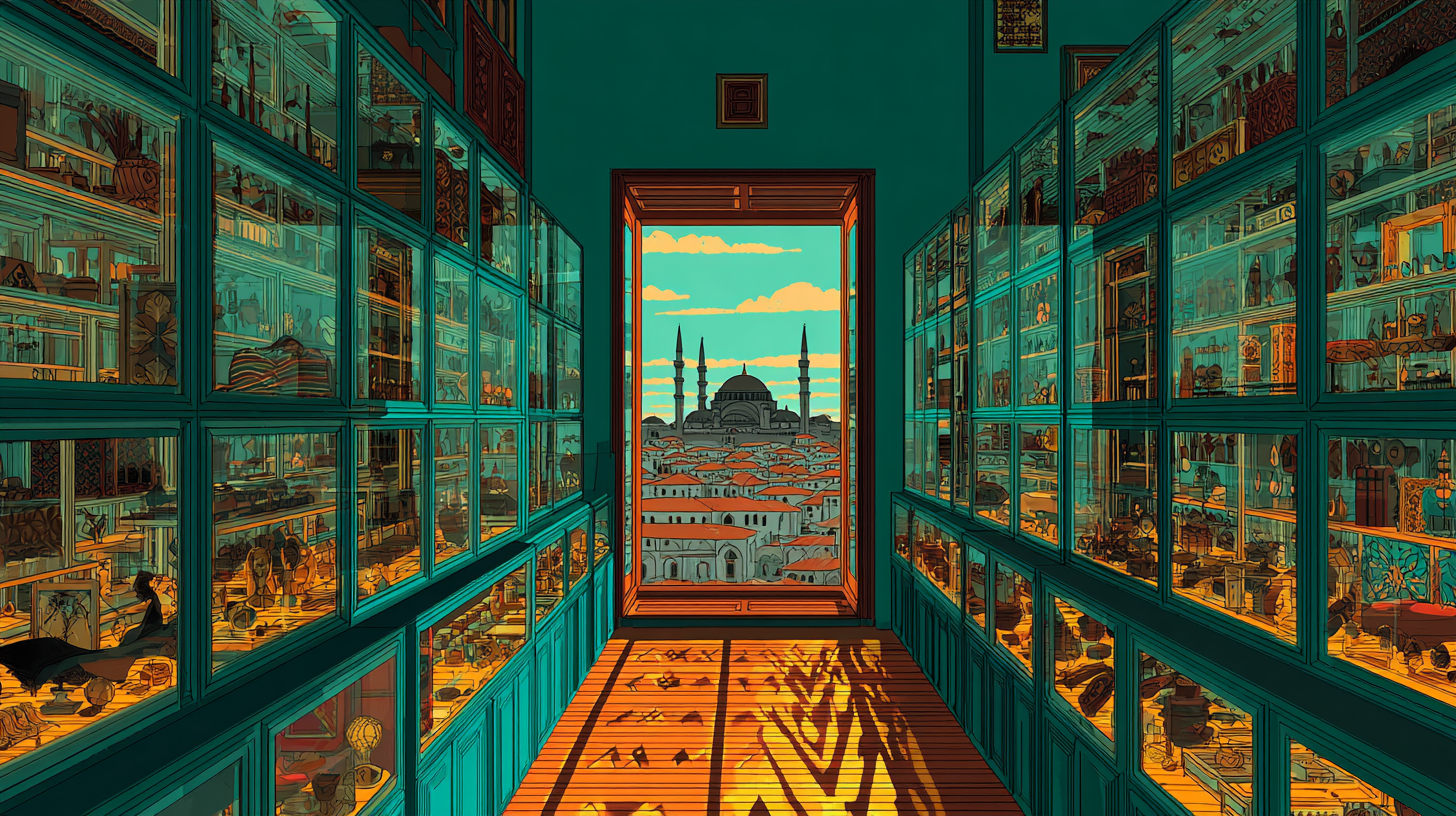
The central pivot of the novel is the moment when the narrator begins to collect objects. It is not a conscious decision at first, it is an impulse that is rationalised late, when the accumulation has already grown too large to be denied. A used glass, a hair-clip, a cup, a pair of shoes, until reaching four thousand two hundred and thirteen cigarette ends smoked by the woman he loves, each catalogued with the date and the circumstance, arranged with a precision that any institution of collective memory would envy if its directors were honest about what an experience actually preserves.
This accumulation could be read as pathology, and the novel does not avoid that reading, it leaves it available for the reader who wishes to take it. But Pamuk also installs another reading, more disturbing. What the narrator constructs is not the symptom of a disorder but a philosophical response to a real problem that most people resolve by choosing not to think about it. Time destroys. Memory is faithless. Recollections become distorted, contaminated by resentment, by selective nostalgia, by the need to construct coherent narratives about lives that were not coherent. Objects, by contrast, do not lie. A used glass retains the form of the moment in which it was used. A cigarette end carries inscribed within it the pressure of lips, the duration of a conversation, the nervousness or calm of the person who smoked it. It is affective charge materialised, the presence of an instant that would otherwise have no support in the world.
The distinction matters more than it may seem. We live in an era that confuses preservation with information, that believes photographing something is equivalent to preserving it, that archiving data is the same as keeping experience. What is lost when an experience is digitalised is not the content but the texture, the weight, the physical resistance of things that were in contact with the bodies we love. A photographic archive of ten thousand images is not the equivalent of a worn shoe. Not because the shoe is more beautiful but because it contains something that no pixel can store, the information of what it means to have been there, to have walked with that body through those streets, to have worn that sole down on that specific ground. The narrator does not document, he accumulates. He does not record, he preserves. The difference is the same as that between a police file and a domestic altar. The first organises information so that it can be used. The second organises presence so that it can be inhabited. Nobody consults an altar. One is with it, which is an entirely different verb.
The Museum of Innocence, founded by Orhan Pamuk in Istanbul in 2012, is located in the Çukurcuma neighbourhood and houses the objects described in the novel. In 2014 it received the Council of Europe Museum Prize as museum of the year. (Museum of the Year Award, Council of Europe, 2014)
Istanbul as a body that changes without asking permission
The novel takes place in Istanbul but Istanbul is not the setting, it is the argument. Modernisation arrives as all modernisations arrive, as something that simply occurs, like weather, as if economic acceleration were a natural phenomenon and not the result of decisions serving specific interests. Neighbourhoods change class without anyone signing an eviction order. New buildings erase old ones without ceremony, without anyone having time to grieve accordingly. The narrator collects the woman he loves but also collects that Istanbul which is disappearing, that way of life made of certain rhythms and certain ways of meeting that modernisation dissolves with the same efficiency it applies to everything without a market price.
What Pamuk never states directly but which structures the entire novel can be said without ornament. Modernity does not ask what is lost because what is lost appears in no balance sheet. Demolished neighbourhoods generate no accounting liabilities. The forms of sociability that disappear produce no fiscal deficit. And yet these are precisely the things that make a place a place and not simply a geographical coordinate with a price per square metre. What a society decides to preserve defines what that society decides to be. What it allows to disappear defines what it prefers to forget.
The museum as an act against organised amnesia
Pamuk did not content himself with writing the novel. He built the museum. This is not an anecdotal detail for the author’s biographical note but the gesture that transforms the book into something exceeding literature and entering the territory of political intervention on collective memory. The museum exists in Istanbul, in the Çukurcuma neighbourhood, and contains the objects described in the fiction, manufactured or gathered to make real what the novel imagined. The fiction installed itself in the world as a material fact, as if the author had decided that writing about loss was not enough and that it was necessary to construct the physical antidote as well.
The novel The Museum of Innocence was published in Turkish in 2008 and translated into more than forty languages. The physical museum opened in 2012, four years after publication, and was conceived by Pamuk simultaneously with the writing of the book. (Orhan Pamuk, interview with The Paris Review, 2011)
This simultaneity is what matters. Pamuk did not build the museum as a consequence of the novel but at the same time as he was writing it, as if the two operations were inseparable. What this produces is a simple question without a comfortable answer. Who decides what deserves to be preserved? What kind of experience has the right to exist after the bodies that lived it have disappeared?
The great museums of the world preserve what power has decided has value. Art produced by the dominant classes for the dominant classes. Objects of State, instruments of war, relics of the religions that won their wars. The logic of institutional conservation is not neutral, it is a logic of selection that reproduces the hierarchies of the present by projecting them onto the past. What enters a museum is not the most valuable in any absolute sense but the most valuable according to the criteria of those who hold the power to decide. The rest is lost, not because no one wanted it but because the mechanism operates in favour of what already has recognised value and against what does not yet have it.
The Museum of Innocence preserves cigarette ends, used glasses, plastic hair-clips, cinema tickets, empty perfume bottles. The provocation is deliberate. What Pamuk asserts with that museum is that private experience, love lived at the margins of the socially acceptable, objects without market value that carry inscribed within them an irreproducible presence, deserve the same treatment as royal crowns and the paintings of the Flemish masters. Not as anthropological curiosity but as memory in the full sense, something that took place, that mattered, and that has the right not to disappear because the dominant system of value does not know how to put a price on it.
This argument has no geographical borders. Organised amnesia is the predictable result of a development model that measures progress in terms of speed and profitability and treats memory as an obstacle when it cannot be converted into a product. The Latin American cities that demolished their historic centres to build avenues in the nineteen-sixties applied the same logic that is transforming Istanbul in the novel; it was not negligence, it was a decision about what deserves to occupy space, taken with the same coldness with which all decisions are taken that affect those who have no power to resist them. The working-class neighbourhoods disappearing today in Bogotá, Mexico City, and Buenos Aires are victims of the same mechanism. The archives that are lost, the testimonies that are never collected, the languages that die without anyone having had time to document them, are the result of decisions about what deserves to be preserved, always taken in favour of what already has recognised value and against what has it but no one with power has yet decided to acknowledge.
When the novel became a television series and Pamuk appeared in a cameo, as if the author were coming to greet his own creation on the threshold of the museum, the mise en abyme was complete. The author within the fiction, the fiction within the real space, the real space within literary history. This is not a postmodern game of mirrors, it is a declaration about what a person, or a society, decides to do with time. The Taj Mahal was built for all to see, monumental, incontestable, funded by the power of the State and destined to last centuries as proof that that love existed and that the one who lived it had the means to impose it on the landscape of the world. The Museum of Innocence was built to keep what no one else would have considered worthy of preservation. A palace of dust, yes. But dust, if someone decides to look at it, contains everything that marble cannot keep, and what marble cannot keep is precisely what is lost the most…
G.S.
Sources
- Orhan Pamuk, The Museum of Innocence (Faber & Faber, 2009)
- Orhan Pamuk, interview with The Paris Review, Issue 198, 2011
- Museum of the Year Award, Council of Europe, 2014 — https://www.coe.int/en/web/culture-and-heritage/museum-prize
- Official website of the Museum of Innocence, Istanbul — https://www.masumiyetmuzesi.org