On 7 July, Colombia’s president-elect publicly asked the Armed Forces to disobey Gustavo Petro should his orders contradict the Constitution. Ten days earlier, a data-journalism alliance made up of Cuestión Pública, Vorágine, Rutas del Conflicto, El Veinte and the Centro Latinoamericano de Investigación Periodística had revealed that nearly 17,000 public officials, including active-duty police and military personnel, appeared registered in the campaign database that carried Abelardo de la Espriella to the Presidency. Petro, meanwhile, keeps insisting on a theory of electoral fraud by algorithm that no competent electoral authority has corroborated. Between the two versions of Colombia’s July 2026 scandal, the documented one and the invented one, the country has almost always chosen the louder.
The database nobody protected
The Defensores de la Patria campaign gathered, between 2025 and 2026, more than 1.4 million records through a form hosted on its own website. Name, national identification number, email, phone, municipality. The campaign’s data policy claimed the information was secure. It was not. It sat publicly on the internet with no protection whatsoever, and that is where the journalistic alliance found it, cross-referencing those records against the public-service payroll database.
The result is not a suspicion, it is an archive. Nearly 17,000 people with institutional email addresses or a direct match against the state payroll appear registered as supporters or referrers of the campaign. Among them, active-duty personnel from the National Police, the Army, the Aerospace Force and Civil Aeronautics. Also officials from the Fiscalía, the SENA, the DIAN, the ICBF, the Procuraduría and the Contraloría, institutions whose function is precisely to oversee power, not to campaign for it. In at least five documented cases, the registered official held hierarchical authority over the person they had referred, and that referred person had received, during the same period, a public contract within the very same entity.
Nobody actually negotiated any of this in an office. It happened through a web form and a click, the most banal shape that the capture of a state apparatus can take. When De la Espriella asked the Armed Forces on 7 July not to obey the outgoing president, he was not addressing a neutral institution awaiting instructions from nowhere. He was addressing, in part, a network that already knew him, woven months before anyone was yet talking about civil disobedience.
Colombia has a minimal ritual for these occasions, almost liturgical in its simplicity. The outgoing president receives the incoming one at Casa de Nariño, there is a photograph, a handshake, and that gesture binds both sides, obliging the one leaving to hand over the state without reservation, and the one arriving to receive it as a continuity that precedes him. Iván Duque and Gustavo Petro performed it barely four days after the 2022 run-off. This time, the gesture remains vacant on both ends, and that vacancy says more about the health of the transition than any speech delivered during it.
What the fraud claim fails to explain
Petro has maintained since the run-off closed that the result was altered by algorithms developed by private Israeli companies, transmitted from a server with a Los Angeles IP address. He has presented no evidence at all, none. The director of the Electoral Observation Mission, Alejandra Barrios, ruled out any possibility of mass fraud as early as the first round, describing Colombia’s results-transmission system as one of the most robust on the continent. The European Union’s electoral observation mission, with 141 observers deployed across thirty departments, validated the reliability of the process. The Registraduría publicly explained its audit and control mechanisms, contracted out this year for the first time to two independent firms.
According to the journalistic alliance made up of Cuestión Pública, Vorágine, Rutas del Conflicto, El Veinte and CLIP, the campaign database of Abelardo de la Espriella contained 1.4 million records, of which nearly 17,000 corresponded to public officials, including active-duty Police and Armed Forces personnel.
None of this absolves Petro of having said what he said. Comparing De la Espriella’s arrival at the Presidency to fascism, invoking Hitler, insisting on an unsubstantiated theory before the international press, all of that carries a real political cost and amounts to irresponsibility on the part of a sitting head of state. But the scandal of the invented fraud ended up taking the place of the documented scandal. An outgoing president shouting without evidence is a spectacle. A leaked database showing the Police enrolled in the campaign of the man who will command them from August onward is a fact, and facts, in Colombia, rarely win the headline.
The real dispute, hidden behind the noise
Iván Cepeda, senator and defeated presidential candidate, announced he would not recognise De la Espriella’s authority unless the latter renounced his American citizenship, clarified any possible ties to the DEA or CIA, and guaranteed that Petro would not be extradited. The right-wing press reduced him, almost immediately, to a sore loser and little else. The reading becomes sharper once one looks at who backs the argument. Roughly twenty former justices of the Corte Constitucional, the Corte Suprema, the Consejo de Estado and the Jurisdicción Especial para la Paz signed a legal document distinguishing precisely between De la Espriella’s Italian citizenship, acquired by descent and carrying no incompatibility whatsoever, and his American citizenship, acquired through naturalisation in 2023 by an oath requiring him to defend the United States Constitution first.
This is not rhetorical hyperbole. It is a genuine constitutional problem, with a technical name, conflict of loyalties, and a precedent cited by the signatories themselves, the Corte Constitucional’s 2015 ruling C-601. Cepeda added to that list a fourth, less legal and more political motive, his rejection of Colombia’s incorporation into the so-called Shield of the Americas, which he described as a mechanism of military alignment with United States strategic interests. In his reading, the first three conditions protect the country’s judicial sovereignty against a president with divided constitutional loyalty. The fourth protects its military sovereignty against an ally who has already announced his intention to fold it into his own continental security architecture. Not even within the outgoing government was the strategy unanimous. Justice minister Jorge Iván Cuervo and Energy minister Edwin Palma publicly stated they preferred to act within political and democratic debate rather than withdraw from it, a distance Cepeda has not publicly answered. Former candidate Enrique Peñalosa, for his part, accused Cepeda of applying a double standard, recalling that Petro himself retains Italian nationality without anyone in his own camp ever having questioned him over it. The objection has formal merit. It also glosses over the fact that neither Italian nationality, not Petro’s nor De la Espriella’s, requires the loyalty oath that American naturalisation does, the precise legal distinction the former justices themselves took the trouble to point out.
While that debate advanced in Colombia, federal prosecutors in Brooklyn were opening, according to the AP news agency, an investigation into Petro’s possible links to drug trafficking. The timing proves nothing on its own, but it documents that the American judicial apparatus was already active against the outgoing president well before he had even left office, and regardless of what that investigation eventually establishes or fails to establish. It is not an isolated case. Months earlier, petrista influencer Beto Coral had been arrested in the United States pending deportation, in the final stretch of the campaign, and Petro himself appears, alongside his wife and son, on the so-called Clinton List of American sanctions. De la Espriella’s alliance with Donald Trump, displayed without embarrassment throughout the campaign and reaffirmed since the vote, is therefore not a promise for the future. It is the continuation of a pattern already well under way before a single ballot had been counted.
The institution both sides claim
De la Espriella suspended the handover process on 7 July, called the outgoing government corrupt, promised to make Petro pay for his offences, and announced he would not set foot in Casa de Nariño before his inauguration, breaking a republican ritual that even the tensest transitions in the country’s recent history had preserved. Petro responded that he would place empty chairs in the Palace, waiting for someone willing to come and receive him. The image, meant as a denunciation, ended up describing rather accurately the state of the very institution both sides claim to defend, a presidential hall turned stage set, chairs arranged with nobody sitting in them willing to speak to anyone on the other side.
De la Espriella accompanied the rupture with a phrase set to have a long career, “constitutional obedience” as his answer to what he called “front lines, blockades and urban terrorism”. The phrase installs, before he has even taken office, a framework in which protest and crime are fused in advance, so that any future form of resistance is already classified as a threat before it has even taken shape. That same day, the Cuerpo de Generales y Almirantes en Retiro de las Fuerzas Militares, an association of retired senior officers, publicly rejected Cepeda’s call to civil disobedience and reaffirmed its support for the incoming administration, closing the circle of a dispute in which both sides ask the very same uniforms to choose a side.
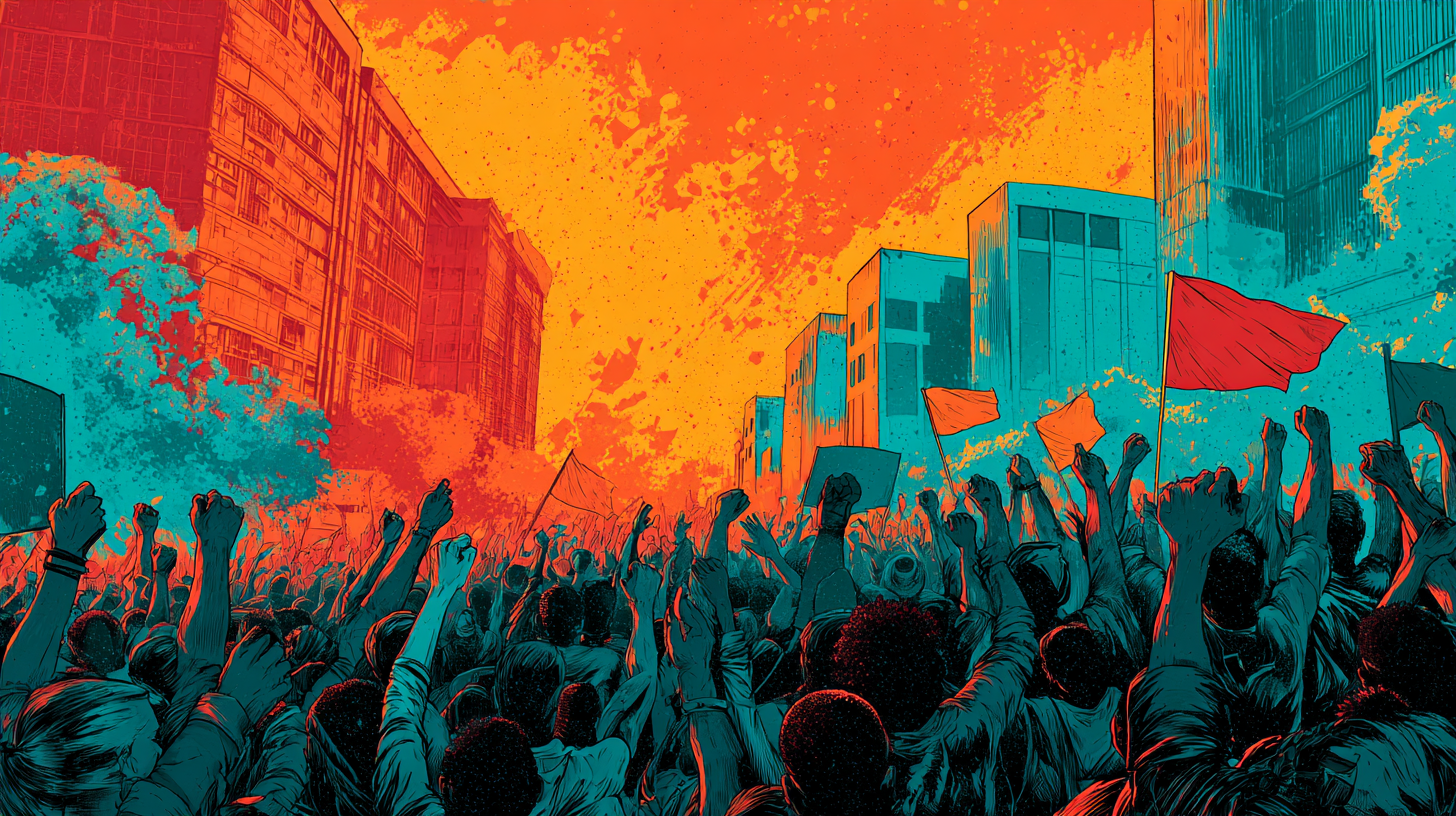
Petro, for his part, called for a mobilisation on 20 July and promised a public farewell from southern Bogotá, the very date on which the new Congress elected in March’s legislative vote will be installed, so that the square and the chamber will compete that day for the attention of a country no longer quite sure which of the two stages still decides anything. Neither side is really disputing the ballot box. They are disputing who keeps the loyalty of the uniforms, the Police, the Army, the Fiscalía. That is the ground on which power is fought in Colombia once the electoral result is no longer enough to settle it, and it is precisely the ground on which a leaked database showed, before the public scandal even broke, which way part of that apparatus had already leaned.
Abelardo de la Espriella won the 21 June 2026 run-off with an approximate lead of 250,000 votes over Iván Cepeda, the narrowest margin in the country’s recent history, according to the count validated by the Consejo Nacional Electoral.
Colombia is preparing for a presidential inauguration on 7 August at which the incoming president has already asked the military to disobey the outgoing one, and the outgoing one has already asked the people to disobey the incoming one. Between the two disobediences lies an asymmetry that no tweet and no Sunday address manages to conceal for very long, one rests on a leaked archive with names, identification numbers and job titles that anyone can verify at will, the other on a Los Angeles server that nobody, to this day and despite months of insistence, has been able to show…
G.S.
Sources
- En la campaña de Abelardo De la Espriella hay miles de funcionarios públicos inscritos, incluyendo policías activos
- Sin temor a equivocarnos, la información entregada por la Registraduría demuestra consistencia técnica
- De la Espriella respondió a cuestionamientos por su nacionalidad estadounidense
- Se cumplirá la Constitución, crece polémica por mensaje de desobediencia civil de Cepeda
- Cepeda amenaza desobediencia civil si De la Espriella no renuncia a la ciudadanía estadounidense
- De la Espriella ordenó suspender el empalme con el gobierno Petro
- La izquierda cuida la cabeza de Petro arriesgando una oposición institucional
- Misión de Observación Electoral de la Unión Europea, Declaración preliminar, segunda vuelta Colombia 2026
- Almirantes retirados rechazaron la decisión de Petro y Cepeda de no reconocer a De la Espriella como presidente electo