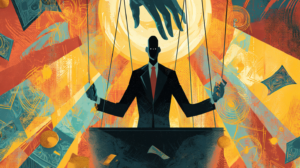
We have been told for decades a reassuring story, that of the free market. A vast horizon where millions of individual wills would meet without a master, like the waters of a river finding their own way to the sea. That is the famous invisible hand of the market, the one that would distribute rewards with an almost divine impartiality. The story has the force of fairy tales, it consoles more than it explains. The market has never been a desert where everyone advances with equal weapons. It resembles instead a stage whose sets, whose rules, and sometimes even the script, are written long before the actors step under the lights.
The legend and what it excuses from explaining
The most powerful do not wait for the wind to favour them. They learn to make it themselves.
Behind price fluctuations, behind the exalted speeches about pure competition, there is a patient network of influence, alliances, standards and power relations. Large corporations shape the technical standards that decide which products can enter a market, they steer consumption habits through advertising and design, they negotiate directly the regulations that are supposed to limit them, they absorb their competitors or force them to keep pace until they disappear. Markets do not obey chance. They answer to whoever designs them. Each of these mechanisms is legal, documented, and exercised in broad daylight, which makes it no less decisive.
The case of mobile telephony illustrates this mechanism well. A standard-essential patent is a technology that every company must use if it wants to manufacture a product compatible with a shared technical standard, in this case the LTE network that lets phones connect to the internet. Whoever controls those patents effectively controls who can enter the market, and at what price. In 2018 the European Commission fined Qualcomm 997 million euros for having paid Apple for several years to use its LTE chips exclusively, blocking rivals from a market that depended on a technical standard Qualcomm itself helped define.
That coordination is rarely accidental. It comes from those who hold the resources, the capital, the technology or the information needed to move ahead of everyone else. The legend of the free market survives precisely because none of these mechanisms requires secrecy to work, they are filed, published, and defended in broad daylight, which is exactly what makes them so difficult to contest.
The design that decides what the consumer believes it chooses
Consumption habits are not shaped by chance either. Companies do not wait for the customer to decide alone. They design the interface so that one decision, keep consuming, is always the easiest to make, while the opposite one costs the most time and patience.
In September 2025 the United States Federal Trade Commission secured a record 2.5 billion dollar settlement with Amazon, the largest civil penalty ever imposed for the violation of one of the agency’s rules. The case was not about a faulty product or an unfair price. It was about the design of the website itself. According to the complaint, Amazon repeatedly inserted the option to enrol in its Prime service during checkout while hiding the option to decline it, and once enrolled, forced the user through an internal four-page, six-click, fifteen-option path before being able to cancel the subscription.
The Amazon case is not an isolated exception, it is the visible tip of a widespread practice. A joint review by twenty-seven consumer protection authorities across twenty-six countries, coordinated in 2024 by the Federal Trade Commission and the international ICPEN network, examined more than six hundred subscription websites and apps and found that three out of four used at least one of these manipulative design techniques.
Nobody forces the consumer to click. But the path on offer is only paved on one side. Calling this freedom of choice requires forgetting who drew the map before the user ever set foot on it. The interface, unlike a salesman standing behind a counter, never tires, never has an off day, and is tested against millions of users before a single line of its code goes live.
How power manufactures the wind instead of waiting for it
The merger and acquisition of companies, that is, the operation by which one firm buys or absorbs another to eliminate it as a competitor or to acquire its technology, is one of the oldest and least discussed instruments of this manufacturing. It presents itself as a management decision, almost a technical one. In reality it redraws the entire map of a sector, decides who survives and who disappears, and does so long before any ordinary consumer chooses between two brands on a shelf.
Behind every such deal also sits a figure less visible than the purchase price, the number of jobs the merger makes redundant, the local subsidiaries closed because they duplicate functions already covered by the parent company, the suppliers who overnight lose their only client. None of this appears in the press release announcing the deal. Financial analysts call it synergy. Workers usually have another word for it.
The scale of this phenomenon is not marginal.
According to Bain & Company’s Global M&A Report 2026, global mergers and acquisitions grew 40% in 2025 to reach 4.9 trillion dollars, the second highest figure ever recorded.
That money does not buy assets alone. It buys position, and it buys the power to set the price the rest of the market will have to follow.
What stands out is that the very bodies meant to police these deals barely question them. The 2015-2024 special edition of the OECD’s Competition Trends report, drawing on data from more than sixty-five countries, recorded over 95,000 merger notifications across that decade. 98% were cleared with no conditions attached, and fewer than three in a thousand were blocked or challenged.
The result is a smaller market, with fewer voices able to argue over its rules, and regulators who rarely intervene. The OECD itself has documented that this concentration, sustained across its member countries from the late nineties into the following decade, coincides with higher profit margins and lower productivity for the economy as a whole. The script, here too, was written in advance.
Lobbying as the market’s institutional architecture
There is a fourth mechanism, still more discreet because it operates out of the final consumer’s sight, acting directly on those who write the laws. Lobbying, the organised practice of paying specialists to influence lawmakers and regulators before a rule is passed, is not an anomaly of the system. It is one of its central pieces.
The economist George Stigler put a name to it more than five decades ago, regulatory capture, the idea that agencies created to oversee an industry eventually end up serving the interests of that same industry. It is not a fringe theory. It is today one of the most cited frameworks for explaining why certain regulations protect precisely those they should be restraining.
The case of the American Innovation and Choice Online Act, introduced with bipartisan support in the United States Congress to curb the power of major digital platforms, illustrates the mechanism precisely. The bill seemed on track to pass. It did not. An academic analysis published by UNAM’s Centre for North American Research documented how interest groups tied to the very companies the law sought to regulate deployed a lobbying campaign capable of neutralising that political consensus, a textbook case of what the literature calls state capture.
According to an analysis by OpenSecrets, federal lobbying spending in the United States surpassed 5 billion dollars for the first time in 2025, reaching 5.08 billion, the largest annual increase recorded since mandatory quarterly filings began in 2008.
That money is not spent to win a public debate. It is spent to avoid having one. It funds direct access to whoever drafts the tax exemption, the technical clause, the sector rule that no citizen will ever read but that will determine how much a medicine costs, how toxic a pesticide may be, or how long a patent can last before others are allowed to compete.
Its effectiveness rests precisely on that dullness and on its patience. No march has ever been organised against a paragraph tucked into the technical annex of a budget bill. Outrage needs a face, a date, an image. Lobbying offers none of the three. It operates with the discretion of something never designed to make the news, which is, of course, the point.
Polanyi, the map and the territory
Karl Polanyi warned of this more than seventy years ago, and the warning has aged remarkably well. The market never existed independently of the institutions that sustain it. It is a human construction, as political as it is economic. To forget that fact is to confuse the map with the territory, the story with the reality the story claims to describe.
In The Great Transformation, Polanyi showed that the self-regulating market, presented today as the natural state of things, was in fact a recent and deliberate construction. For land, human labour and money to be bought and sold like any other commodity, centuries of communal regulation, parish relief systems and customary rights over land first had to be dismantled, in nineteenth-century England. Polanyi called this the fiction of commodities, because neither land, nor labour, nor money were originally produced to be sold, that condition was imposed on them by political decision. The free market did not precede the state that made it possible. It followed it.
Polanyi also observed that every expansion of the market eventually provokes a countermovement from society seeking to protect itself from its effects, trade unions, labour regulation, public health systems. He called this the double movement. Recent economic history can be read as an updated version of that same struggle, with mergers, technical standards, interface design and lobbying on the side of expansion, and a citizenry still searching for the language and the tools to organise its response. The problem is not the absence of a possible countermovement, it is the difficulty of naming precisely what should be organised against, when the mechanism always presents itself under the disguise of technical neutrality.
This illusion is not harmless. When an economic decision is presented as an inevitability of the market, it escapes democratic debate. A factory closing, a job relocated abroad, an entire industry concentrated in a few hands, inequality growing year after year, all become natural phenomena then, almost meteorological, when in reality they depend on perfectly human decisions, taken by people with names and surnames sitting on very real boards. Weather cannot be summoned to a hearing. Boards can.
Recognising that markets are organised does not amount to condemning the market economy as such. It simply invites a return to lucidity. If men built the rules of the game, other men can transform them, provided they first agree to look at who is holding the pen.
True freedom, then, does not consist in believing the myth of a pilotless market. It lies in the collective capacity to make visible the very real hands that organise exchange, so that their power is never withdrawn from the sight of citizens. A market with no one steering it is not liberty. It is simply a steering wheel nobody has been shown…
G.S.
Sources
- Global M&A Report 2026, Bain & Company
- Lobbying firms took in a record $5 billion in 2025, OpenSecrets
- Una década de OCDE Competition Trends, Centro Competencia (CeCo), summary of the OECD Competition Trends 2015-2024 report
- La desaceleración económica y la concentración de mercados en México, Nexos, OECD data on the Herfindahl-Hirschman index
- La UE multa a Qualcomm con 997 millones por comprar la fidelidad de Apple, Xataka, European Commission decision, 2018
- Trapped By Design, How Dark Patterns Manipulate Your Choices, Berkeley Technology Law Journal, on the FTC settlement with Amazon
- FTC, ICPEN, GPEN Announce Results of Review of Use of Dark Patterns, Federal Trade Commission
- Big Tech, competencia económica y captura del Estado, Norteamérica, Revista Académica del CISAN-UNAM
- George Stigler, The Theory of Economic Regulation (Bell Journal of Economics and Management Science, 1971), no link, academic work
- Karl Polanyi, The Great Transformation (Beacon Press), no link, physical book