YEAR III  ·  No. 640  ·  FRIDAY, SEPTEMBER 18, 2026

GENEVA --:--  ·  BOGOTÁ --:--  ·  ACIDREPORT v4.0
AcidReport
ESSAYGLOB

Humanity descends from two enemy apes, which is why it never agrees on how to govern itself

No animal asks itself how it should live in society. The bee does not deliberate over the monarchy, the doe does not contest the harem, the wolf does not hold a referendum on the pack. The human being does, and has done so since it existed, without ever reaching a shared answer, not even within a single political family. Neither language, nor laughter, nor writing explains it, attributes that comparative ethology has withdrawn one by one from the catalogue of what was supposedly exclusive to humans. It lies in the genetics of two primates that hate each other and from which Homo sapiens descends in almost equal measure, the pacifist bonobo and the belligerent common chimpanzee. From there, not from culture or ideology, comes the political fracture that runs through the entire species, from the family dinner table to the presidential palace, without any distinction of latitude or language.

What no longer distinguishes the human being

Rabelais wrote that laughter is the proper trait of man, a formula that survived centuries as an axiom before comparative ethology dismantled it piece by piece. Chimpanzees emit laughter vocalisations during social play, documented and recorded for decades. After laughter fell language, bonobos trained in captivity have demonstrated an ability to understand hundreds of symbols and combine them with communicative intent. Then fell toolmaking, New Caledonian crows design and carry metal hooks to extract larvae from bark. Then fell cultural transmission across generations, orcas and chimpanzees develop hunting and fishing techniques that vary from one population to another and are actively taught to the young. Every candidate for what was “proper to man” turned out, sooner or later, to be shared with another species to some degree, sometimes rudimentary, sometimes surprisingly elaborate. One question remained open, if none of those traits is exclusive, what exactly separates Homo sapiens from the rest of the animal kingdom.

The answer does not lie in an isolated cognitive attribute but in a collective behaviour. No other living species argues internally over the form of social organisation it should collectively adopt. Bees do not split into monarchists and republicans. Zebras do not debate how the herd should be shared. Ants, for their part, do not question the queen, nor do they propose an assembly of workers. Every social species operates under a fixed pattern, genetically transmitted, without internal dissent over the model itself. The human being is the exception, the only species that tries, abandons and tries again distinct political systems, monarchy, republic, theocracy, dictatorship, sometimes within a single generation, without ever reaching a definitive agreement on which of them deserves to prevail over the others. Not even two siblings raised under the same roof necessarily arrive at the same conclusion about how a country should be governed, which rules out education too as a sufficient explanation.

Two ape lineages in a single genome

Genetic closeness explains the origin of that indecision. The bonobo and the common chimpanzee are not distant cousins of the human being, they are its closest relatives, almost siblings before they are cousins, and yet they represent two opposing political regimes within the genus Pan. Jane Goodall documented between 1974 and 1978, at Gombe, Tanzania, what primatology now calls the four-year war, a chimpanzee community, Kasakela, that systematically exterminated the males of the neighbouring community split off from itself, Kahama. The violence was neither an accident nor an anomaly, it was the very mechanism of territorial expansion, armed patrols of teeth combing the frontier in search of isolated individuals to ambush. Nothing remotely similar exists in the bonobo’s ethological record. Frans de Waal described how a group of females resolves, through brief genital contact followed by mutual grooming, the same social tension that in a chimpanzee community would trigger an attack, a ritual for defusing conflict before it escalates, and not a single case of lethal homicide between members of the same bonobo community has been documented in more than five decades of field observation.

Human beings share 98.7% of their genome with both the bonobo and the common chimpanzee, but an additional 3% of human DNA resembles one of the two species more than those two species resemble each other, a phenomenon called incomplete lineage sorting (Prüfer et al., Nature, 2012).

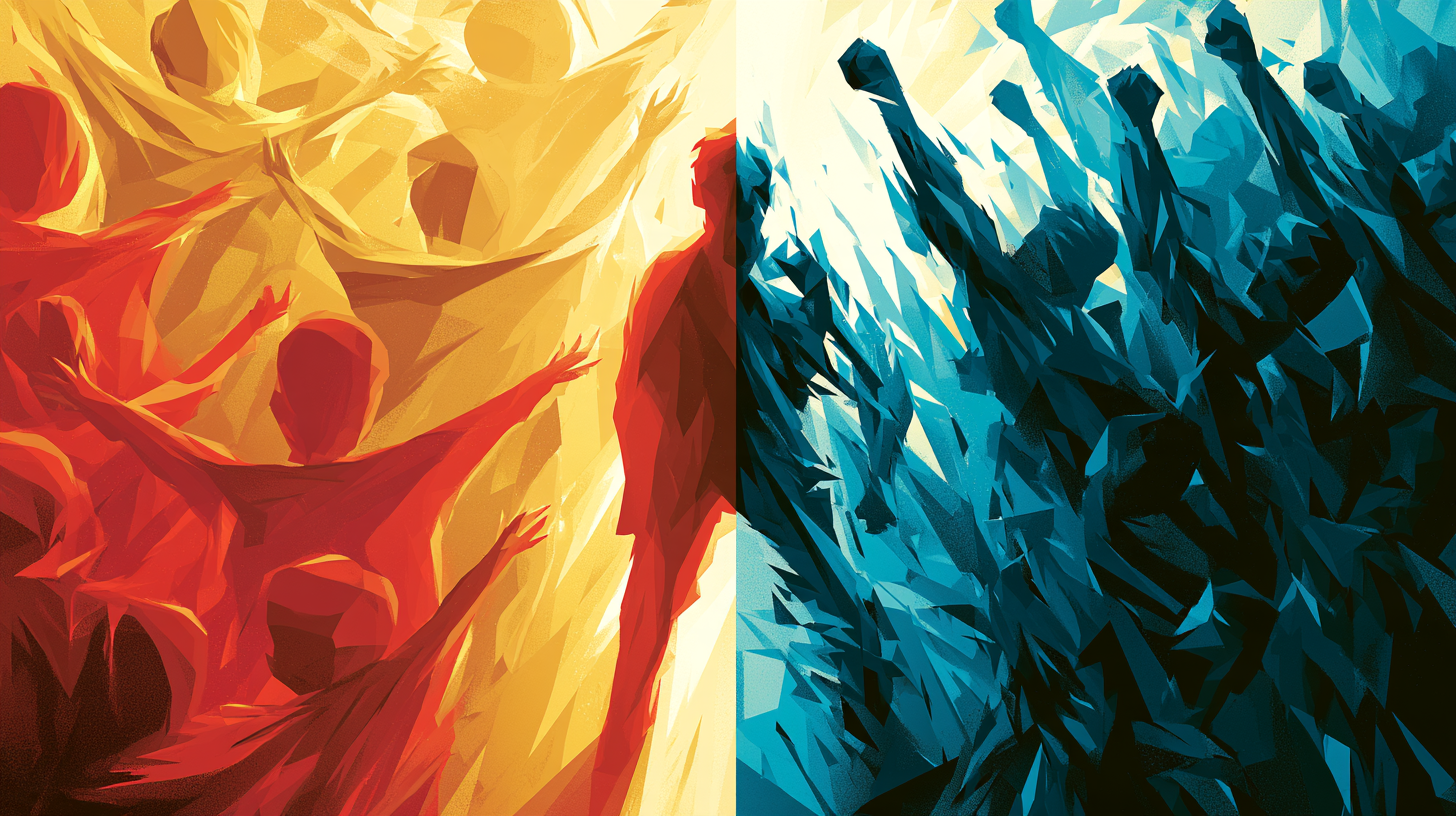
Homo sapiens does not descend from a single one of those two genealogies, it descends from both at once, without evolution ever having settled which one should prevail. That double inheritance, not a later cultural choice, is what resurfaces every time a human society fractures between those who seek to pacify conflict through bonding and those who resolve it through force. Frans de Waal documented that contrast over more than four decades of primatological observation and summed it up in a formula any political scientist could adopt without changing a word, the common chimpanzee does politics through coalitions of power, the bonobo through coalitions of affection. No treatise of political science has ever improved on that distinction, it has only dressed it in more abstract vocabulary, left and right, authoritarianism and liberalism, as if those categories were anything other than the same ancestral question posed anew, cooperate or dominate. The question is as old as the genus Pan, long before a single treatise, a single party or a single flag ever existed.

Why power selects the chimpanzee and not the bonobo

Exercising power demands total dedication, and that is precisely the structural advantage of the chimpanzee temperament over the bonobo’s. Whoever spends their life accumulating alliances, watching for betrayals and calculating the exact moment to topple a rival has neither the time, nor probably the desire, to devote themselves to anything else. Whoever prefers peace and freedom, which are not the same as power even though political language deliberately confuses the two, finds better uses for their energy. The result is not a statistical accident but an almost mechanical selection, a price rarely paid by artists or peacemakers.

Vladimir Putin, a KGB agent before he was a head of state, has governed Russia uninterruptedly since 1999, has imprisoned or seen die under circumstances never clarified a good part of his most visible opponents, the case of Alexei Navalny is the most internationally documented, and ordered, on 24 February 2022, the full-scale invasion of Ukraine, a war of aggression that continues without a clear military resolution. Augusto Pinochet led in Chile, between 1973 and 1990, a dictatorship responsible for thousands of deaths and disappearances, according to the National Commission for Truth and Reconciliation, he built around that violence an institutional apparatus, the National Intelligence Directorate, designed to make it systematic rather than episodic, and he only lost power in 1990 because he had first lost, in 1988, a plebiscite he himself had designed to win with ease.

Donald Trump built an entire political career on the logic of permanent domination, the public humiliation of rivals and the repeated refusal to accept an electoral defeat, a stance extensively documented after the 2020 American election and which culminated, on 6 January 2021, in the assault by a crowd of his supporters on the Capitol in Washington while Congress was certifying the result. Abelardo de la Espriella, president of Colombia since 7 August 2026 following a victory by the narrowest margin ever recorded in a Colombian presidential election, defended during his career as a lawyer clients accused of alleged paramilitary ties as well as the Venezuelan businessman Alex Saab, and publicly praised the former paramilitary commander Salvatore Mancuso.

Between 2008 and 2019, Abelardo de la Espriella filed close to 109 defamation lawsuits against Colombian journalists, a figure documented by press freedom organisations.

Keiko Fujimori fits the series just as well, and her case may be the most telling of all about the price power demands. She lost three consecutive presidential elections, in 2011 to Ollanta Humala, in 2016 to Pedro Pablo Kuczynski by barely forty-one thousand votes, and in 2021 to Pedro Castillo, and between those defeats she spent more than five hundred days in pretrial detention over the Cócteles case, the Peruvian branch of the Odebrecht scandal. Her father, Alberto Fujimori, had been sentenced to twenty-five years in prison for crimes against humanity and corruption, controversially pardoned in December 2023 and dead by September 2024, mere months before she, on her fourth attempt, finally won Peru’s presidency in June 2026 by a margin of 9,270 votes, the narrowest ever recorded in Peruvian electoral history. Fifteen years of defeats, imprisonment and a surname weighed down by a conviction for crimes against humanity were not enough to convince her to give up the attempt, and that is exactly the trait the whole series shares. Against that line-up, Gandhi and Mozart are not proof that the bonobo ever wins, they are proof of the opposite, the exception that confirms how rare victory is for those who never wanted to play that game at all.

No truce possible between the two inheritances

There is no moral superiority written into the genome, only two evolutionary strategies equally successful on their own terrain. Human bonobos and chimpanzees will keep being born in every generation, in every country, in every office, without any institutional reform ever managing to close that founding fracture. What changes, century after century, is only which of the two inheritances controls the machinery of the state at a given moment, and that balance of forces is rarely decided at the ballot box alone, it is decided earlier, in each person’s willingness to pay the price power demands. No constitution, however well drafted, has ever managed to tilt that balance permanently, control changes hands every so many years and changes again, sometimes through elections, sometimes through a coup, sometimes, as in Pinochet’s case, through the fine print of a law its own author had underestimated, without the species ever seeming to draw closer to a final verdict on itself. Every generation believes it has settled the question and the next one reopens it, as though the genome refused to leave closed a matter it settled millions of years ago, in the only way it knows how to settle things, without ever quite settling them.

There remains a question of consolation, not of solution, for whoever is born on the losing side of that double inheritance when it comes to competing for power. The human bonobo does not vanish when it loses the political contest, it simply seeks another territory in which to deploy the same energy without needing to subdue anyone, and that territory carries an old name, art, a ground no chimpanzee disputes because no chimpanzee needs it. Mozart governed nothing and never claimed to, he died in 1791 at thirty-five years old without ever having exercised any political authority over anyone, and yet his music, written under patrons rather than a throne of his own, outlived every empire that was his contemporary. The species as a whole keeps negotiating, with no possible arbiter, which of its two ape grandfathers deserves to speak in its name…

G.S.

Sources

Gabriel Schwarb

ABOUT THE AUTHOR

Gabriel Schwarb

Gabriel Schwarb is the founding director and editor in chief of AcidReport, a Swiss-Colombian writer with more than three decades of professional practice in art direction, web development and investigative journalism. The outlet operates as a non-profit association, governed by Article 60 of the Swiss Civil Code, with no political affiliation, no advertising and no external funding. It publishes in Spanish, French and English, and covers Latin America and Europe as a mirror, each continent explained through the other.

He founded it convinced that Iván Duque's 2018 victory over Gustavo Petro had not been clean, a suspicion reinforced by the Ñeñe Hernández scandal, and that the real Colombia found no place in its own media. Born as an information bridge between Colombia and Europe, the project later widened to all of Latin America, and is read today across the entire world. His method combines strict source verification, archival work and public correction of errors. He does not publish to please. He publishes to answer.

See all articles →

Leave a comment

ESSAYGLOB

Humanity descends from two enemy apes, which is why it never agrees on how to govern itself

No animal asks itself how it should live in society. The bee does not deliberate over the monarchy, the doe does not contest the harem, the wolf does not hold a referendum on the pack. The human being does, and has done so since it existed, without ever reaching a shared answer, not even within a single political family. Neither language, nor laughter, nor writing explains it, attributes that comparative ethology has withdrawn one by one from the catalogue of what was supposedly exclusive to humans. It lies in the genetics of two primates that hate each other and from which Homo sapiens descends in almost equal measure, the pacifist bonobo and the belligerent common chimpanzee. From there, not from culture or ideology, comes the political fracture that runs through the entire species, from the family dinner table to the presidential palace, without any distinction of latitude or language.

What no longer distinguishes the human being

Rabelais wrote that laughter is the proper trait of man, a formula that survived centuries as an axiom before comparative ethology dismantled it piece by piece. Chimpanzees emit laughter vocalisations during social play, documented and recorded for decades. After laughter fell language, bonobos trained in captivity have demonstrated an ability to understand hundreds of symbols and combine them with communicative intent. Then fell toolmaking, New Caledonian crows design and carry metal hooks to extract larvae from bark. Then fell cultural transmission across generations, orcas and chimpanzees develop hunting and fishing techniques that vary from one population to another and are actively taught to the young. Every candidate for what was “proper to man” turned out, sooner or later, to be shared with another species to some degree, sometimes rudimentary, sometimes surprisingly elaborate. One question remained open, if none of those traits is exclusive, what exactly separates Homo sapiens from the rest of the animal kingdom.

The answer does not lie in an isolated cognitive attribute but in a collective behaviour. No other living species argues internally over the form of social organisation it should collectively adopt. Bees do not split into monarchists and republicans. Zebras do not debate how the herd should be shared. Ants, for their part, do not question the queen, nor do they propose an assembly of workers. Every social species operates under a fixed pattern, genetically transmitted, without internal dissent over the model itself. The human being is the exception, the only species that tries, abandons and tries again distinct political systems, monarchy, republic, theocracy, dictatorship, sometimes within a single generation, without ever reaching a definitive agreement on which of them deserves to prevail over the others. Not even two siblings raised under the same roof necessarily arrive at the same conclusion about how a country should be governed, which rules out education too as a sufficient explanation.

Two ape lineages in a single genome

Genetic closeness explains the origin of that indecision. The bonobo and the common chimpanzee are not distant cousins of the human being, they are its closest relatives, almost siblings before they are cousins, and yet they represent two opposing political regimes within the genus Pan. Jane Goodall documented between 1974 and 1978, at Gombe, Tanzania, what primatology now calls the four-year war, a chimpanzee community, Kasakela, that systematically exterminated the males of the neighbouring community split off from itself, Kahama. The violence was neither an accident nor an anomaly, it was the very mechanism of territorial expansion, armed patrols of teeth combing the frontier in search of isolated individuals to ambush. Nothing remotely similar exists in the bonobo’s ethological record. Frans de Waal described how a group of females resolves, through brief genital contact followed by mutual grooming, the same social tension that in a chimpanzee community would trigger an attack, a ritual for defusing conflict before it escalates, and not a single case of lethal homicide between members of the same bonobo community has been documented in more than five decades of field observation.

Human beings share 98.7% of their genome with both the bonobo and the common chimpanzee, but an additional 3% of human DNA resembles one of the two species more than those two species resemble each other, a phenomenon called incomplete lineage sorting (Prüfer et al., Nature, 2012).

Homo sapiens does not descend from a single one of those two genealogies, it descends from both at once, without evolution ever having settled which one should prevail. That double inheritance, not a later cultural choice, is what resurfaces every time a human society fractures between those who seek to pacify conflict through bonding and those who resolve it through force. Frans de Waal documented that contrast over more than four decades of primatological observation and summed it up in a formula any political scientist could adopt without changing a word, the common chimpanzee does politics through coalitions of power, the bonobo through coalitions of affection. No treatise of political science has ever improved on that distinction, it has only dressed it in more abstract vocabulary, left and right, authoritarianism and liberalism, as if those categories were anything other than the same ancestral question posed anew, cooperate or dominate. The question is as old as the genus Pan, long before a single treatise, a single party or a single flag ever existed.

Why power selects the chimpanzee and not the bonobo

Exercising power demands total dedication, and that is precisely the structural advantage of the chimpanzee temperament over the bonobo’s. Whoever spends their life accumulating alliances, watching for betrayals and calculating the exact moment to topple a rival has neither the time, nor probably the desire, to devote themselves to anything else. Whoever prefers peace and freedom, which are not the same as power even though political language deliberately confuses the two, finds better uses for their energy. The result is not a statistical accident but an almost mechanical selection, a price rarely paid by artists or peacemakers.

Vladimir Putin, a KGB agent before he was a head of state, has governed Russia uninterruptedly since 1999, has imprisoned or seen die under circumstances never clarified a good part of his most visible opponents, the case of Alexei Navalny is the most internationally documented, and ordered, on 24 February 2022, the full-scale invasion of Ukraine, a war of aggression that continues without a clear military resolution. Augusto Pinochet led in Chile, between 1973 and 1990, a dictatorship responsible for thousands of deaths and disappearances, according to the National Commission for Truth and Reconciliation, he built around that violence an institutional apparatus, the National Intelligence Directorate, designed to make it systematic rather than episodic, and he only lost power in 1990 because he had first lost, in 1988, a plebiscite he himself had designed to win with ease.

Donald Trump built an entire political career on the logic of permanent domination, the public humiliation of rivals and the repeated refusal to accept an electoral defeat, a stance extensively documented after the 2020 American election and which culminated, on 6 January 2021, in the assault by a crowd of his supporters on the Capitol in Washington while Congress was certifying the result. Abelardo de la Espriella, president of Colombia since 7 August 2026 following a victory by the narrowest margin ever recorded in a Colombian presidential election, defended during his career as a lawyer clients accused of alleged paramilitary ties as well as the Venezuelan businessman Alex Saab, and publicly praised the former paramilitary commander Salvatore Mancuso.

Between 2008 and 2019, Abelardo de la Espriella filed close to 109 defamation lawsuits against Colombian journalists, a figure documented by press freedom organisations.

Keiko Fujimori fits the series just as well, and her case may be the most telling of all about the price power demands. She lost three consecutive presidential elections, in 2011 to Ollanta Humala, in 2016 to Pedro Pablo Kuczynski by barely forty-one thousand votes, and in 2021 to Pedro Castillo, and between those defeats she spent more than five hundred days in pretrial detention over the Cócteles case, the Peruvian branch of the Odebrecht scandal. Her father, Alberto Fujimori, had been sentenced to twenty-five years in prison for crimes against humanity and corruption, controversially pardoned in December 2023 and dead by September 2024, mere months before she, on her fourth attempt, finally won Peru’s presidency in June 2026 by a margin of 9,270 votes, the narrowest ever recorded in Peruvian electoral history. Fifteen years of defeats, imprisonment and a surname weighed down by a conviction for crimes against humanity were not enough to convince her to give up the attempt, and that is exactly the trait the whole series shares. Against that line-up, Gandhi and Mozart are not proof that the bonobo ever wins, they are proof of the opposite, the exception that confirms how rare victory is for those who never wanted to play that game at all.

No truce possible between the two inheritances

There is no moral superiority written into the genome, only two evolutionary strategies equally successful on their own terrain. Human bonobos and chimpanzees will keep being born in every generation, in every country, in every office, without any institutional reform ever managing to close that founding fracture. What changes, century after century, is only which of the two inheritances controls the machinery of the state at a given moment, and that balance of forces is rarely decided at the ballot box alone, it is decided earlier, in each person’s willingness to pay the price power demands. No constitution, however well drafted, has ever managed to tilt that balance permanently, control changes hands every so many years and changes again, sometimes through elections, sometimes through a coup, sometimes, as in Pinochet’s case, through the fine print of a law its own author had underestimated, without the species ever seeming to draw closer to a final verdict on itself. Every generation believes it has settled the question and the next one reopens it, as though the genome refused to leave closed a matter it settled millions of years ago, in the only way it knows how to settle things, without ever quite settling them.

There remains a question of consolation, not of solution, for whoever is born on the losing side of that double inheritance when it comes to competing for power. The human bonobo does not vanish when it loses the political contest, it simply seeks another territory in which to deploy the same energy without needing to subdue anyone, and that territory carries an old name, art, a ground no chimpanzee disputes because no chimpanzee needs it. Mozart governed nothing and never claimed to, he died in 1791 at thirty-five years old without ever having exercised any political authority over anyone, and yet his music, written under patrons rather than a throne of his own, outlived every empire that was his contemporary. The species as a whole keeps negotiating, with no possible arbiter, which of its two ape grandfathers deserves to speak in its name…

G.S.

Sources

Gabriel Schwarb

ABOUT THE AUTHOR

Gabriel Schwarb

Gabriel Schwarb is the founding director and editor in chief of AcidReport, a Swiss-Colombian writer with more than three decades of professional practice in art direction, web development and investigative journalism. The outlet operates as a non-profit association, governed by Article 60 of the Swiss Civil Code, with no political affiliation, no advertising and no external funding. It publishes in Spanish, French and English, and covers Latin America and Europe as a mirror, each continent explained through the other.

He founded it convinced that Iván Duque's 2018 victory over Gustavo Petro had not been clean, a suspicion reinforced by the Ñeñe Hernández scandal, and that the real Colombia found no place in its own media. Born as an information bridge between Colombia and Europe, the project later widened to all of Latin America, and is read today across the entire world. His method combines strict source verification, archival work and public correction of errors. He does not publish to please. He publishes to answer.

See all articles →

Leave a comment