Schopenhauer was not a man who chose his words to reassure. His thesis on love, set out in the essay “Metaphysics of Sexual Love” as a supplement to his major work, has a perfect coldness and a coherence that leaves no easy way out. Love is not what we think it is. It is not a choice of the spirit nor a convergence of souls. It is a lure. Nature, understood as a blind force with no conscious purpose, uses us to perpetuate itself, and love is the disguise that allows it to do so without us noticing too clearly.
The will behind desire
Schopenhauer’s philosophical system revolves around a concept he calls “the will” (from the German der Wille), an irrational and unconscious force that drives all existence, from the plant turning towards the light to the human being who believes he is choosing whom to love. This will has no transcendent objective nor divine plan; it simply wants to keep existing, to multiply, to perpetuate itself at any cost. It is the engine of everything that lives, and it is completely indifferent to the suffering it generates along the way.
In this scheme, sexual desire is not an accident of biology nor a secondary pleasure. It is the most concentrated expression of that will. The individual who feels attracted to another person believes he is choosing on the basis of personal qualities, a particular beauty, a voice, a way of laughing. Schopenhauer concedes that these perceptions are real. But he argues that they are not the cause of love, only its wrapping. What chooses, at bottom, is not the individual but the species, which seeks through that individual the best possible material to carry on. The “self” that loves is, in this reading, less subject than instrument.
In “The World as Will and Representation” (first edition, 1818; second expanded edition, 1844), Schopenhauer argues that the sexual instinct is “the most intimate kernel of the will to live”, and that all individual experience of love is nothing more than its expression masked through the consciousness of the subject.
The sentimental layer
The question that arises is why we need that covering. No other animal invents a system of meanings to surround its reproductive behaviour with a dignity it would not otherwise possess. Human beings elaborate languages, gestures, institutions, poetry and ceremonies to wrap that same act. The most obvious reason is that we are the only animals that know they are animals, and that knowledge is unbearable without some form of mediation.
The sentimental fiction, the idea that we love someone because they are “special”, because they “complete” us, because that encounter had something inevitably written into it, is not an error nor a collective naivety. It is a function. It allows us to do what we would do anyway out of pure drive, but with the feeling that something more is at stake, something that places us above the purely organic. That feeling is not false in the sense that it is not felt. It is false in the sense that it does not describe the real cause of what we are living through.
What Schopenhauer says is not that love is an empty invention. It is something more precise and more disturbing. The reasons we give for love do not correspond to its real engines. The narrative we construct about why we love whom we love is, to a great extent, a post-hoc justification of something already decided beneath the surface, in that stratum where the will operates without consulting us and without our having any real possibility of intervening. Consciousness always arrives late.
Schopenhauer pushes his argument to the logical limit that few dare to follow. If the will to reproduce is the blind engine of all existence, then the only real form of freedom lies in denying it. He called this operation Verneinung des Willens (the negation of the will, that is, the active rejection of the impulse that governs us), and identified it in the great ascetics, in voluntary celibates, in the mystics of every tradition who had chosen to shed desire as the condition for escaping the trap. He did not see them as defeated beings, but as the only ones who had understood the mechanism clearly enough to refuse to execute it. The rest of humanity, including those who believe they love in full freedom, continues to follow the programme faithfully.
The ritual as disguise
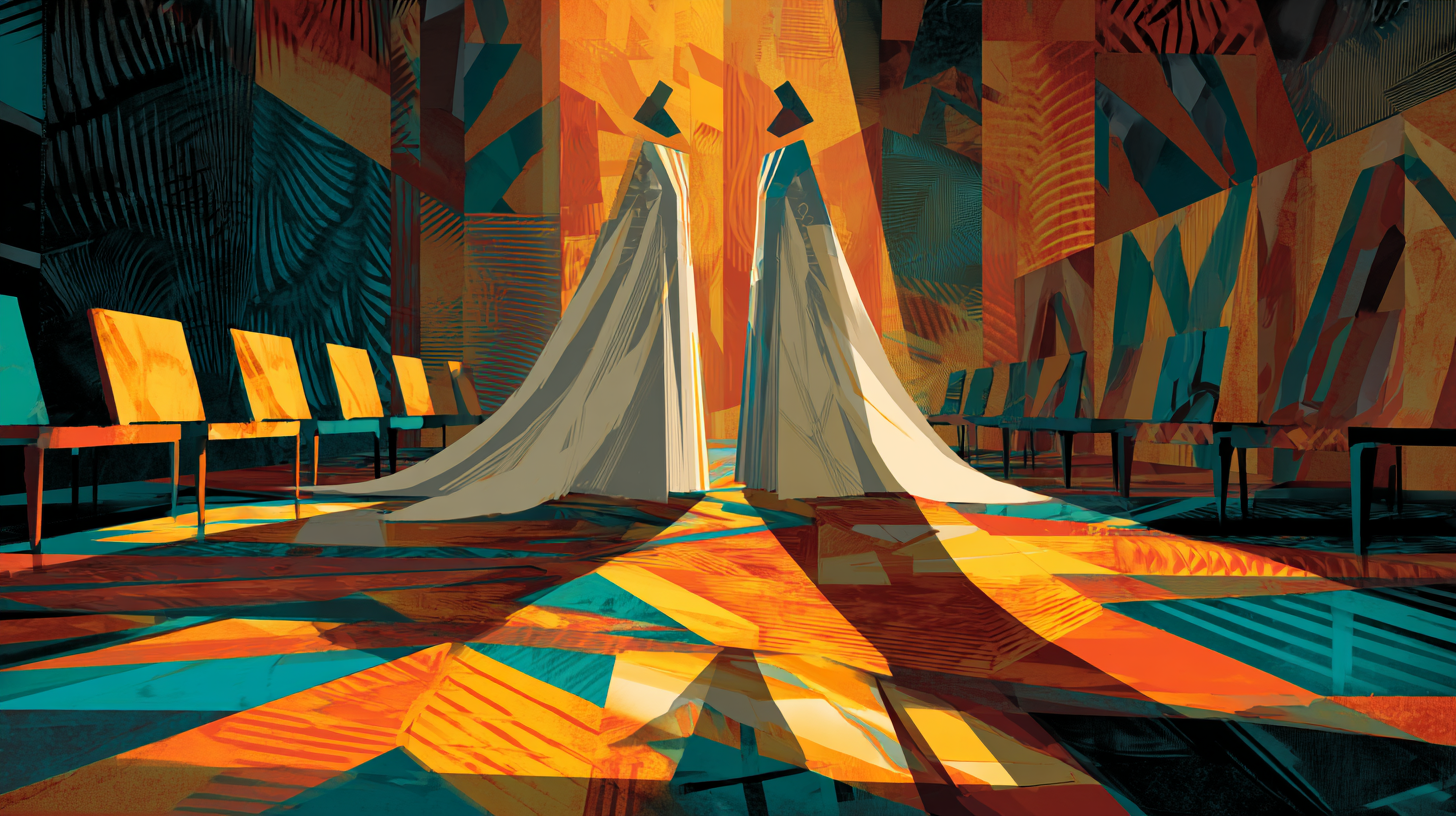
If love is the mechanism, marriage is the institution that consolidates it and gives it a public form. What is instructive is not the affective bond itself but the apparatus surrounding it. The white dresses, the rings, the vows, the flowers, the witnesses, the banquet, the music, the best man’s speech. All that display has as its declared function the celebration of the union of two people. But it also has an undeclared function, which is to make us forget where that union ultimately points. The wedding night does not appear in any welcoming address. The reproductive purpose of marriage remains systematically out of frame.
The lexical field of covering confirms this. In English, the word “habit” designates both a customary behaviour and a religious garment, the robe that covers and defines a monk before others. “Habitual” and “inhabit” share the same Latin root, habitus, what one wears, what one is clothed in. Nudity is associated in almost every culture with the animal, and the first civilisatory gesture is that of covering oneself. Marriage is that gesture taken to its most elaborate and most costly expression.
Modern industry took that mechanism and refined it into a system of economic extraction of remarkable efficiency. The feast of 14 February, which in its current commercial form is a twentieth-century invention built on a mediaeval foundation practically empty of content, generates each year in the United States expenditure in excess of twenty-four billion dollars on flowers, jewellery, dinners and cards. The date celebrates nothing that actually occurred; it celebrates the possibility that the market occupies the space where genuine emotion ought to be.
The concept of the “soulmate” (the belief that there exists a predestined person for each individual, who must be found and held at any price) is not an anthropological truth but a relatively recent cultural product, amplified and normalised by the twentieth-century film industry. Before Hollywood, the majority of humanity arranged marriages according to economic, family or political criteria, with no romantic pretension and without anyone considering it a tragedy. That sentimental coating of the bond is, in that sense, a recent historical construction that wasted little time presenting itself as a natural necessity.
It is no accident that the global wedding industry moves each year sums comparable to the budget of many medium-sized states. People continue to spend on ceremonies even when they cannot afford to, going into debt for a one-day event that in many cases precedes a relationship that will not last. That is not irrationality. It is the scale of the symbolic work demanded of the ritual. The larger the disguise, the more convincing the illusion appears. And the more expensive the illusion, the harder it becomes to admit that it was one.
In 1947, the agency N.W. Ayer devised the “A Diamond is Forever” campaign on behalf of De Beers, the consortium that controlled the global diamond market. In fewer than three decades, that advertising convention became a social norm across Western countries, transforming a marketing instrument into a sentimental obligation perceived as a millennial tradition.
What remains when the veil falls
Recognising the mechanism is not the same as deactivating it, and it does not necessarily lead to any form of philosophical serenity from which everything would suddenly appear with clarity. Schopenhauer is cited as the philosopher of pessimism, the one who strips away illusions to leave only emptiness behind. But his operation is not destructive; it is diagnostic. And diagnoses do not always bring relief, sometimes they bring only precision.
Knowing that love is, in part, a programme executed by a will that does not belong to us resolves nothing. Attraction does not vanish with knowledge of its origin. Desire does not switch off because we know where it comes from. What does disappear, or should, is the certainty of having been chosen by something beyond biology, the feeling that the universe arranged that specific encounter between those two specific people. That certainty was not a truth. It was an anaesthetic.
What follows after losing it is not necessarily indifference or cynicism. It is a different way of being in the bond, more exposed because it no longer has narrative cover, more fragile in appearance but also less susceptible to the collapse that comes from discovering that the story one was telling oneself corresponded to nothing real. Loving without the guarantee of destiny requires sustaining the other’s presence without the aid of any cosmic metaphor, without the argument that there was no other possible option.
For Schopenhauer, that was not possible for the majority. His system leaves little room for optimism on that point. The will is too powerful, the mechanism too well designed, and the species too willing to let itself be deceived rather than face what lies beneath. What he proposes is not a better way to love but a more lucid way to recognise the deception. Whether that is enough to change anything is a question each reader must answer alone, without the universe offering the slightest clue…
G.S.