Nobody remembers who said it first, but everyone has repeated it as though it were self-evident. We are all in the same boat. The phrase circulates in presidential speeches, in corporate social responsibility reports, in the soft rhetoric of international forums, always serving the same purpose. It reassures. It suggests that when the storm finally arrives, it makes no distinction between passengers. Material reality says the opposite, with a stark precision no metaphor manages to dissolve. The sea does not erase hierarchies at all. It reveals them, with a clarity that public discourse prefers not to face directly.
The storm as a revealer, not an equaliser
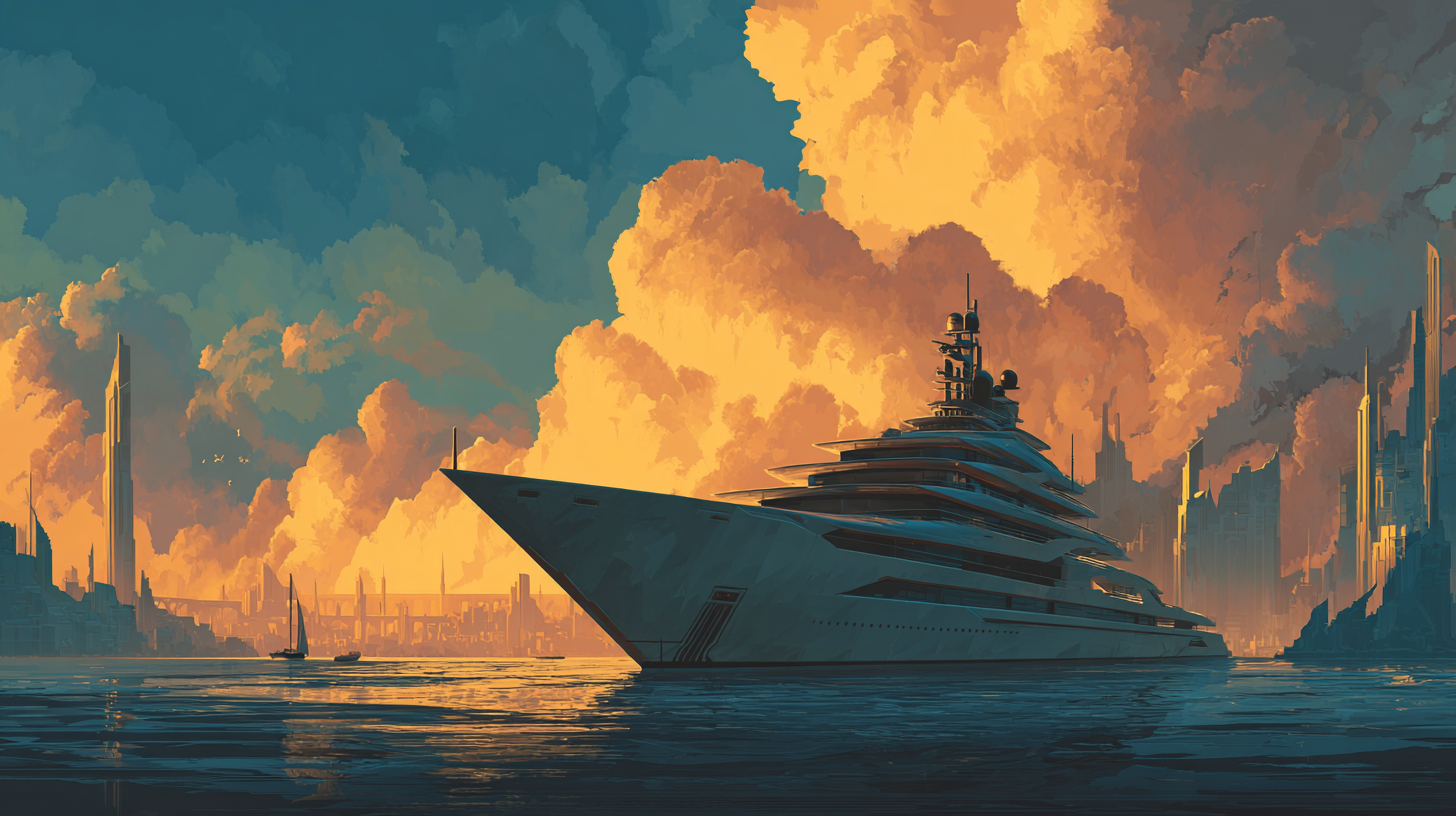
Some bail water without rest on a vessel splitting at the seams, while others sail on steel liners, escorted by private rescue insurance, reserved ports and escape routes already mapped out in advance. Economic crises do not fall evenly. Neither do health crises, nor climate ones. They follow exactly the slope of existing inequalities, worsen it, then naturalise it, as though the outcome had always been inevitable.
The phrase about the shared boat performs a precise function within the architecture of contemporary consensus. It appears in the social responsibility reports of the very corporations whose majority shareholders amass fortunes equivalent to the gross domestic product of entire nations. It appears in the opening speeches of climate summits, where heads of state arrive by private jet to demand collective sacrifice. In both cases it performs the same task, diluting differentiated responsibility into a generic human experience that no one can challenge without appearing cynical.
Part of the great fortunes seems to have made a silent decision. To stop belonging, in practice, to the common world.
When the oceans rise, they buy higher ground. When cities suffocate, they wall themselves behind guarded compounds. When societies fragment, they move their capital at a speed no people will ever know. Absolute selfishness does not consist merely in owning more. It consists in believing one can save oneself alone, while the rest sink with the boat one no longer shares.
New Zealand sells plots to billionaires who install underground shelters equipped to survive years without contact with the outside world. According to reporting by Bloomberg and The Guardian, firms such as Rising S Company and Vivos have delivered or installed roughly a dozen of these luxury bunkers in the country over the past decade, while figures such as Peter Thiel acquired thousands of hectares in the New Zealand south. Private islands in the Pacific and the Caribbean are now marketed not as holiday destinations but as contingency plans against climate or social collapse. The real estate market for individual survival grows precisely where public discourse insists the fate is shared.
Those who finance these same refuges often appear, months earlier, at international summits promising collective solutions to global warming. The inconsistency does not seem to trouble them. They have grasped something the rest of the planet is still slow to accept, that the public promise and the private plan can coexist without friction, so long as no one bothers to compare the two speeches aloud.
According to Oxfam, the twelve richest men on the planet own more wealth than the poorest half of humanity, some 4.1 billion people, and billionaires’ accumulated fortune reached 18.3 trillion dollars in 2025, an increase of 81% since 2020.
None of this requires illegality. The ordinary legal architecture of contemporary capital suffices, that network of tax residencies, trusts and shell companies which lets a fortune cross borders in seconds while the worker who generated it needs months of paperwork to cross the same border with his body. Mobility, in this century, has become the purest form of inequality. Some exercise it without restriction, changing tax jurisdiction the way one changes shirts. Others drown attempting it, at the bottom of a sea that never checks passports.
An invulnerability bought in instalments
Past a certain threshold, wealth changes nature. It stops being a tool and becomes an illusion of invulnerability.
It persuades its holder that everything can be bought. Time, security, health, even the future. That certainty seals its owner inside a universe where poverty becomes a landscape observed through tinted glass, something contemplated without ever touching one. Faces disappear behind market curves. Human tragedies stop being tragedies and become the variables of a model.
This voluntary seclusion has its own infrastructure. Private schools that never share a corridor with the children of employees. Health services that reserve entire operating theatres while public hospitals ration beds. Private security that outnumbers and outguns whole municipal police forces. Each of these services is presented as a simple improvement in quality of life. Together they compose a complete, silent secession, requiring no declaration and no flag.
None of these arrangements is new in principle. What is new is their scale, and the ease with which they can now be assembled anywhere on the planet, purchased off the shelf like any other consumer good, requiring no permission from the societies they quietly abandon.
The philosopher Emmanuel Levinas wrote that the face of the other obliges us, that there is something in the mere presence of one’s fellow that imposes a responsibility prior to any calculation. But for that face to oblige, one must first agree to look at it.
Extreme wealth carries within it a risk greater than greed itself, that of rendering the sufferer invisible. Indifference then becomes the supreme privilege. It is no longer ignorance. It is the calm, almost administrative refusal to feel concerned. Whoever flies a private jet over a camp of displaced people need not hate them. It suffices not to lower one’s gaze.
Levinas thought of ethics as an interruption, a moment in which the other breaks the comfort of the self and obliges it to respond before it has even decided to. Money, taken to its extreme, works the exact opposite way. It builds distance where ethics demands proximity. It buys height, isolation, opacity, all the conditions needed to ensure that interruption never occurs. It is not that the extremely wealthy choose not to see. It is that they have organised their entire lives so that seeing ceases to be possible.
Climate does not correct inequality, it magnifies it
The climate crisis is sometimes presented as the great equaliser, the force that would finally oblige everyone to share the same atmospheric fate. The available data say the opposite, with a force difficult to soften. The damage is distributed along the same slope as wealth, only in reverse. Those who contributed least to producing it are those who suffer it first, while those who produce most of it have the means to defer its consequences by a generation, perhaps two.
There exists a limit known as the carbon budget, the amount of emissions the planet can still absorb without crossing the warming threshold the United Nations considers safe. That limit is not shared out per person. It is shared out by purchasing power.
According to Oxfam, the richest 1% of the planet exhausts its fair annual share of that budget in barely ten days, while the poorest half of humanity would need around 1,022 days, nearly three years, to exhaust its own.
There is no need to imagine a conspiracy to explain this imbalance. It suffices to follow the money and the investment decisions that accompany it. The same fortunes that finance yachts and private jets also hold portfolios laden with oil, gas and mining, shielded by political influence no ordinary citizen could ever match. The mechanism is simple, as all well-designed extraction mechanisms are. No one needs to order the outcome, nor sign any decree. The system is already calibrated to produce it on its own.
United Nations climate conferences accredit fossil fuel delegations of growing size each year. According to Oxfam, the most recent climate summit held in Brazil accredited around 1,600 people linked to oil, gas and coal companies, more than the delegation of any host country except Brazil itself. The very limits negotiated there are the ones these industries fund others to breach. The contradiction troubles no one because it is no longer perceived as one. It has become procedure.
Those fleeing these same consequences find borders growing ever more militarised, while the capital that provokes them crosses without visa or control. The asymmetry is neither accidental nor anecdotal. According to a report by the Transnational Institute, seven of the wealthiest countries, responsible for 48% of historic greenhouse gas emissions, spent on average 2.3 times more on militarising their borders than on climate finance for the most vulnerable countries between 2013 and 2018. The wall is built, with engineering and budget, after the storm that justifies it has already been invoiced.
No fortune survives the ruins of the common good
History insists on recalling a truth that empires always forget. No fortune prospers durably upon the ruins of the common good.
Rome learnt this when its elites, entrenched in villas ever further from the urban tumult, stopped needing the plebeians who fed their opulence, and discovered, too late, that they had also stopped protecting them. Versailles learnt it more abruptly still, and just as irreversibly. No wall, however high, has proved eternal once the rest of society decides it has nothing left to lose.
Every age believes itself the exception to this rule. Every elite convinced it has solved, through technology or money, the problem that sank the ones before it. This century’s New Zealand bunkers and private islands are, in that sense, less an innovation than an updated repetition of the same miscalculation, the belief that individual flight might substitute for collective solutions. The difference, this time, is that the scale of the damage is no longer local nor reversible within a single generation, and no amount of private acreage changes that arithmetic.
A society in which a few accumulate without limit while the multitude exhausts itself eventually breaks the invisible pact that allows each person to live in peace, that tacit agreement no constitution writes down but which underpins, in practice, all possible coexistence, everywhere and in every century. When that pact breaks, it does not do so in an orderly fashion. It does so through eruptions no actuarial forecast quite manages to anticipate, and no private island quite manages to escape entirely.
We are not all in the same boat. Some row, others set the course. Some count the days remaining until the next disaster, others count their dividends. But we share the same ocean, the same atmosphere, the same earthly fate, even though the distribution of consequences is radically different. And when the waves rise too high, no yacht, however luxurious, manages to sail indefinitely amid a sinking world.
True greatness is not measured by the height of the deck from which one contemplates the horizon. It is measured by the capacity to climb down to where the water is already coming in, before the shipwreck of a few becomes, as has already happened before, the shipwreck of all, a debt collected without regard for who signed the original loan…
G.S.
Sources
- Billionaire wealth jumps three times faster in 2025 to highest peak ever, sparking dangerous political inequality (Oxfam International, January 2026)
- A person from the richest 0.1% produces more carbon pollution in a day than someone in the bottom 50% produces all year (Oxfam America, November 2025)
- Richest 1% have blown through their fair share of carbon emissions for 2026 in just 10 days (Oxfam International, January 2026)
- The secret escapes of billionaires: from bunkers to secure compounds (Yahoo Finance / loveproperty.com, December 2025)
- The Super Rich of Silicon Valley Have a Doomsday Escape Plan in New Zealand (Bloomberg)
- Global Climate Wall (Transnational Institute)
- Levinas, Emmanuel. Totality and Infinity (physical work, no link)
Updated September 24, 2026