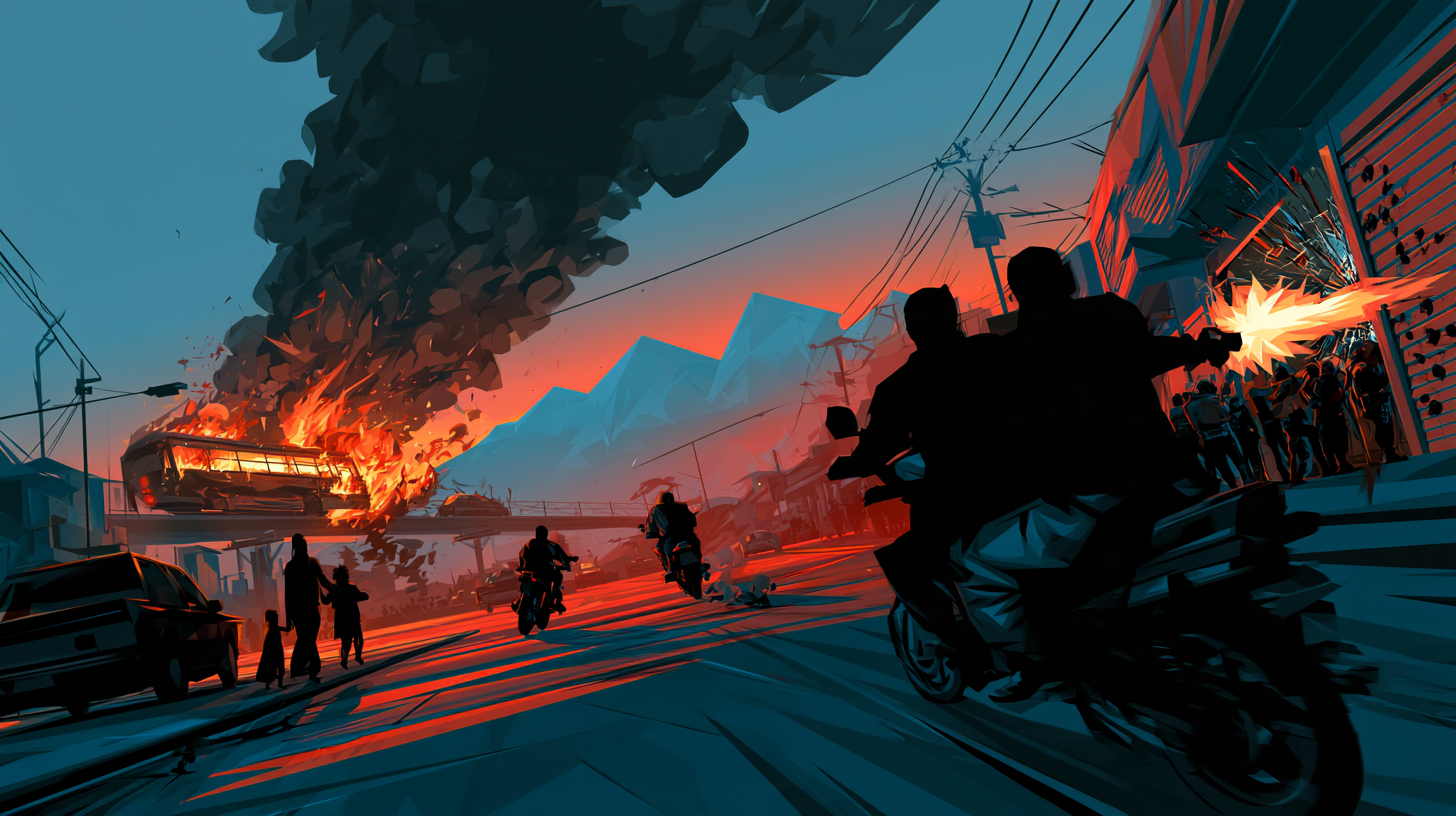
On Monday 21 September 2026, an anti-narcotics operation in the rural area of Santa Marta killed seven alleged members of an armed group, the Autodefensas Conquistadoras de la Sierra Nevada (ACSN), among them alias Cholo, presented as its second-in-command, in the same territory where a military operation in June had already been followed by blockades. A communiqué in the group’s name announced a forty-eight-hour armed strike, and men on motorbikes rode through the city shooting at shops until it closed. President Abelardo de la Espriella responded with militarisation, a tour with a pistol at his belt and the transfer of seventy-six prisoners, while the governor spoke of ‘two nobodies’ and the mayor of a return to normality. The Ombudsman’s Office (Defensoría del Pueblo) had issued eight warning documents on the Sierra Nevada in five years, and its alert of December 2025 already described the extortion levies and controls that have now become visible. No measure announced up to 23 September, according to the press consulted, targets those levies. The corpse is answered, not the till.
A reprisal with a history
On Monday 21, the Police Anti-Narcotics Directorate carried out an operation at Quebrada del Sol, in Guachaca, a rural area of Santa Marta, which according to El Espectador left seven dead and three arrested. Among the dead were José Luis Pérez Villanueva, alias Cholo, and a son of alias Pinocho, the supreme leader of the ACSN (also known as Los Pachenca), which the authorities describe as heir to the paramilitarism of the Sierra Nevada.
Cholo had a singular legal history.
According to El Espectador, Resolution 0-0337 A of the Attorney General’s Office, dated 20 November 2025, had suspended his arrest warrants within the socio-judicial dialogues of the so-called total peace that Gustavo Petro’s government held with the ACSN, which is why he walked free when he was stopped in December. The warrants were reactivated on 1 September 2026, with the dismantling of that policy, and twenty days later he was dead.
The communiqué in the ACSN’s name announced a forty-eight-hour armed strike (paro armado), that is, a forced closure of shops and transport imposed at gunpoint. According to Cambio, the morning of Tuesday 22 brought closed shops, two buses burned on the Once de Noviembre bridge, a taxi set alight and shots fired at an Olímpica store. The regional authorities maintained that day, according to the same outlet, that there was no active armed strike and that every blockade point had been cleared since dawn.
Norma Vera Salazar, a human rights defender, recalls in La Silla Vacía that the organisation had already responded with blockades to the death of alias 80 in 2020 and during the elections of March 2022. In June 2026, after a military operation in the same area of Quebrada del Sol, she counts seven further blockades. Same place, same reaction. The armed strike of the Gulf Clan in May 2022, another group and another trigger, the extradition of alias Otoniel, reached 119 municipalities according to El Espectador. I read in that series a foreseeable response, and that is my own reading. The press reports that the security forces deployed on Tuesday 22, with patrols and flyovers, when the shops were already closed, and in the reports I consulted I find no protective plan for shopkeepers announced before the operation, which does not prove that none existed.
Shops shot at and a city that closes itself
El Espectador cited that Tuesday an estimate of more than ninety per cent of businesses closed, transport suspended towards La Guajira, classes cancelled and threats denounced by the Arhuaco Cabildo, an indigenous council. La Silla Vacía spoke of between eighty and ninety per cent. Seguimiento, an outlet of the Magdalena, described two men on a motorbike who fired at the refrigerators of a neighbourhood shop while three children repaired a bicycle in the workshop next door and fled in tears. ‘So that they start believing them,’ one of the attackers said according to that outlet, announcing that they would go on to El Rodadero, the seaside resort.
On Wednesday 23 the problem changed shape. Seguimiento recorded queues of hundreds of people outside the supermarkets Olímpica, Ísimo, D1 and Ara, which opened with controlled entry, and panic buying of basic foodstuffs for fear of a prolonged closure. Noticaribe kept listing closed businesses, among them the market and the centre. The two descriptions may correspond to different neighbourhoods and different hours.
The city its inhabitants describe is less orderly. Local sources, citizens who live in Santa Marta and whom AcidReport consulted, say that the few supermarkets open were overrun by waves of shoppers, that little is left on the shelves and that neighbourhood shops are shot at in front of minors. The last point matches what Seguimiento and several videos document. The rest could not be checked against a second independent source, and none of the outlets consulted reports empty shelves or shortages. It is published for what it is, a testimony from people living through the crisis, under the express responsibility of the author.
The freight transport association Colfecar warned, according to El Diario, that a prolonged interruption could compromise the supply of food, medicine and fuel. A warning is not a fact, and the distinction matters in a city that eats each day what it buys that day.
According to the Santa Marta Chamber of Commerce, the armed strike caused losses of 39.59 billion pesos in the city, with more than 22,000 establishments and more than 100,000 workers affected. (Santa Marta Chamber of Commerce, cited by Vanguardia, 23 September 2026)
El Diario specifies that this figure corresponds to the first day. The same Chamber estimates that the informal economy represents around sixty per cent of the local economy and that tourism accounts for a little over half of the city’s output. In such an economy, two days of closure do not register as an accounting balance but as food that someone does not buy.
Normality, firmness and a pistol at the belt
On Tuesday 22, the governor of the Magdalena department, Margarita Guerra, said according to El Tiempo that closing shops would be ‘a gift to the armed strike announced by the Conquistadores’, and called for firmness. In another statement reported by La Veintitrés she maintained that there was no armed strike and described the perpetrators as ‘two nobodies’ who arrive on a motorbike, shoot and order shops to close. The two sentences trip over each other. The underlying argument has its logic, since ceding the shops amounts to ceding territory, but the political scientist Karol Solís Menco replied, citing burned taxis and shots fired at supermarkets with children inside, that denying the facts from an armoured car with an escort was a lack of respect towards the governed.
Shopkeepers asked for the accompaniment of the security forces in order to open, according to Publimetro, and demanding that they reopen without it, in front of men who have already fired on neighbouring shops, shifts to their till the cost of the State’s firmness.
Mayor Carlos Pinedo declared, according to Vanguardia, that ‘everything is returning to normality’, asked for businesses to open and put the reinforcement at six hundred police officers and five hundred soldiers. Lerber Dimas Vásquez, a human rights defender, replied on X that his idea of normality did not coincide with that of the mayor and the governor. El Tiempo noted that same Wednesday that many businesses remained closed despite the institutional deployment.
One may ask which normality is meant, because the one the Ombudsman’s Office describes in its 2025 alert includes periodic levies on economic activities and controls over schedules and conduct imposed on the civilian population.
The presidential response was on another scale and had another audience.
La Silla Vacía reports that the president ordered the militarisation of the city on Tuesday with a martial phrase, ‘bandits are answered with the full force of the State’. On Wednesday he announced a reinforcement of 1,100 uniformed personnel for Santa Marta and Ciénaga and carried a pistol at his belt, which that same outlet calls unprecedented for a civilian head of state. According to Cambio, he toured the Cristo Rey and Gaira neighbourhoods in a bulletproof vest and with armed escorts, named the Once de Noviembre neighbourhood an operations centre of the ACSN and described the area as ‘calm’. La Silla Vacía also recorded that he walked beside the seven bodies of the dead, in white bags, and that he ordered seventy-six ACSN prisoners transferred to maximum-security prisons, with the formula ‘whoever does not submit ends up in bags’.
Juan Carlos Losada, of the Liberal Party, told the journalist Daniel Coronell that militarising works as a shock plan and does not resolve the underlying problem, that control is not evident if men on motorbikes keep shooting at shops, and that the images and what the locals say contradict the official narrative. Where are the intelligence and the prevention, he asked.
That sequence looks like a policy addressed mainly to the public outside Santa Marta. The troops, the transferred prisoners and the weapon answer the visible armed actor, and none of those measures, according to what the press consulted reports up to 23 September, concerns the levy that sustains him or the shops that pay it. It is a reading and not a datum, and it rests on an absence, that of any announcement about extortion, which a single decree can correct tomorrow.
There is, besides, a liturgy. A head of state who walks beside seven bodies in white bags and promises that whoever does not submit ends up in bags practises an aesthetic of force for which political history has a name. I read in it a fascist trait, a qualification of my own and not a datum, which does not follow from having won elections but from turning the corpse into an argument of government.
Eight warnings and an extortion rent that nobody touches
The Ombudsman’s Office had issued eight warning documents on the Sierra Nevada before March 2024. It did so again on 2 December 2025 with an early warning covering twenty-one municipalities which, according to El Heraldo, describes the ACSN as holding hegemonic control in areas such as Ciénaga and Santa Marta, with periodic levies on economic activities and controls over schedules and conduct imposed on the civilian population.
The Ombudsman’s Office reported in March 2024 that it had issued eight warning documents on the Sierra Nevada de Santa Marta in the previous five years, and on 2 December 2025 it issued an early warning for 21 municipalities in the departments of Magdalena, Cesar and La Guajira. (Ombudsman’s Office and El Heraldo)
Norma Vera Salazar argues in La Silla Vacía that Cholo’s death did not dismantle the organisation, which retains family networks, territorial control and illegal economies.
Two opposed doctrines, the negotiation of total peace and De la Espriella’s iron fist, converge on a point that neither mentions. The first gave legal cover to the interlocutors without it being established that it touched that rent, and the second eliminates the interlocutors without it being established that it touches it either. In such an informal economy, the rent works as a private tax levied on those with the least margin to pay it, and the armed strike is the form that tax takes when someone disputes it.
The incompetence lies not in having failed to prevent an armed strike that the Ombudsman’s Office and three precedents foretold, it lies in having responded with soldiers, pistols and speeches, and with no announced measure against the extortion that funds the group.
The armed strike will end, or has already ended, and the city will recover the tepid rhythm of its days of sun and tourists. If the response follows the logic described, the shops will reopen with the police on the corner for a week, two, until the deployment moves on to another crisis, and someone will come to collect, because the collection does not depend on the boss being alive. The State will have done its duty by being visible for forty-eight hours, a span that Santa Marta measures in more than thirty-nine billion pesos and in three children fleeing a shop…
G.S.
Sources
- El Espectador, Muerte de alias «Cholo» desata caos en Santa Marta
- El Espectador, Muere alias «Cholo», presunto segundo jefe de las Autodefensas de la Sierra Nevada
- Cambio, Santa Marta, así fueron las primeras horas del paro armado atribuido a las ACSN
- Cambio, Con chaleco antibalas y arma al cinto, así fue el recorrido de De la Espriella por los barrios de Santa Marta
- La Silla Vacía, Santa Marta continúa el paro armado tras la muerte de alias «Cholo»
- La Silla Vacía, Abelardo ordena militarizar Santa Marta por paro armado
- La Silla Vacía, Con arma en cinto, Abelardo anuncia medidas de seguridad para Santa Marta
- La Silla Vacía, Acsn, 76 miembros serán trasladados a cárceles de máxima seguridad
- La Silla Vacía, Norma Vera Salazar, El paro armado de Santa Marta sobrevive a sus jefes
- Defensoría del Pueblo, Defensor del Pueblo solicita mayor atención y protección para quienes habitan en la Sierra Nevada de Santa Marta
- El Heraldo, Disputa entre estructuras armadas en la Sierra Nevada de Santa Marta mantiene en peligro latente a las comunidades
- El Heraldo, Policía realiza patrullajes en zonas comerciales y la FAC hace sobrevuelos en Santa Marta
- Seguimiento, Aberrante, ante la mirada de tres niños, Acsn ataca a bala una tienda en Santa Marta
- Seguimiento, Largas filas e incertidumbre, samarios acuden a supermercados por temor al desabastecimiento
- Seguimiento, Escalada terrorista, queman taxi en Santa Marta y un camión de carga en la Troncal
- Noticaribe, Santa Marta amaneció desolada y con negocios cerrados
- Noticaribe, Terror, a bala integrantes de las ACSN obligan a cerrar los negocios en Santa Marta
- Vanguardia, Santa Marta calcula millonarias pérdidas tras jornada de violencia
- Vanguardia, Alcalde de Santa Marta anuncia refuerzo de seguridad tras jornada de violencia
- La Veintitrés, Polémica en Santa Marta, gobernadora niega paro armado y politóloga la contradice con pruebas
- El Tiempo, Gobernadora del Magdalena se pronuncia tras problemas de orden público en Santa Marta
- El Tiempo, Santa Marta intenta recuperar la normalidad
- Publimetro, Paro armado en Santa Marta, comerciantes piden garantías para abrir sus negocios
- El Espectador, Clan del Golfo, ¿qué hubo detrás del paro armado?
- Juan Carlos Losada, interview with Daniel Coronell, September 2026
- El Diario, Paro armado en Santa Marta deja pérdidas por $39.000 millones y golpea al transporte de carga