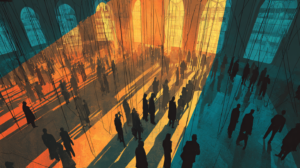
On 3 June 2026, in the centre of Santiago, Chile’s Carabineros broke up a march called by the Confederation of Chilean Students against the budget cuts of José Antonio Kast’s government, deploying water cannons, tear gas and unmasked police dogs. It was the first major student mobilisation since Kast had taken office on 11 March, barely eighty-three days earlier. A law student at the University of Chile sustained multiple fractures to her face and required surgery. At least ten people were detained. The Metropolitan Presidential Delegation had unilaterally modified the authorised route hours before the march began. What happened that Wednesday was not an isolated episode of police excess, but the first empirical test of a control architecture the government has been building since the first day of its mandate, following a logic that deserves to be examined with precision.
The shock programme
José Antonio Kast won the second round on 14 December 2025 with more than 58 per cent of the vote, driven by a campaign focused on public security, irregular immigration and promises of radical austerity. He took office on 11 March 2026 with an explicit programme to cut six billion dollars in public spending over eighteen months to restore the fiscal balance left by Gabriel Boric’s outgoing government. The first concrete measure was an immediate 3 per cent reduction across all ministerial budgets. The Ministry of Health suffered the sharpest cut, losing the equivalent of 486 million dollars, or 2.5 per cent of its annual budget. The Ministry of Education shed a further 221 million dollars, representing 1.3 per cent of its resources. Fifteen social programmes were suspended outright and forty-two others were cut by between 15 and 42 per cent.
Kast defended the adjustment before Congress in a statement that circulated widely. “It won’t be quick, there will be pain. I won’t promise you miracles, but I do promise we will restore order to the public finances.” At the same time, what was called the Megareform, a package of legislative changes passed in the Chamber of Deputies with the votes of the governing right and the People’s Party, reduced corporate income tax from 27 to 23 per cent, on the grounds that the cut would stimulate economic growth. The operation has a recognisable geometry; fewer resources for the services the majority depend on, lower taxes for those who accumulate the most. That both are presented as a single programme of national reconstruction is a detail that political language manages without effort.
Kast is the founder of the Republican Party of Chile, a far-right organisation he built after breaking with the Independent Democratic Union in 2019. His government took power without an absolute majority in Congress and his cabinet was described as technocratic; sixteen of the twenty-four ministerial posts went to individuals with no party affiliation. Among the most remarked-upon appointments were two lawyers who had defended Augusto Pinochet before the courts, a detail that signals a continuity in the way that political space has historically managed dissent rather than any mere sentimental affinity. Kast signed the Madrid Charter, the founding document of the Latin American and European far-right party alliance, alongside Javier Milei and Santiago Abascal. It is not a marginal detail; it defines the ideological framework within which this programme operates.
What it cost to win
Free university education in Chile was not a spontaneous concession by the state. It is the direct result of two decades of student mobilisations that transformed political debate in the country. In 2006, tens of thousands of secondary school pupils occupied their schools and marched in what became known as the Penguin Revolution, demanding an end to profit-making in education and universal access to public schooling. The movement achieved no immediate changes, but it installed the education question as an unresolved axis of Chilean political contestation. In 2011, a new wave of university and school mobilisations paralysed the country for months. The state’s response was again insufficient, but the accumulated pressure forced the construction of a free tuition system for students from the bottom 60 per cent of households by income, progressively extended over subsequent years. It was not the system the movement had demanded, but it represented an acknowledgement that higher education could not continue to be a lifelong debt for families without capital.
In October 2019, Chile experienced the most significant social uprising in its recent history. What began as a student protest against a fare increase on the Santiago metro escalated into weeks of mass mobilisation across the country, with demands that exceeded any sectoral reform. The outcome was a constitutional referendum, the drafting of a new constitution ultimately rejected in a plebiscite, and the election of Gabriel Boric as president in 2022 on a platform that included deepening free tuition and creating a Higher Education Fund to expand access. The Kast government arrives to dismantle not just an education policy, but the result of twenty years of mobilisation.
Free university education in Chile covered, before the Kast government, students from the bottom 60 per cent of households by income. The system operated through direct transfers from the state to accredited universities that joined the free tuition scheme, and was progressively extended from its initial implementation in 2016.
The Kast government declared in its first week that it would not continue the Higher Education Fund, that it would restrict free tuition to those under thirty, and that it would strengthen the recovery mechanisms for the State Guarantee Credit, the student loan system whose debt has been suffocating hundreds of thousands of Chilean families for twenty years. The Minister of Education, María Paz Arzola, argued that free tuition had substituted private resources with public ones without sufficient impact on equity of access. It is a technical argument that sidesteps the data that social spending on education produces; the reduction of structural debt for working families, expected earnings over a working life, the social mobility generated for those who are the first in their family to attend university. Removing that data from the calculation is not a technical omission. It is a political choice with specific intended beneficiaries.
The double scissors
Up to this point, the Kast government behaves as austerity governments behave the world over. What distinguishes it is the legal architecture it constructs simultaneously to manage the protest that its own policies generate. On 1 June 2026, in his first annual address to Congress in Valparaíso, Kast announced the submission of a bill to create the National Register of Vandals and Incivilities. The measure establishes an official list of persons convicted of offences related to vandalism and public disorder. Those on the register would lose state social benefits, including free university tuition and the Universal Guaranteed Pension, the basic retirement benefit for elderly people with insufficient pension savings. Kast summarised it in a phrase designed to travel. “Nobody who destroys public property deserves free tuition.” The Attorney General and several legislators raised doubts about the measure’s constitutionality and its compatibility with international human rights treaties. From the opposition, at least one deputy warned that the register “can be used for anything, and one of those things is criminalising the legitimate protest of students, workers or citizens.”
What makes the Register particularly effective as an instrument of discipline is not its criminal severity but its administrative architecture. It does not require a firm conviction for a serious offence; it includes “incivilities” defined broadly enough to cover behaviour that accompanies any social mobilisation of any scale. Spray-painting a wall, blocking a street, covering one’s face at a march. The loss of social benefits it provides for operates not as an accessory penalty in the strict legal sense, but as an administrative sanction running parallel to criminal proceedings, making it easier to apply and harder to challenge. The United Workers’ Central rejected the bill explicitly, warning that it constitutes a strategy of institutional persecution aimed at containing trade union, student and neighbourhood organisations.
Two days before that speech, Congress had approved the Protected Schools Act. The law authorises the searching of students’ bags, prohibits the wearing of face-covering items, and provides for those convicted of offences on school premises a specific sanction; a five-year ban on accessing free university tuition. This is not a minor accessory penalty. For a young person from a working-class family in Chile, losing free tuition for five years can mean losing the realistic possibility of completing higher education. The logic of both laws converges on the same point; access to education becomes a revocable franchise, conditional on the political behaviour of whoever holds it.
On 3 June 2026, the Confederation of Chilean Students (Confech) and the Teachers’ Union convened the first mass national mobilisation of the Kast period. The Carabineros intervened with water cannons, tear gas and unmasked dogs. At least ten arrests were reported. A law student at the University of Chile sustained multiple facial fractures and required surgery. The Metropolitan Presidential Delegation had unilaterally modified the authorised route before the march began.
The logic of circular punishment
The mechanism operating in Chile under the Kast government has the elegance of well-designed devices. First, rights are cut. Then, the legal infrastructure is built to suppress those same rights from those who protest their suppression. The result is a closed circuit; protesting against the loss of free tuition can cost the free tuition, demonstrating against the defunding of public health can cost the old-age pension. There is no need to declare a state of emergency or formally suspend constitutional guarantees. It is sufficient to make social rights conditional, dependent on the political conduct of those who hold them. It is a form of discipline that requires no dictatorship because it operates within the frameworks of the rule of law, with its own instruments.
When a state builds that system, the question of what kind of freedom remains available to people who have nothing beyond their social rights ceases to be rhetorical. The answer given on 3 June from the Alameda requires no translation. “Public education will be defended.” What the slogan does not say, but the body of the law student taken to surgery does, is how much defending it can cost…
G.S.
Sources
- Chile. Reprimen a estudiantes durante paro nacional contra recortes sociales de Kast
- Violentos choques en Chile por marcha masiva estudiantil contra los recortes de Kast
- Chile. Brutal saldo de la represión policial en marcha contra recortes de Kast
- Kast anuncia creación de un registro de vándalos en Chile durante su primera rendición de cuentas
- Presidente Kast anunció la creación del Registro Nacional de Vándalos
- El plan de Kast para la educación superior, limitar la gratuidad y descartar el FES
- Escuelas protegidas, más allá del castigo
- Estudiantes protestan contra los recortes presupuestarios del Gobierno de Kast en Chile
- Kast lanza un registro de vándalos en Chile y enfrenta sus primeras protestas por su programa de ajustes
- Gobierno de José Antonio Kast