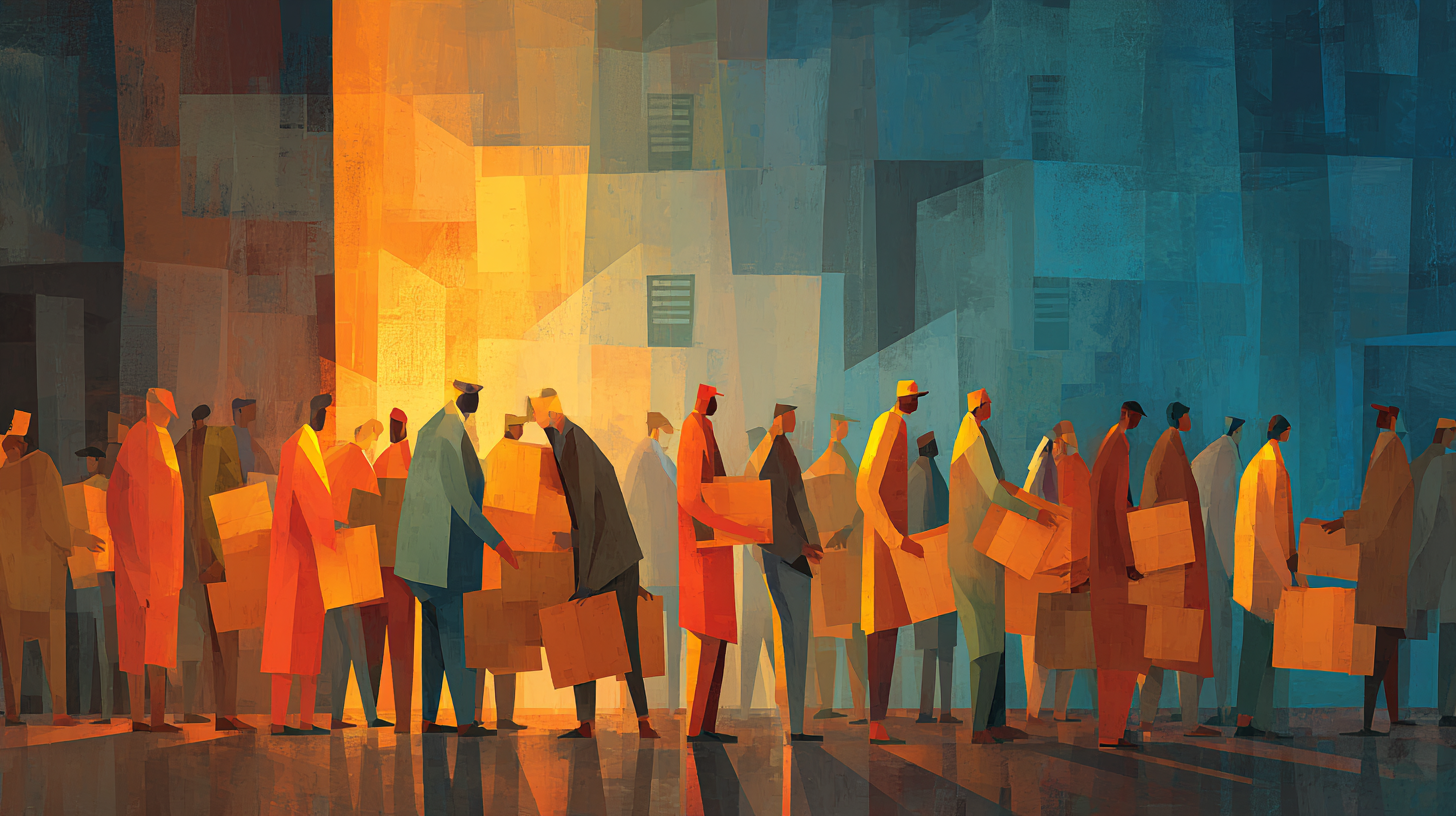
A recent text, written in an almost liturgical register, poses the right question and then retreats from it. It asks whether charities ought to replace the state, answers that they should not, and then describes with precision the mechanism by which they already are. That contradiction is not a rhetorical slip. It is the symptom of a process so familiar that it no longer registers as a process at all, but as scenery, a backdrop contemporary society has stopped looking at because it has always been there, or at least because it believes it remembers it that way.
In at least three countries that served as laboratories, and on an entire continent that served as a laboratory before all three of them, the substitution of enforceable rights by organised generosity has stopped being a hypothesis and become permanent infrastructure. This is not a conspiracy coordinated from some ministry. It is something more effective than a conspiracy, a structural incentive that every government, regardless of political orientation, discovers on its own and applies with the same words, community resilience, civil society, shared responsibility, without anyone needing to deliberately copy the neighbour in order to arrive at the same solution. The convenience of the arrangement is precisely what makes it so durable, since no single official ever has to sign the order that turns a right into a favour, and no single budget line ever reads as an admission of retreat.
The British experiment
The mechanism has a birth date. In November 2009, David Cameron unveiled what he would call the Big Society, a project promising to replace central government with communities capable of solving their own problems without always turning to officials and local authorities. A year later, now prime minister, he began applying it. The result, according to widely cited estimates, was a real terms cut of around 40% in public service spending by the end of the decade.
The National Council for Voluntary Organisations, the federation representing most British charities, calculated that these bodies now deliver services worth close to £16.8 billion on the government’s behalf, often without the funding needed to sustain that load. The state did not disappear. It delegated, then stopped paying for what it had delegated.
Food banks in the Trussell network distributed more than 2.6 million emergency parcels across the United Kingdom in 2025, one every twelve seconds, from more than 1,600 locations across the country.
An attempt was made to institutionalise the idea. The Society Network Foundation was set up as an independent partner to government, meant to embody the Big Society ideal, the enterprising charity ready to take on state functions. It ended up under two National Audit Office inquiries into the misuse of three million pounds of public money, and collapsed in 2014. The failure was quick. The political usefulness, by contrast, lasted far longer than the institution itself. The project did not fail for lack of goodwill among those who ran it on the ground. It failed because it was designed to fail at its explicit promise while perfectly fulfilling its implicit function, which was to make a politically unsustainable cut look reasonable. Ten years later, when another British government announced a fresh round of austerity, the vocabulary of the big society began circulating again, with different protagonists and the same script, proof that the collapse of one particular institution does nothing to invalidate the usefulness of the story that sustained it. What survived was not the foundation, nor even the Conservative government that had launched it, but the underlying assumption that a nation can quietly outsource its social contract to whoever is willing to pack the boxes.
Germany’s logistics of managed poverty
In Germany, the mechanism took a different but equally revealing shape. The first Tafel, the German food bank, was founded in Berlin in 1993. Three decades later there are more than 970 across the country, regularly serving close to 1.5 million people, sustained by around 75,000 volunteers. Almost half of those who attend receive Bürgergeld, the basic unemployment benefit. Nearly a third are children who come with their parents, figures that in any other context would read as a summary of a national emergency, and which here read instead like the annual report of an institution that has learned to run itself with the efficiency of an established company.
What is rarely mentioned is who built the logistical architecture that made this scale possible. In 1996, the consultancy McKinsey offered its help to the Tafeln free of charge, designing the collection and distribution system that today links supermarkets, bakeries and wholesalers to hundreds of distribution points. The same discipline that major consultancies routinely apply to optimising corporate profit was applied here, without a fee, to the optimisation of scarcity.
There is not enough irony to describe that gesture.
There is, instead, a perfectly coherent internal logic. A society unable to afford feeding its poorest citizens can nonetheless afford to have its best managers design the system that administers that incapacity efficiently. Nearly a third of German Tafeln have had to temporarily suspend new admissions or open waiting lists. Demand is growing faster than donations. No one within the movement frames this as a criticism of the state. It is framed, almost always, as an appeal for more public generosity, which amounts to asking civil society to fund, ever more generously, the absence it is itself concealing. Every fresh appeal for donations tacitly repeats the same unspoken bargain, that citizens will keep paying twice, once through taxes that no longer cover the need, and once again through the food they hand over at the door.
Across the Atlantic, the same mechanism reaches a scale no European country can match, precisely because the United States never had, even briefly, the promise of a welfare state comparable to Britain’s or Germany’s. Feeding America, the country’s largest non-profit, reported revenue close to 4.9 billion dollars in the most recent fiscal year on record, a turnover befitting a mid-sized corporation, not a charitable cause. Here the euphemism largely disappears, the sector is openly called the charitable food sector, a name that admits outright that it has, in practice, replaced a right the country never quite finished recognising as one. Hardly anyone seriously argues Feeding America should cease to exist. The debate, at best, is whether it deserves a little more federal funding next year.
The Feeding America network coordinates more than 200 food banks and 60,000 community pantries, and recent estimates put the number of people who depend on that system to eat at around 42 million, more than twelve per cent of the country’s population.
The continent that lived it first
Latin America does not need to look at any of these three countries to understand the mechanism. It lived it first, and more brutally, under a less generous name, structural adjustment. During the 1980s and 1990s, the so-called Washington Consensus imposed on the region programmes conditioned on access to financing from the International Monetary Fund and the World Bank, which required cuts to public spending on health, education and social protection in exchange for macroeconomic stability and the confidence of capital markets.
Colombia offers a particularly clear case, because there the withdrawal of the central state was not disguised as communal generosity but as constitutional reform, which gives it a legal legitimacy the British case never had to feign. The 1991 Constitution ordered a growing share of national government revenue to be transferred to departments and municipalities, rising from 36.5% in 1993 to a ceiling of 46.5% in 2002. On paper, this was decentralisation, more territorial autonomy, greater proximity between the state and the citizen. In practice, many local administrations were handed the responsibility of providing services without the institutional capacity to do so, and that vacuum was filled, year after year, by non-governmental organisations funded from abroad, in a country where the state’s absence across large rural areas was never only administrative but also military, adding to the substitution a dimension no European country has had to face, that of civilian organisations operating precisely where the monopoly on force itself was contested.
The Colombian Confederation of NGOs, founded in 1989 at the very threshold of that process, today brings together close to a thousand organisations working in development, peace and human rights, many of them de facto performing functions that under a different model of the state would fall to a ministry or a regional government. The difference with the three preceding cases is not one of nature but of chronology, and also of vocabulary. Europe and the United States are only now discovering, with the new language of the Big Society, civil society and the charitable food sector, what Latin America already knew under the less generous name of structural adjustment. The NGO replaced the state before the euphemism of civil society as government partner even existed, and it did so, moreover, under the watch of the same international financial institutions that would later export the model northward, as though the continent had served as a testing ground before the product reached the global market.
Rights that become favours
No government announces publicly that it intends to replace rights with charity. The process advances through an accumulation of apparently innocent gestures. A budget is cut, the volunteers who compensate for the cut are praised, and their very existence becomes the proof that the cut was survivable.
The mechanism is simple, as all well-designed mechanisms of extraction tend to be. No one needs to explicitly order that rights become favours. It is enough to reduce funding year after year, while multiplying the symbolic recognition given to those who cover the difference. The text that inspired this reflection evokes the image of a common house built by the state, its warmth maintained and its cracks repaired by voluntary associations. It is a generous image. But it fails to ask who decided, in the first place, to stop heating that house, and who keeps deciding it every year, in every budget law, long after the first generation of volunteers has grown old in the role.
The organisations named in this text did not seek this role. The volunteers at Trussell, at the Tafeln and at Feeding America, the community organisers who carried Latin America’s social programmes through the years of structural adjustment, acted almost always out of genuine conviction. But the sincerity of their motives does not change the structural function of a system that employs them without pay. That system needs gratitude, not demands. It needs grateful volunteers, not exacting citizens, and the more visible the public gratitude towards them becomes, the less visible grows the question of why they remain necessary thirty years after they began.
Every time a government publicly thanks a charity for its work, it also thanks, without saying so, its own absence. The applause and the void occupy exactly the same space, and that space, in London, in Berlin, in Bogotá, or in any city of a country that calls itself developed, always takes the same shape, that of a right no one formally repealed and which, nonetheless, no longer exists. The volunteers will keep showing up tomorrow, because that was never in question, and the state will keep being thanked for their doing so, which was the point all along…
G.S.
Sources
- End of year food bank stats
- Food banks provide over 2.6 million food parcels
- David Cameron and the collapse of (the big) society – Ekklesia
- The Big Society, Reheated – Tribune
- Big Society – Wikipedia
- Tafel (Organisation) – Wikipedia
- Tafeln fordern soziale Zeitenwende
- Which Food Banks are the Biggest in the U.S., 2025 – Food Bank News
- How many Americans rely on food banks
- Consenso de Washington – Wikipedia
- Colombia en la década de los noventa – SciELO
- Colombian Confederation of NGOs – Who we are