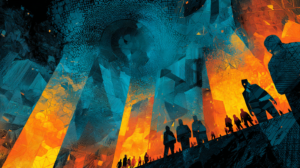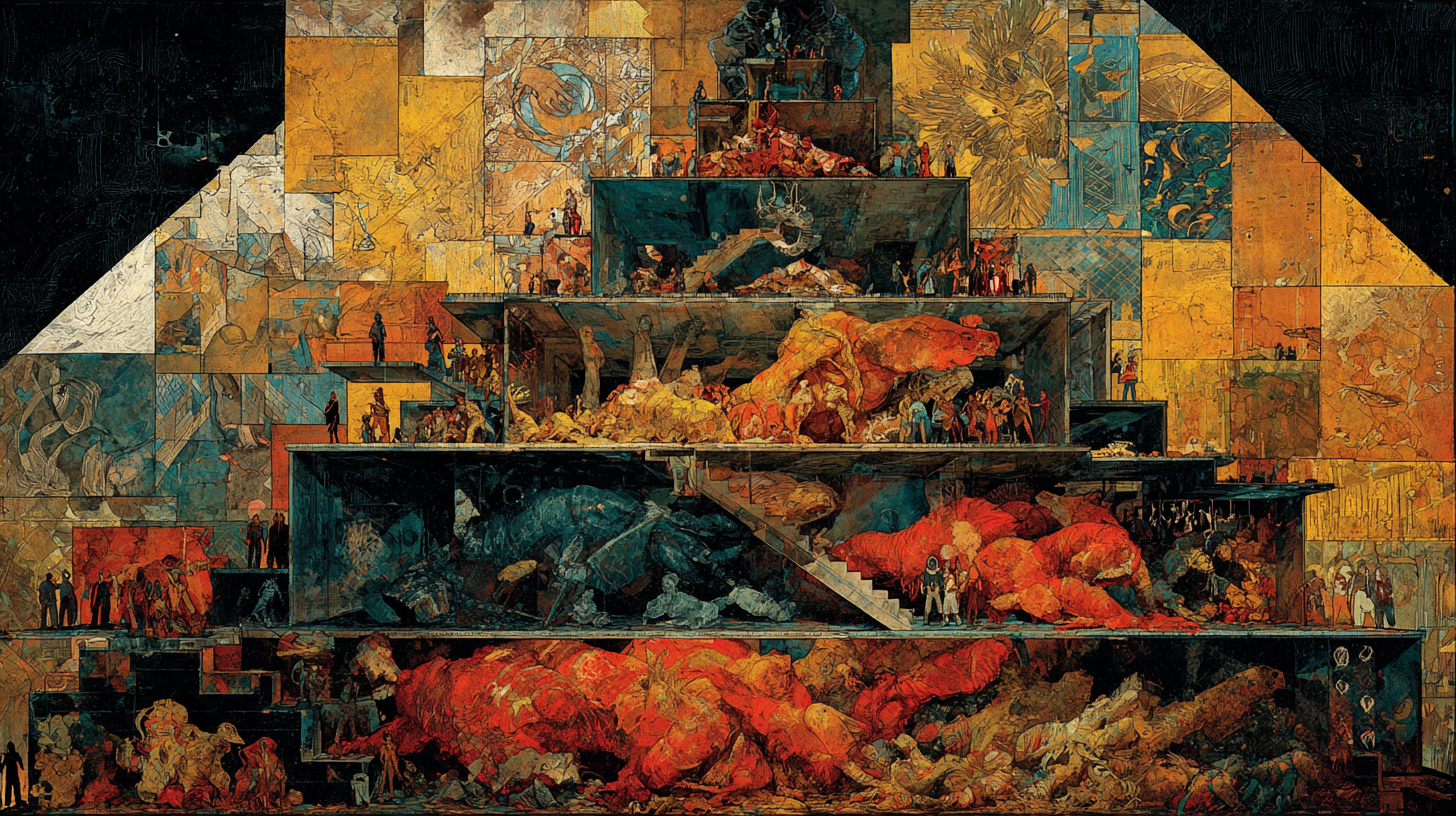
In 1927, Fritz Lang filmed a city divided into two halves that do not recognise each other. Above, an elite that plans from illuminated towers. Below, an invisible working class that sustains the system without participating in it. At the intermediate level, the great machine that drives everything. The film, written by Thea von Harbou and turned into images by her husband, did not anticipate the future. It described structures of domination that already existed in Weimar Germany and in the skyscrapers of Manhattan, and projected them forward with a coldness that cinema would not match for decades. We are in 2026, the year that some historical editions of the novel identified as the setting of the story. What is unsettling is not what Lang got right. It is how little he needed to exaggerate.
What Weimar Already Knew
The vertical city exists. The invisible labour that sustains its mechanisms exists. The artificial intelligence designed to impersonate faces and manipulate masses exists. Metropolis reaches its imagined year with a relevance that should surprise no one who has been paying attention.
In 1924, Fritz Lang travelled to New York as part of a delegation from the production company UFA, sent to seal distribution agreements with Paramount and Metro Goldwyn Mayer. He arrived at night. The Manhattan skyscrapers lit from below, the underground streets packed with workers who would never see the heights where decisions were made — that gave him the image. Not the idea. The idea was already in Berlin, in the Weimar Republic Germany that was accumulating the consequences of the 1923 hyperinflation, the defeat in the First World War and the class tensions of an industrial society that had found no stable way to govern itself. Since 1919, the Bauhaus had been developing in Weimar the idea of the city as a machine for living. What Lang saw in Manhattan was not the future. It was the German present with a steel-and-glass facade.
The film that results from that trip does not propose a dystopia. It records an anatomy. The workers in the underground plants reproduce the miners of the Ruhr and the workers of Krupp. The towers of Joh Fredersen reproduce the boards of IG Farben and Le Corbusier’s Plan Voisin for Paris. Those who plan do not see those who execute, those who execute do not understand what is planned, and the system as a whole advances with an efficiency that needs no shared consciousness to reproduce itself. The year 1927 and the year 2026 share the same structure, with different names and more efficient technologies for making it invisible.
Metropolis was filmed between May 1925 and October 1926 with a final budget of 5.3 million Reichsmarks, roughly equivalent to 21 million euros today and more than triple the initial budget. Paramount cut the original 153-minute version to under 90 minutes for the American market in 1927. The version closest to the original could not be reconstituted until 2010, when it incorporated 26 minutes recovered from a 16 mm copy found at the Museum of Cinema in Buenos Aires in 2008, where it had remained unknown for decades.
The City Built in a Mirror
Lang had studied architecture at the Vienna Technical University and painting in Paris, which marked his visual style and the design of the sets. His imagery was also indebted to illustrators who were mapping the new urban landscape, such as Gerd Arntz in his series on the working mass. For Metropolis the Schüfftan process was created, an optical system in which a mirror at 45 degrees to the camera axis made actors appear inside scale models as if they were real sets. Lotte Eisner documented this in The Haunted Screen (1969): the models of the city with its roads and bridges built in empty space become immense, and the workers’ house facades are extended on screen. The result is a city that exists as an image before it exists as a place, built to be seen from above and understood as a system.
The film articulates that space in shots that are also class declarations. At the top, Joh Fredersen’s immense office controls the entire city visually. Below, the workers ascend en masse towards the great central machine, to which they connect mechanically until they are exhausted. In one of the most cited sequences, Lang transforms that machine through dissolves into the altar of Moloch devouring its workers. The choreography of thousands of extras, the mechanical movements of the mass, construct this city as an X-ray of modernity before anyone had formulated that diagnosis in words.
The Author Cinema Chose to Forget
Thea von Harbou was born in Bavaria in 1888 into a minor noble family. Before meeting Lang she was already a prolific novelist and a recognised screenwriter in the German studios. She signed the screenplay for Metropolis alone. She discovered and recommended the lead actor. She constructed the moral resolution of the narrative. She first published the novel in serial form in the Berlin magazine Illustriertes Blatt in 1926, in a work described by specialists as an autonomous creation with its own narrative solutions. Cinematic mythology reduced this shared edifice to a single image: Fritz Lang the visionary genius and Von Harbou the efficient collaborator. The erasure is so systematic that it is, in itself, demonstrative of something.
The tension inhabiting Metropolis has a biographical explanation that complicates its political reading without resolving it. Von Harbou would join the Nazi party in 1932. Lang, of Jewish descent, fled Germany the day after declining Joseph Goebbels’s proposal to run the UFA. The couple divorced that same year. What this episode reveals about Metropolis is not that the film is fascist. It is that the solution it proposes is conservative and paternalistic. There is no class struggle, only a reconciliation guided by an intermediary from the ruling class. The final line — the mediator between the head and the hands must be the heart — does not describe a revolution. It describes a tutelage. Luis Buñuel pointed this out without restraint, reproaching its resolution as paternalistic, moralistic and Christian.
Siegfried Kracauer noted in “From Caligari to Hitler” (1947) that Metropolis expressed Weimar society’s impulse to delegate the solution of class conflict to a benevolent mediator arising from the elite itself. German Expressionism knew how to diagnose the collective soul of a nation in crisis, and its recurring figures — Caligari, Nosferatu, Mabuse, Murnau’s Faust — foreshadowed the rise of the leader who would be democratically elected through the promotion of fear. What Kracauer diagnosed as a specific trait of Weimar proves, viewed from 2026, to be a structural constant of late capitalism.
The Machine with a Human Face
Metropolis’s android, the Maschinenmensch built by Rotwang to impersonate Maria, raises a mechanism that needs no extrapolation to apply to the present. To manufacture a double of whoever holds collective trust, programme it to emit the messages desired by power, and use it to provoke a response that justifies repression. If power in technocracies had previously been represented through a watching eye, like Kubrick’s HAL 9000, or a commanding voice, like Godard’s Alpha 60, identification with a human-figured android would prove more effective through seduction. Today’s systems for generating synthetic content — the voice and video models that replicate the image of any public figure — reproduce the same device with an efficiency that Brigitte Helm’s models and make-up could only suggest.
What distinguishes the present from the 1927 fiction is not only technical sophistication. It is the scale of distribution. In Metropolis, the android must physically occupy Maria’s space to deceive the crowd. In 2026, the functional equivalent is distributed simultaneously to millions of devices through platforms that have no incentive to distinguish between verified information and manufactured content, and that organise their recommendation systems according to engagement, not truth. The constant surveillance that Lang filmed as a feature of the futuristic city has found its everyday equivalent in the facial recognition systems deployed in public spaces across dozens of countries without any legal framework to regulate them.
In 2023, the global artificial intelligence market reached 189 billion dollars, with a projection of reaching 4.8 trillion by 2033, according to the United Nations Conference on Trade and Development. In that same period, more than 65 countries had deployed facial recognition systems in public spaces for security or population control purposes, according to data documented by the Carnegie Endowment for International Peace, without the majority having specific legal regulation.
The Cinema That Learnt to Recognise Itself
The legacy of Metropolis in the imagination of the following century is broad and deep. Its influence is unmistakable in the stratified city of Blade Runner, Brazil or The Matrix; in television as a control machine, from Fahrenheit 451 to 1984; in screens as distraction devices, from Alphaville to Her; in the robot Maria as the first imaginary of androids and replicants debating their humanity all the way to The Matrix. The relationship between this science fiction and the technological development of cinema is not coincidental; it runs from silent to sound film, from television to AI-generated images. The history of cinema has maintained a near-century-long conversation with Metropolis, from its 1927 imaginaries to the contemporary autonomous vision machines that surveil and deter without our offering resistance.
What the Heart Delegated to an Algorithm
The film ends with a sentence that functions as both motto and condemnation. The mediator between the head and the hands must be the heart. In 2026, that function has been outsourced. Human resources management systems administer the conflict between capital and labour with an efficiency no human mediator could achieve, because they do not sleep, have no doubts and have no interests other than those of their operator. The reconciliation that Von Harbou imagined as an act of moral will has become an automated process that neutralises conflict before it takes collective form, individualises grievances and converts resistance into a statistical anomaly susceptible to correction.
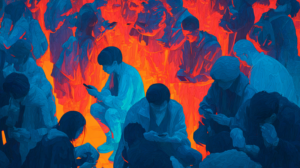
In his “Postscript on the Societies of Control” (1990), Gilles Deleuze took up Foucault to imagine, with Félix Guattari, a city in which everyone could move about thanks to their electronic card, with days or hours when the card would be refused; what matters is not the barrier but the computer that signals the position, licit or illicit, and produces a universal modulation. That card is today the personal smartphone, through which the apparatus of control of the state — or of the corporation that comes to supplant it — is informed of all our movements, choices and thoughts.
The most complete copy of Lang and Von Harbou’s vision appeared in an archive in Buenos Aires in 2008. It had been there for decades, intact and unknown, while the world watched the mutilated version Paramount had considered sufficient. There is something exact in that image: archives preserve what the market deemed dispensable. The question is not whether Metropolis was ahead of its time. The question is why we keep responding in the same way. Why, even, do we no longer respond at all?
G.S. & M.D.
Sources
- Metropolis (1927 film), Wikipedia, 2025
- Thea von Harbou, Wikipedia, 2025
- “AI market projected to hit $4.8 trillion by 2033”, UNCTAD, April 2024
- Kracauer, Siegfried, From Caligari to Hitler, Princeton University Press, 1947
- Eisner, Lotte H., The Haunted Screen, University of California Press, 1969
- Deleuze, Gilles, Negotiations, Columbia University Press, 1990
- Carnegie Endowment for International Peace, AI Global Surveillance Index, 2023