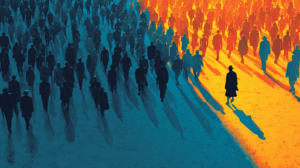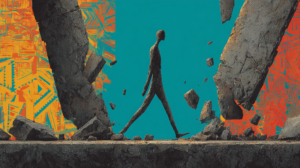
Colombia arrives at the consultation without having made an appointment. That already says something. A country that for six decades produced one of the most sustained accumulations of violence in the Western hemisphere, and that nevertheless maintains a capacity for celebration that disconcerts those who try to reduce it to its statistics, deserves to be read with other tools. Not those of conflict journalism or the humanitarian report, but those of the clinic, understood as a discipline of systematic observation. This essay applies the therapeutic device as an analytical framework, not as decorative metaphor. Colombia presents recognisable symptoms. Complex trauma, compensatory narcissism, functional dissociation, interrupted mourning. The question is not whether the diagnosis is fair, but what it reveals about a country that learnt to smile before learning to speak of its dead.
The First Session
The first impression is always the same. It arrives late, smells good, and the smile it brings is so resolute that one understands immediately that the unpunctuality is not an oversight but a doctrine. Colombia has known this for centuries.
It talks a great deal. It talks with a facility for narrative that in another context would be admirable, and that here, in this closed room with a box of tissues on the table, becomes immediately suspicious. Verbal fluency as shield, humour as firebreak, anecdote as trench. The therapist notes without stating it, and what he writes is more interesting than what the patient has said. Careful presentation. Marked need to please from the first contact. Possible avoidance of discomfort through peripheral charm. But that would be getting ahead of oneself. One must listen first.
“Well, you see,” says Colombia, settling into the chair with that particular energy of peoples accustomed to reinventing themselves, “I think I come because I have some problems with people. With people from outside, basically. They don’t understand me. For decades they haven’t understood me and frankly I’m tired of it.” The therapist nods and writes what he does not say. It presents as a relational problem what is probably an identity problem. Classic.
The Trauma That Has No Name
There is a clinical category that modern manuals call complex trauma, which is distinguished from simple trauma in that there is no single event to explain it but rather a chronic accumulation of events that together produce a deep deformation of one’s perception of the world and of oneself. Colombia presents this with an almost didactic precision. Sixty years of internal armed conflict, not one war but several overlapping wars that fed on each other with an almost biological logic, like fungi on a damp substrate. Guerrillas, paramilitaries, drug trafficking, the State. And beneath all of that, older than all of that, the original violence: the conquest, the colony, slavery, the systematic extraction of resources that left behind not an economy but an anatomy of dispossession.
The problem with complex trauma is that when it lasts long enough it stops being perceived as trauma. It becomes climate. And climate is not something one therapises. Climate simply is. Violence, for Colombia, is the constant backdrop against which everything else has developed: music, literature, religiosity, the architecture of affection. García Márquez did not invent magical realism. He simply transcribed the reality of a place where the extraordinary occurred with such frequency that it had lost its extraordinary character.
KEY FACT
The Truth Commission documented in its 2022 final report a total of 450,664 people killed in the armed conflict between 1985 and 2018, 121,768 enforced disappearances and more than 7.7 million internally displaced persons, making Colombia the country with the largest internal displacement in the world for more than a decade.
Joy as Pathology
There is something disturbing, in the clinical sense, about Colombia’s capacity for celebration. Not in any sinister sense, but in the sense that it does not fit, does not square with any available model. A country that has produced such a quantity of death and pain should not have that Carnaval de Barranquilla. It should not have that salsa in Cali. It should not have that capacity to organise parties in any circumstance and on any pretext, including pretexts that in other countries would be occasions for mourning. Psychologists have a name for this. They call it defensive joy, and it consists of the development of an extraordinary capacity for pleasure as a protection mechanism against pain that cannot be processed directly.
The party, in Colombia, is not frivolity. It is popular psychiatry. It is the only way an entire people found to avoid going completely mad under the weight of what it had been given to live through. Dancing until dawn is a way of not thinking, and thinking, under certain historical conditions, would be intolerable. Whoever judges this as superficiality simply has not understood anything, or has had the luck to live in a place where pain arrived in doses small enough to be processed through the ordinary channels of the individual psyche. Colombia’s joy is not a negation of suffering. It is its alchemical transformation.
The Narcissism of Geography
Colombia has a relationship with its own territory that borders on fixation. In the sessions it returns to it compulsively. The only country in the world with two oceans. The greatest biodiversity per square kilometre on the planet. The finest coffee. The emeralds. The flowers, especially the flowers — Colombia exports flowers to the world as though it needed to send a physical, constant proof that life here is possible, that something beautiful can grow in this soil. This has a clinical name. It is called compensatory narcissism, and it appears typically in subjects who have suffered a significant narcissistic wound and who develop in response a hypervaluation of certain peripheral attributes that allow them to sustain a self-esteem that would otherwise collapse.
Colombia was for decades the global synonym for cocaine and danger. Pablo Escobar was not only a criminal but a narrative that installed itself in the global imagination with the persistence of a virus and displaced everything else. Being Colombian abroad during the 1990s meant being suspect by default, explaining oneself, justifying oneself, demonstrating that one was not what the other had already decided one was.
From that wound arose a national redemption project that at some point became obsessive. Shakira. James Rodríguez. Nairo Quintana. García Márquez’s Nobel. Every Colombian who succeeds abroad is celebrated with disproportionate intensity, because what is being celebrated is an entire narrative of collective vindication. The wound of the stereotype does not heal with time. It scars, which is different. And beneath the scar the tissue remains fragile.
Authority and Foreign Capital
Colombia’s relationship with state authority is that of a child with a father who is simultaneously protective and abusive, present and absent, a source of law and a source of arbitrariness. When the therapist asks about the father, in the twelfth session, there is neither hostility nor idealisation, but the affective pragmatism of one who has learnt not to expect too much without having been able to eliminate the expectation entirely.
The Colombian state never finished reaching the entire territory. There are regions where it was for decades an abstraction, a rumour, an unkept promise. In that absence other authorities grew — the guerrilla, paramilitarism, drug trafficking — illegitimate but present structures that imposed an order of fear. What international reports call institutional voids was, strictly speaking, a historical decision to concentrate the state in urban centres and economic corridors, leaving the rest of the territory in the hands of those who knew how to capitalise on it.
That geometry was not accidental. Plan Colombia, launched in 2000 with Washington funding that would exceed ten billion dollars over two decades, militarised the territory without resolving the absence of the state. It cleared corridors for foreign investment, protected mining and oil concessions, and left intact the economic structure that produces violence. The psychological result of this history is a deep distrust of any form of institutional authority, combined with a constant demand that that authority function. The combination is the hallmark of one who has been deceived in a sufficiently systematic way to be unable to trust, but sufficiently intermittently to be unable to abandon hope.
Memory and Its Economy
Colombia forgets with a speed that alarms foreigners and that Colombians describe, when it is pointed out to them, as resilience. The nuance matters. Resilience processes adversity; forgetting suppresses it. These are distinct mechanisms with distinct effects. And what is avoided does not disappear; it accumulates without label, without narrative, available to be activated by the first stimulus that encounters it.
Colombia has a Truth Commission. It has a National Centre for Historical Memory. It has a peace agreement signed in 2016 after four years of negotiations in Havana. All of that exists and is real and significant. And yet the country continues to process its history with the same ambivalence as always: wanting to know and not wanting to know, wanting to remember and wanting to forget, demanding the truth and fearing what the truth will reveal.
This is not hypocrisy. It is the exactly predictable behaviour of a subject carrying a trauma so large that direct exposure to it is unbearable, but whose continued suppression is also, in the long run, unsustainable. The therapist notes in the final session that the patient has begun to speak of its dead. Not of the statistics. Of the dead as people, with names, with stories. This is new. It is, probably, the only real way in which something can begin to change.
KEY FACT
The American banana company Chiquita Brands admitted in 2007 before the United States justice system to having funded the Autodefensas Unidas de Colombia with at least 1.7 million dollars between 1997 and 2004. This was a procedural exception within a system of structural collusion that involved companies in the mining-energy, cattle-ranching and oil-palm sectors across more than a dozen departments for decades.
Prognosis
Prognoses in therapy are a form of pious lie. Nobody knows what is going to happen. Human systems are non-linear, capable of producing transformations no model predicted, arising from disturbances that seemed minor. Colombia has also always been unpredictable. It has surprised downwards, with depths of violence nobody had foreseen, and it has surprised upwards, with moments of collective lucidity, of civil mobilisation, of political tenderness that seemed impossible within the same system that produced them.
What the therapist can say is this: the patient is alive. After everything it has gone through, the patient is alive and has the habit of continuing. It has a vitality that is not exactly joy but a will to exist more resistant than all the forces that have organised themselves to extinguish it. The working diagnosis is as follows: complex post-traumatic stress disorder with compensatory narcissistic traits, consolidated functional dissociation and a national mourning process in its early stage. Extraordinary creative capacity. Unextinguished vitality. Guarded prognosis, with favourable elements. The patient did not come to the next appointment. It sent a message saying it was fine, that life was improving. The therapist kept the message. He knew it would come back…
G.S.
Sources
- Truth Commission, Hay futuro si hay verdad, Final Report, Colombia, 2022
- National Centre for Historical Memory, ¡Basta ya! Colombia: memorias de guerra y dignidad, Bogotá, 2013
- Judith Herman, Trauma and Recovery, Basic Books, New York, 1992
- Winifred Tate, Drugs, Thugs, and Diplomats: U.S. Policymaking in Colombia, Stanford University Press, 2015
- UARIV, Unique Victims Registry, Colombia, 2024
- U.S. Department of Justice, United States v. Chiquita Brands International, Washington, 2007