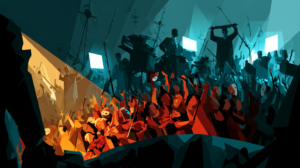
Since the end of September, thousands of French teenagers have been blockading their lycées (French secondary schools) to demand teachers, buildings fit to sit in and a school that does not fall apart in their hands. The government has answered with more than five thousand arrests since Monday 28 September, about 85 per cent of them of minors according to its own interior minister, and Mediapart counts in addition more than two thousand periods of police custody (the gardes à vue, twenty-four hours of detention, renewable) whose subjects are, overwhelmingly, minors. At the same time, the 2027 education budget raises its overall envelope and abolishes teaching posts. That contrast is a form of government. I argue here, as a reading of my own, that the right hand of the state, the hand of accounts and of order, answers with arrests a conflict it has itself sown in the left hand, the hand of schooling and social services, and that the vocabulary used to describe the movement serves to spare everyone from looking at the second.
A school run on the way down
The mobilisation starts from leaking ceilings, classrooms without a teacher and a feeling that is hard to rebut with a press conference, the feeling that French public education is being managed for decline. The blockades have spread from lycées in the Paris suburbs to Lille and Rouen, and Mediapart even describes a rural lycée in Seine-Maritime, at Yvetot, that joined without disorder and under the tolerant gaze of teachers and gendarmes.
Two clarifications correct the story circulating on social media. The movement is lycéen in origin, meaning it began among secondary pupils, and university students joined only later, on Thursday 1 October, after blockading some campuses, according to Mediapart. Firefighters went on strike on 29 September as part of a public-sector day of action against the budget, according to France 24’s live coverage, but I have found no source attesting to joint action with the pupils. The two struggles target the same budget and cross on the calendar, nothing more.
More than 160 lycées in Île-de-France are closed on Monday 5 October, over a third of the region’s schools. (Mediapart, news feed, 4 October 2026)
On 1 October the education minister, Édouard Geffray, presented his department’s budget for 2027. A comment published on Mediapart’s blog platform by François Jarraud sums up the paradox in a line, one billion euros more and 3,644 teachers fewer. The Café pédagogique, an outlet specialising in education, speaks instead of 1,588 posts cut. The two figures may measure different perimeters, teachers in one case and posts in general in the other, and I could not reconcile them with the text of the bill, which is why I set them side by side, with their origin. Both confirm the direction, the envelope rises while the number of adults in front of classes falls.
Mediapart’s analysis of the general 2027 budget places that cut within an overall strategy. To reduce the deficit in a slowing economy, the executive cuts first in the state, in social security and in local authorities.
Five thousand arrests in a week
The political response comes in two stages. In the first, measures are announced, mostly security measures, while the education minister strings together emergency meetings to put out the fire before Tuesday 6’s day of mobilisation, according to Mediapart. In the second, the interior minister, Laurent Nuñez, rejects any disproportionate intervention, says police act proportionately under the control of their command, calls the accusations serious and unfounded and announces five investigations opened by the national police inspectorate (the IGPN, the internal oversight body), according to Sud Radio.
More than 5,000 people have been arrested since Monday 28 September, about 85 per cent of them minors, and more than 1,700 on Friday alone, according to the interior minister, Laurent Nuñez. (Sud Radio, October 2026)
The figure comes from the government, which is why it is useful, since no one can accuse the minister of exaggerating it against himself. Amnesty International France accompanies it with a daily series that shows the escalation, 164 arrests on 28 September, 440 on the 29th, 625 on the 30th and 1,948 on 1 October. An arrest is not a conviction, and the same word can cover very different situations, from an identity check to police custody with a search and a cell. Mediapart specifies that more than two thousand people, overwhelmingly minors, have gone through the latter. That more than eight in ten of those held are minors defines the operation.
In their investigation of this custody, Inès Bennacer and Pierre Jequier-Zalc collect accounts from teenagers who describe violent conditions. The only extract available free is that of Ethan, fifteen, a pupil at a vocational lycée in Saint-Denis, who recounts for an hour the twenty-four hours spent at the police station after a blockade. The rest sits behind a paywall and I have not read it.
There are other cases, of unequal weight. A twenty-one-year-old cyclist files a complaint in Nîmes against police officers who, according to the account gathered by Mediapart, ordered him to leave and tried to stop him filming after a blow received on the margins of a blockade. Amnesty International France also documents the case of a fourteen-year-old girl whom an officer allegedly seized violently by the neck in Alençon on 29 September. In both cases these are accounts that the authorities have neither confirmed nor denied, as far as I have been able to read.
The other side of the file exists and must appear. France 24 headlines on 2 October that, in the face of the disorder, the policing of order is in question, and franceinfo reports fires, mortars and damage, as well as an investigation opened after the filmed assault on a policewoman in Paris. These facts belong to the picture and I do not dispute them.
An injury to the face of a fourteen-year-old boy
The case that concentrates the gravity is that of Saint-Ouen-l’Aumône, in the Val-d’Oise. According to Amnesty International France, on 28 September a police officer fired a grenade launcher at close range at a fourteen-year-old boy and hit him in the face, injuring the jaw, knocking out several teeth and putting him in hospital. The Défenseur des droits (an independent institution that, among other functions, oversees police conduct) has taken up the case, according to franceinfo’s headline of 2 October. Amnesty’s note does not specify the model of the weapon. A thread posted on X by an author I could not identify with certainty speaks of a Cougar grenade launcher and a shot from under two metres, a detail that no official or press source has confirmed to me and that I therefore treat as an indication and not as a fact.
What the weapon was matters. The LBD, the 40-millimetre defence ball launcher, fires rubber projectiles. The Cougar is designed to throw gas grenades at a distance. No source I have been able to read establishes which of the two, or whether another, wounded the boy, and the difference counts, because each refers to a different rule of use.
Amnesty also reports the case of a Tours lycée pupil seriously injured in the eye on 30 September, presumably by an intermediate-force weapon. Other publications, anonymous or militant, speak of loss of sight and of an LBD, and the prosecutor, cautiously, speaks of compatible injuries. The weapon is not established, and to write LBD at this point would be to claim more than is known.
The most widely shared videos call for a different caution. One shows in Reims a masked man, dressed as a rioter, throwing a glass bottle and fleeing the camera, and it is from this that the accusation that he is a plainclothes police officer has spread. Entrevue, which examined the footage, notes that no official source has identified the man. I do not say it is false, I say that no one has proved it to date, and that a text meant to last does not write in the indicative what is merely plausible. The same goes for the twenty-four lycées trashed or burned that RTS headlines, a figure I could not read in its source.
The left hand and the right hand of the state
Pierre Bourdieu distinguished two hands in the state, the right, that of the ministries of order and money, and the left, that of the social trades, school, health, housing, which the first disowns in the name of balance. Loïc Wacquant, a sociologist close to Bourdieu, later described how the cutting of social assistance comes with an extension of the penal apparatus over the populations that assistance has ceased to support. Neither speaks of France in 2026, but the scheme fits, in my reading, with an uncomfortable exactness what is happening this week. The budgetary arbitration, which is the business of the right hand of accounts, removes posts from schools, and the left hand, that of the education minister, carries out that account and receives the conflict. When the conflict erupts, another branch of the right hand, that of order, deals with the result by way of police custody.
What the vocabulary adds is the alibi. According to franceinfo, the government evokes a manoeuvre organised by La France insoumise, an imputation that the leader of that party, Manuel Bompard, denounces as a conspiratorial drift. Mediapart analyses this reading of a manipulated youth as a very old reflex, and publishes in its blog section a piece on how the words violence, manipulation or disorder depoliticise the pupils’ demands. I do not arbitrate that exchange, because its verdict does not change the analysis. I note that when the official diagnosis of a movement for teachers is a party manoeuvre, the need for teachers is adjourned, and I suspect that this adjournment is the function of that discourse and not a side effect.
This is a reading, not an established fact, and the mechanism it suggests is simple. A population with no vote, minors, expresses by the only route within its reach, the blockade, a demand about a public service that the state is reducing. The state, which holds the monopoly of force and of custody, answers with force and custody and leaves the demand without a reply. None of this requires bad faith. It is enough to have an administration with one effective tool, the police, and another that costs money, the teaching staff, and which, I believe, picks the first out of calendar convenience. There is a serious objection and I acknowledge it. The disorder has happened, there are documented fires, an adult throwing projectiles in a video and injured police officers. To claim that the state represses an innocent youth would be an error of fact and a poverty of analysis. But the objection does not answer the underlying question, which is not whether there was violence, but why the answer to the lycées as a whole was to arrest more than five thousand people in a week, more than eight in ten of them minors, while the political answer remained a cycle of meetings.
Several facts remain to be established, and my argument does not replace them. I do not know how many police officers have been injured, since the figures I have found range between 83 and 305. No source I have been able to read identifies the weapon that wounded the boy at Saint-Ouen-l’Aumône, and neither the Défenseur des droits’ decision nor the outcome of the IGPN investigations is available. The exact content of the custody of minors remains in the hands of the proceedings and the juvenile courts, and the definitive number of teaching posts remains to be fixed in the finance bill. All of this will say whether this reading holds. These pages are an essay and not an investigation, and I have not yet obtained the Interior Ministry’s version on these points.
What I can write without waiting is the oldest thing in this affair. In a country that prides itself on making public school its social pact, pupils ask for teachers and receive police custody, and the pact, as it is applied, seems to say that school is a service until someone asks for it out loud…
G.S.
Sources
- Mediapart, home page and news feed of 4 October 2026
- Mediapart, 48 heures d’enfer, à leur sortie de garde à vue, des lycéens traumatisés
- Mediapart, Un maintien de l’ordre brutal répond à la mobilisation lycéenne
- Mediapart, La mobilisation lycéenne prend une ampleur nationale
- Mediapart, Le gouvernement cherche une improbable réponse politique
- Mediapart, Le pouvoir tente d’éloigner les lycéens des lycées
- Mediapart, À Nîmes, un cycliste porte plainte contre des policiers
- Mediapart, Budget 2027, l’exécutif cible encore l’État, la Sécurité sociale et les collectivités
- François Jarraud, Un milliard en plus au budget 2027, 3 644 professeurs en moins
- Amnesty International France, Mouvement lycéen, des mineurs face à la répression des forces de l’ordre
- franceinfo, Le Défenseur des droits se saisit de la blessure d’un jeune lors du blocage des lycées
- franceinfo, Une enquête ouverte après l’agression filmée d’une policière à Paris
- franceinfo, Mobilisation lycéenne, la mobilisation dégénère
- franceinfo, Direct, le gouvernement évoque une manœuvre organisée par LFI
- France 24, Mobilisation lycéenne, face aux débordements, le maintien de l’ordre en question
- France 24, Direct du 29 septembre, mobilisation dans la fonction publique, grève des pompiers
- Sud Radio, Blocages des lycées, Nuñez réfute toute intervention disproportionnée
- Café pédagogique, Budget de l’éducation 2027, 1 588 suppressions de postes
- Entrevue, Mobilisation des lycéens, un adulte lance un projectile, la rumeur d’un policier en civil enfle
- RTS, France, 24 lycées saccagés ou incendiés pendant le blocus
- Pierre Bourdieu, Contre-feux, Raisons d’agir, 1998 (interview The left hand and the right hand of the state)
- Loïc Wacquant, Punir les pauvres, Agone, 2004