I am not going to repeat what is already known. Colombia has spent a month reading the same file in every outlet, the same paramilitary lawyer turned president, the same foundation run by the first lady administering earthquake aid, the same congratulations from Washington and Jerusalem. The facts are already published, discussed, forgotten almost as fast as they were published. Repeating them adds nothing. What I want to write today is something else.
I am going to use a word that much of the Colombian press avoids out of caution, and that I do not intend to avoid. This is a fascist government.
I do not say it as an insult. I say it as a diagnosis.
Cult of the strongman. Nostalgia for paramilitarism, confessed on a podcast, without anyone needing to draw it out of him. The press turned into an enemy to be sued, the transitional justice system that upholds the memory of the conflict now in the crosshairs to be dismantled, the country’s sovereignty handed over by its own decision to a foreign power. His government programme also proposes withdrawing Colombia from the Inter-American Court of Human Rights and reproducing here the mega-prisons Nayib Bukele built in El Salvador by suspending basic judicial guarantees. That has a name in twentieth-century history. That name does not change because in 2026 it is pronounced in Spanish and in Bogotá, rather than in Italian and in Rome.
That phrase, the press turned into an enemy to be sued, is not a figure of speech, it is a file with a date and a signature. Between 2008 and 2019, De la Espriella filed a hundred and nine lawsuits for slander and libel against journalists, most of them shelved without conviction, catalogued as judicial harassment by the Foundation for Press Freedom. In 2026, once elected, the Inter American Press Association warned of the same pattern. A judge forced him to apologise publicly after he showed photographs of his own genitals to a journalist in the middle of an interview, this past May. An outlet that depends on this government’s goodwill to keep operating can hardly write about it with the freedom its history demands. AcidReport does not depend on that goodwill, and that material independence, not conviction alone, is what allows the word fascist to be written without asking permission to do so.
That said, the word is no longer what is urgent. What is urgent is what to do with the exhaustion of those who hear it.
Fascism, in any of its historical versions, never won by the strength of its battalions alone. It won because it convinced millions of reasonable people that it was no longer worth paying attention. Hannah Arendt, after studying Hitlerism and Stalinism, reached an uncomfortable conclusion, the ground totalitarianism needs is not the conviction of the masses, it is their loneliness.
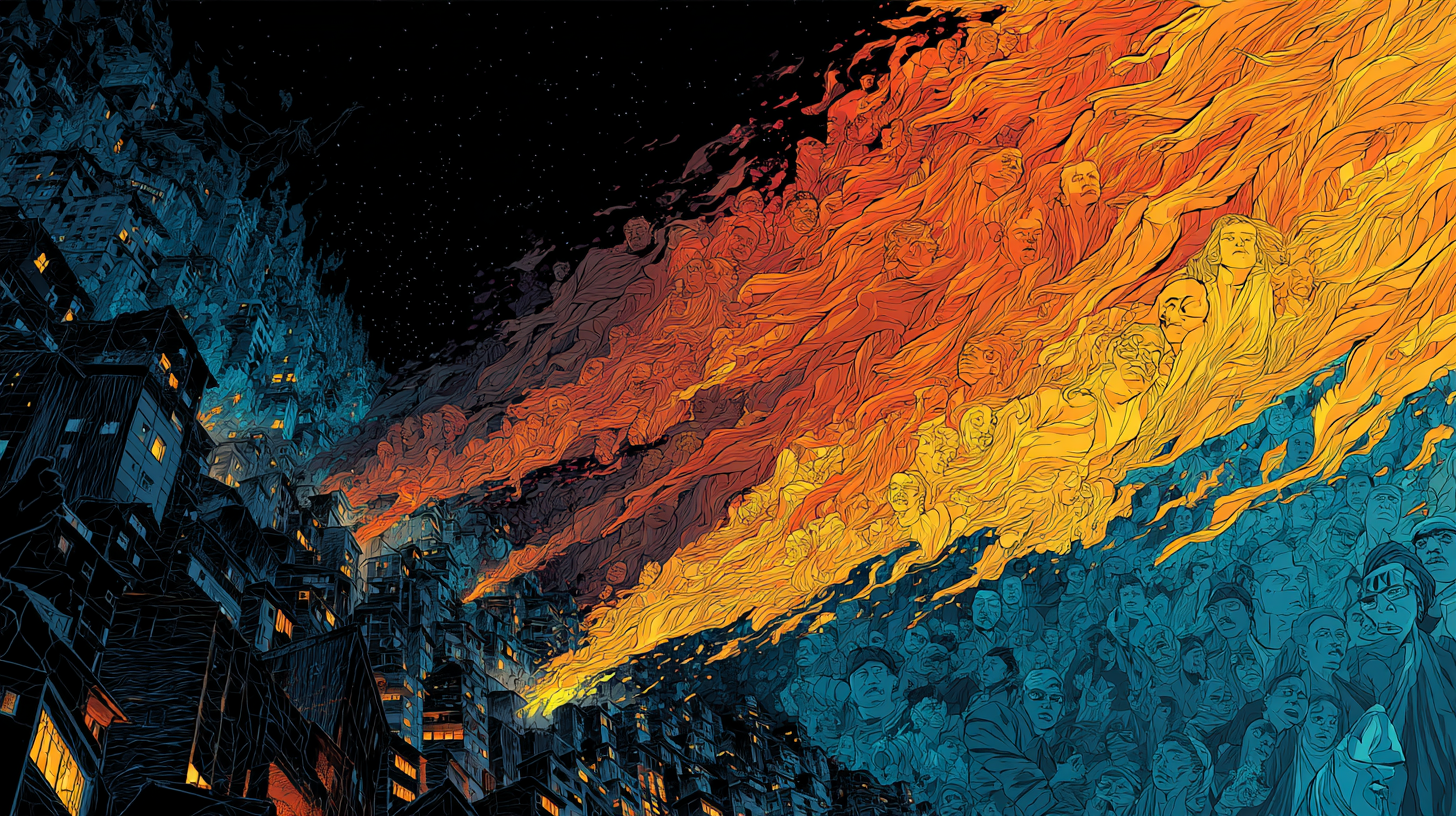
Someone, tonight, somewhere in Colombia, is going to close a tab carrying more news about this government, is going to switch off their phone, and is going to think what does it matter anyway, it makes no difference. They do not know that at that very moment other people are doing exactly the same thing, for the same reason, with the exact same feeling of being alone. That mutual not-knowing, not censorship, not propaganda, is the victory this kind of power needs in order to govern without resistance.
That despair, when it appears, is not a weakness in whoever feels it. It is precisely the result this power is designed to produce. Refusing it is a political act. Not cheap comfort.
I am not going to promise this ends soon, or that it ends well. That would be lying, and that lie, the one about optimism manufactured to sell hope, is just as unworthy as the propaganda it claims to fight. What I do maintain, because Colombian history demonstrates it with an almost cruel insistence, is that no power that needs to lie about its own origin survives intact over time. Colombia has already buried projects once believed eternal, some armed, others dressed in electoral legality. It buried them not with a single heroic gesture, but through the stubborn accumulation of those who kept calling things by their name when naming them came at a cost. The JEP this government wants to dismantle exists precisely because others, before, refused to let impunity become routine.
The parapolitics scandal that a decade ago sent dozens of congressmen to prison was not uncovered by a leaked document in a single afternoon. It was built lawsuit after lawsuit, article after article, over years, against the same contempt now once again being called noise, tabloid press, the resentment of those who lost, from the presidency itself. In February 2025, Salvatore Mancuso himself, the friend De la Espriella publicly claimed in 2008, testified before the JEP about the paramilitary violence his structure carried out in Córdoba and Urabá, the very region where the two men met. Argentina and Chile reached the same conclusion by another road, truth commissions that took years to produce a single report, Nunca Más, Rettig, without undoing the harm already done, but ensuring the official history of those years could no longer be told without the other version also being on record. Naming precisely what a power did, even too late, even without proportionate punishment, changes what that power can go on doing with impunity afterward. That is the wager, modest and already proven on two continents, behind every article this paper publishes.
The same mechanism explains what happened after the earthquake of August 10th. Aid for the victims was not channelled solely through the public risk-management system, built over decades with precise protocols so that no single official decides alone who receives what. Part of it passed through Un Solo Corazón, the private foundation of first lady Ana Lucía Pineda, created barely weeks before the campaign. There is no need to prove intent to understand the mechanism. A government that personalises the state does not do so only in its speeches, it does so too, with graver consequences, in the circuit through which a disaster’s money ends up flowing.
The hope available, then, is not that someone else will solve it. It is more modest and harder than that, the hope that exact memory, held up between several people, keeps being a place power cannot fully enter. Every confirmation between two people of what both of them saw, every refusal to let exhaustion disguise itself as common sense, takes from fascism the one ground on which it can truly win. That takes no heroism. It takes, only, continuing to pay attention when everything pushes toward stopping.
I know what it means, in practical terms, to write this. A government that has already sued a hundred and nine journalists does not need to invent a new reason to sue the hundred and tenth. I write it anyway, not out of courage, but because the alternative, staying silent until silence turns into prudence and then into habit, is exactly the outcome this text set out to name from its first line.
I founded this outlet with that conviction before this government existed, and I hold to it now with more reason, not less. Dissolving lies, one truth at a time, was never a promise of quick victory. It is a discipline, and disciplines are not abandoned because the adversary changes its name. I am still here. Whoever is reading this is still here too. Someone who writes and someone who has not stopped reading, both refusing to forget the same thing at the same time, is more than this government can afford to ignore…
G.S.
Updated September 2, 2026