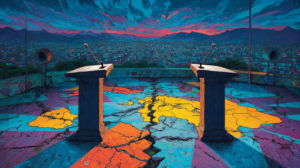
On Sunday 13 September, at eight in the evening, President Abelardo de la Espriella sat before the cameras to give an account of his first weeks in office. He spoke of public finances, of security, of the reconstruction of Chocó after August’s earthquake. And he spoke of public universities. Two days earlier, on 11 September, a protest near the Universidad Nacional and the Universidad Distrital had left graffiti across TransMilenio stations, damaged security cameras, more than a hundred thousand affected commuters and hooded protesters vandalising buses along the central calle 26. The president announced a national protocol allowing the police to enter campuses whenever there are “extraordinary disturbances of public order”. He said peaceful protest would be respected. And he closed with this.
“University autonomy is not a licence for impunity, and I will come after you, even if it means entering the universities to drag you out and make you pay.” (Presidential address, 13 September 2026)
The line drew immediate support from government circles. Senator Sara Castellanos, of the Salvación Nacional party, said university autonomy can never become immunity for vandalism, destruction or terror. Former senator María Fernanda Cabal went further. She claimed communists “invented this so-called university autonomy to colonise and fill lecture halls with guerrillas, prostitution and small-time drug dealers”, and called for the riot police to go in and “throw out the degenerate layabouts stealing university places”. On the other side, Senator Iván Cepeda called the announcement an assault on university autonomy and argued it violates article 69 of the Constitution. The rector of the Universidad Nacional, José Ismael Peña, was more measured than either camp. He recalled, in an interview with La FM, that police “have always gone in” when a crime is caught in the act, without needing anyone’s permission, and that the real problem with the new protocol is not legal but practical. He explained that offenders hide among students, among onlookers, among the very design of the campuses, and that the actual solution lies in intelligence work, not policing. Nobody, however, disputed the underlying fact. That the debate over university autonomy in Colombia is no longer hypothetical. And that, by the time the president spoke those words, the governing body of those universities already had new owners.
BEFORE THE PROTOCOL, HE HAD ALREADY GONE IN
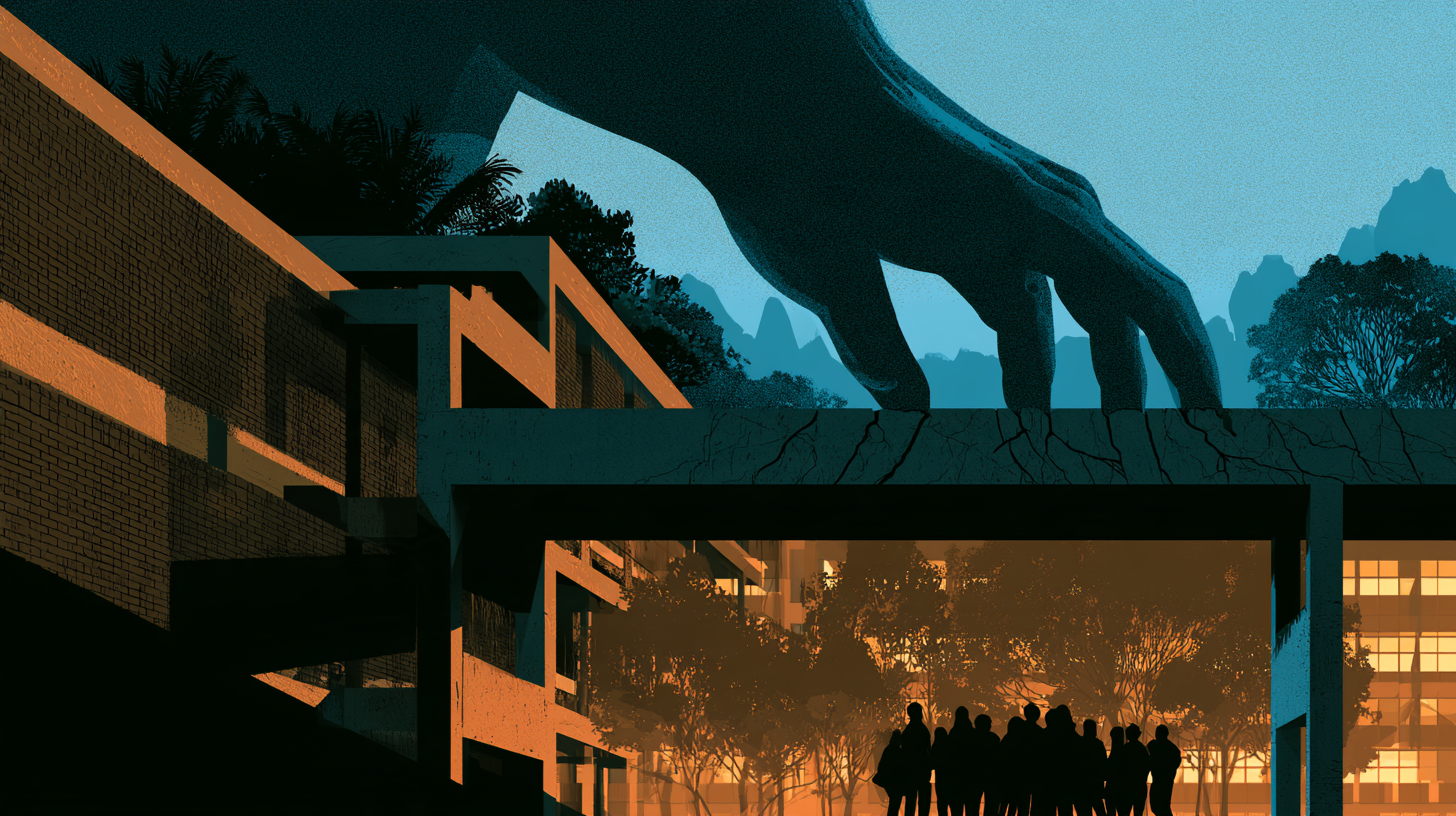
On 25 August, nineteen days before the address, the Ministry of Education signed Decree 1310 of 2026. The administrative act terminated, with immediate effect, the appointments the government of Gustavo Petro still held on the Consejos Superiores of 34 public higher education institutions, replacing them with new representatives of the incoming government. Those councils are the highest governing authority of each university. They decide the budget, decide the statutes, and hold a voice and a vote in electing the rector.
For the Universidad Nacional, one of the two representatives appointed was Rodolfo Andrés Londoño De La Espriella. He is a lawyer trained at the Javeriana, a priest, chaplain of the Casa de Nariño, and the president’s first cousin. The decree did not stop at a single seat. It also placed him on the governing councils of the Universidad Pedagógica Nacional, the Universidad de Antioquia, the Universidad del Valle and the Universidad del Atlántico. Five public universities, one surname. The other representative at the Nacional, nuclear physicist Diego Alejandro Torres Galindo, a graduate of that same university with postdoctoral stints in Scotland and at Rutgers, completes the handover.
None of this happened because of any disturbance of public order. It happened by decree, in August, weeks before a single piece of graffiti appeared on a TransMilenio station. Five days before the address, on Tuesday 8 September, the president signed another decree, the 1368, lifting the general suspension on firearm permits that had been in place since 2018 and extended through to the end of 2026. According to the government itself, the measure does not amount to unrestricted carrying, controls and requirements remain, and it points to its own figures, fifteen thousand seven hundred weapons seized between January and September, nine hundred and eighty linked to Farc dissidents, five hundred and fifty-one to the Clan del Golfo, three hundred and thirty-nine to the ELN. Five weeks into office, the pattern is not that of a government reacting to a specific public-order crisis. It is that of a government shifting, simultaneously and on several fronts, the limits of what had until now been suspended, prohibited or held by others.
WHAT THE CONSTITUTION SAYS
Article 69 of the 1991 Constitution states, in its opening line, that university autonomy is guaranteed. Universities may govern themselves and adopt their own statutes, in accordance with the law. It is one of the oldest and least contested guarantees in the Colombian legal order.
The Constitutional Court has also repeatedly held that this autonomy is not absolute. In ruling C-829 of 2002, the Court stated that university autonomy finds its limit in public order, the general interest and the common good, and that no university can detach itself from a just social order by invoking its own charter. That is, almost word for word, the argument De la Espriella used on 13 September.
The problem is that this jurisprudential limit was conceived for a different scenario from the one produced by Decree 1310. The Court speaks of each university’s internal statutes, of its regulatory powers, of the relationship between those powers and public order when violence erupts inside a campus. It does not address, in any known ruling, the executive’s authority to replace its representatives on 34 governing councils in one stroke and install a direct relative of the president among them. That operation has nothing to do with public order. It has to do with who gets to sit and vote on the budget and elect the rector. The constitutional limit the government invokes in public is real. The ground on which it has already acted is not the ground that limit covers.
COLOMBIA HAS TOLD THIS STORY BEFORE
On 7 June 1929, a police bullet killed student Gonzalo Bravo Pérez, from Pasto, during a protest against the appointment of a police chief who had directed the repression of the banana massacre. Since then, 8 and 9 June have been commemorated in Colombia as the Day of the Fallen Student.
Twenty-five years later, almost to the day, history repeated itself, this time under a dictatorship. On 8 June 1954, under the regime of Gustavo Rojas Pinilla, a policeman opened fire on a group of students playing football near the Ciudad Universitaria and killed Uriel Gutiérrez. More than ten thousand students marched on the Palacio de Nariño the very next day, with the dictator’s own permission. The Batallón Colombia, freshly returned from the Korean War, blocked their path and opened fire on the crowd. At least nine more students died.
Thirty years later, this time under democracy, it happened again. In the early 1980s, students at the Universidad Nacional had reclaimed, building by building, the student residences the university itself had shut down in 1976 after a clash with police. After years of occupation and negotiation, the residences formally reopened in April 1984. Two of the negotiators who made that reopening possible were murdered weeks later. Jesús “Chucho” León, president of Cooperación Estudiantil, was abducted, his body found on 9 May. Medical professor Luis Armando Muñoz was killed on 14 May. The tribute to “Chucho” León, called for 16 May in the Plaza Che, turned into a protest, and the security forces entered the university. Elizabeth Díaz, a student at the time, survived what she witnessed.
“On 16 May they came into the residences, broke down doors, dragged the girls out of the residences, put M-19 hoods on them, put weapons on them, and they turned up in the newspapers.” (Testimony gathered by the Unit for Victims)
The residences were shut down once more. The last students were evicted on 10 June that year. Forty years on, the Colombian state has still not fully clarified what happened that May afternoon.
Three moments, three kinds of government. The conservative hegemony of 1929, the military dictatorship of 1954, the constitutional democracy of 1984. In all three, the security forces entered a university or opened fire on students defending it. The regime changes. The outcome, inside the campus, repeats itself.
A SCRIPT REPEATED AROUND THE WORLD
On 8 October 1931, a decree issued under Benito Mussolini’s regime forced every university professor in Italy to swear an oath of loyalty to fascism. Of more than 1,200 professors, only twelve refused. All twelve were dismissed on the spot, among them mathematician Vito Volterra, jurist Francesco Ruffini and historian Gaetano De Sanctis.
Germany followed the same path from 1933 onward. The Nazi regime expelled Jewish professors and anyone it regarded as a political opponent from the universities, part of the institutional process of forced coordination its own propaganda called Gleichschaltung. Thousands of academics, Albert Einstein among them, left the country or were dismissed from their posts before that first wave had even ended.
Once the Spanish Civil War ended in 1939, Franco’s regime subjected higher education to a systematic purge of professors and imposed National Catholic doctrine as the backbone of the new educational system. Universities stopped appointing their own academic authorities, the state appointed them instead.
Barely had the coup of 11 September 1973 taken place, a date that carries an uncomfortable calendar coincidence with this article, when Augusto Pinochet’s military junta issued Decree-Law 50, replacing the elected rectors of every Chilean university with delegated rectors, retired generals and colonels of the armed forces. Thousands of dismissals of professors and students accused of ties to the left followed.
In Argentina, the dictatorship of Jorge Rafael Videla, installed in March 1976, intervened in public universities in much the same way, censored academic content and persecuted students and lecturers deemed subversive. The final count of those disappeared with ties to university life remains, four decades on, still not fully settled.
Five countries, five decades, a single common concern, repeated with almost no variation in the script. Who controls what is taught, researched and debated inside a public university.
On 13 September, when President Abelardo de la Espriella said he would come after students even inside the universities to drag them out, a priest named De la Espriella already held a vote on five governing councils. A decree had already put firearms back on the streets. The rector of the university most singled out by the announcement answered him, without theatre, that police already went in whenever a crime was committed, and that the problem was never a legal one, only ever a practical one nobody in government seemed willing to name. Between 1929, 1954 and 1984, fifty-five years and three different regimes went by. Between Decree 1310 and the address of 13 September, just nineteen days. The protocol against the universities still does not exist on paper. The entry, in practice, has already happened…
A.B.