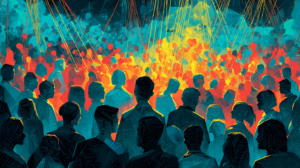
Nearly one in four people aged over fifteen reports feeling quite or very lonely, according to the study conducted by Meta and Gallup between 2022 and 2023 across 142 countries. The figure is staggering, but what is most revealing is who published it. The very company whose platforms have been documented as instruments of systematic isolation was the one that measured and diffused its scale. The diagnosis and the business coexist without apparent contradiction because, in reality, there is no contradiction. Contemporary loneliness is not the result of a cultural failure or a correctable technical fault; it is the most profitable production condition that digital capitalism has managed to scale globally, and what is called the “loneliness epidemic” is, above all, a revenue infrastructure.
The architecture of isolation
To understand how we arrived here, one must distinguish two concepts that Silicon Valley’s marketing departments have deliberately conflated for two decades. Engagement (attachment to the platform, measured in clicks, reactions and time spent) and belonging (the subjective experience of being part of something with other people) are not the same thing. Digital platforms sell the second but build the first. Not because their engineers did not know what they were doing, but precisely because they did.
Internal documents leaked by former Facebook employee Frances Haugen in 2021 and reviewed by a consortium of outlets including The Washington Post and NBC News revealed that the company held its own research on the effect of its algorithms on users’ wellbeing. Researchers knew that the news feed (the stream of posts each user sees upon opening the application), by prioritising content that generates the strongest emotional reactions, produced a cycle of overstimulation followed by emotional depletion. Users spent more time on the platform, but left it more divided and more depressed.
In April 2020, according to the leaked documents, a group of managers presented Mark Zuckerberg with a series of algorithmic adjustments to reduce these effects. Zuckerberg rejected the proposals because they represented a cost to the metrics of “meaningful social interactions”, which was the internal euphemism for engagement. The technical solution existed; the decision was not to apply it. There was no miscalculation or corporate negligence. The platform assessed the wellbeing of its users, calculated its value and discarded it.
This mechanism is not exclusive to Facebook; it is the logic of the entire industry. TikTok optimises for retention over interactions, meaning that high-performing content can generate little real emotional value whilst maximising screen time. Instagram privileges Reels over static posts because they keep users connected for longer, even though internal data documented in the Facebook Papers showed that Instagram generated negative feelings about body image in nearly a third of the teenage girls who used it. The architecture is consistent across every case; what is maximised is not user wellbeing but user availability.
“We know that many things that generate engagement on our platform leave users divided and depressed.” Written by an internal Facebook researcher, whose name was redacted in the documents transmitted to the United States Congress by Frances Haugen in 2021 and reviewed by a consortium of international news organisations.
The atomised user as commodity
The isolated individual is not simply a victim of the system. They are also its raw material. A user who is emotionally unstable, deprived of real support networks and dependent on digital validation presents an extraordinarily valuable advertising profile. They react more frequently, stay connected longer, are more susceptible to content that exploits their anxieties, and more predictable in their consumption patterns. Loneliness, translated into screen time, generates the data that feeds advertising segmentation models. Anxiety has a market rate. Isolation carries a price.
A former artificial intelligence researcher at Facebook, cited in MIT Technology Review’s report on Haugen’s testimony, stated that his team conducted “study after study” confirming the same conclusion. Models that maximise engagement increase polarisation, and this effect was measurable and reproducible. Researchers could track in real time how users became progressively more extreme in their positions as algorithms served them content calibrated to their indignation profile. Social fragmentation is not a side effect of the business model; it is its most efficient mechanism. A polarised user consults more, reacts more strongly, and generates more precise data on their specific vulnerabilities.
The subject produced by algorithmic fragmentation is reactive, volatile and difficult to organise in terms of sustained collective action. Not because they lack opinions, but because their opinions are calibrated for digital conflict rather than political negotiation or the construction of long-term power. The major mobilisations that social networks facilitated in the first half of the 2010s ended, for the most part, without durable organisational structures; the platform that had enabled them to be convened had no interest in their consolidating outside it. Demobilisation does not need batons when it has feeds.
The second market
The logic of capitalism in the face of the pathologies it generates is always the same. First produce them; then convert them into business opportunity. The loneliness epidemic was no exception. As digital platforms perfected their mechanisms of isolation, a second economic sector rapidly organised itself to offer connection at market price. What could not be prevented was sold as a service, and what was sold as a service generated a new class of dependency.
The consultancy Grand View Research estimates that the market for artificial intelligence virtual companions, that is, systems designed to simulate affective relationships and sustained conversation, will reach 141 billion dollars by 2030. The dating app market will reach 17 billion that same year. Digital mental health applications, which include subscription therapy, guided meditation and automated emotional tracking, were valued at 7.5 billion dollars in 2024 and are projected to exceed 21 billion by 2033.
The platform Character.ai, which allows users to build bonds with characters generated by artificial intelligence, recorded nearly 200 million visits in March 2025. The substitution is not metaphorical. It is contractual. The structure of this second market does not contradict the first; it completes it. Platforms that generate isolation sell advertising to companies offering substitute connection. Meta hosts the adverts for the dating applications that promise to remedy the loneliness Meta helps produce. The cycle is closed and precise; the company that manufactured the crisis collects a toll on the solutions. What is called the “wellness economy” is the after-sales service department of digital isolation.
According to consultancy Grand View Research, the global market for artificial intelligence virtual companions will reach 140.754 billion dollars by 2030. That same year, the dating platform market will total 17.28 billion dollars, and digital mental health applications will exceed 21 billion by 2033. The starting point is a documented crisis: nearly 1.4 billion people aged over fifteen feel quite or very lonely, according to the Meta-Gallup study conducted across 142 countries between 2022 and 2023.
What cannot be sold
The substitution of belonging by its market equivalents has a limit that virtual companions cannot cross, even if several investment funds are attempting to finance the attempt with nine-figure sums. Real belonging, the kind that generates social fabric and collective capacity, is not built through individual transactions or monthly subscription therapy sessions. It is built through processes of duration, conflict, negotiation and presence that platforms cannot directly monetise because they cannot control them. Human connection that produces no usable data is the one thing that digital capitalism has failed to process with efficiency.
The atomised individual this economy describes is not tragic in the romantic sense. They are functional. They consume more alone than in community. They make decisions more impulsively when deprived of social counterweight. They are more emotionally manageable when their support network has been replaced by algorithms that learn their fears. And they are politically neutralisable without direct repression, because fragmentation does the work that previously required other forms of control. There is no need to dissolve a collective organisation when its potential members spend four hours a day navigating between grievance and distraction.
Contemporary loneliness functions like every pathology manufactured by capital. It reproduces itself once the substitutes have replaced the original practice. Those who have spent years forming relationships mediated by platforms find it difficult to build belonging outside them. Social skill that goes unpractised atrophies, and the market that offers to replace it has a direct interest in that atrophy persisting. This is not a conspiracy but a convergence of incentives that requires no coordination to function with clockwork precision. Business models do not conspire; they simply optimise, and they always optimise towards what is profitable.
This industry produces loneliness on an industrial scale, measures it with statistical precision, and sells it across two distinct markets. First as attention; then as remedy. The mechanism is efficient, as all well-designed extraction mechanisms are. The only difference is that this one extracts neither minerals nor labour-time nor subsoil resources. It extracts the human capacity to not be alone…
G.S.
Sources
- Meta-Gallup State of Social Connections 2023
- The Facebook Papers · NBC News
- How Facebook’s algorithm works · The Washington Post
- Frances Haugen and Facebook’s algorithms · MIT Technology Review
- Attention Economy Market 2025–2033 · RealTimeDataStats
- Su soledad es nuestro negocio · El Emprendedor
- Loneliness in America 2025 · The Cigna Group
- Shoshana Zuboff, The Age of Surveillance Capitalism (PublicAffairs, 2019)