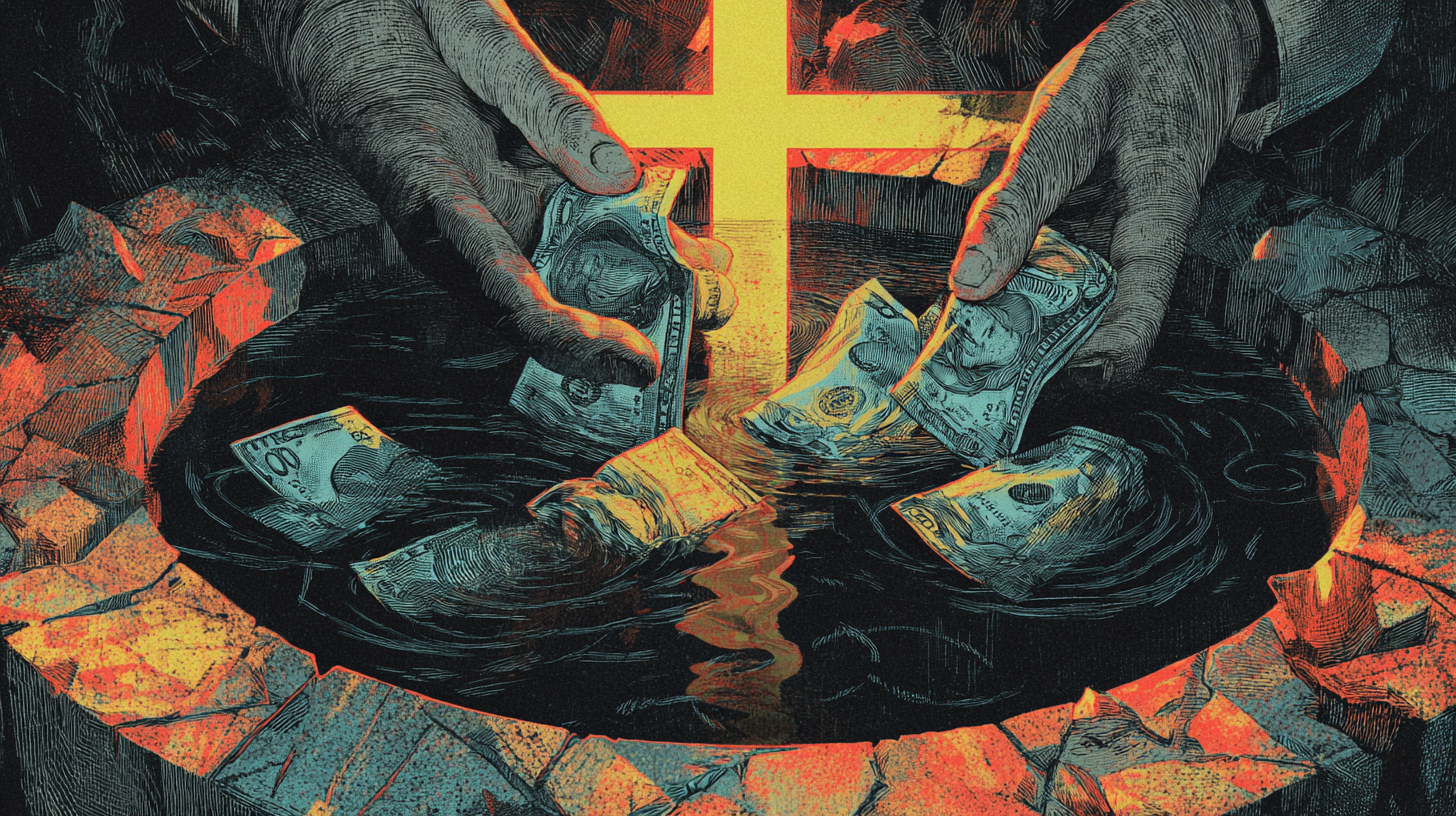
The mechanism is old, but the architecture has improved. Across Latin America, evangelical congregations and sectors of rural Catholicism have become nodes in three distinct networks that share the same infrastructure: the network of illicit money seeking legitimation, the network of votes seeking mobilisation, and the network of the faithful seeking salvation. All three converge every Sunday in the same hall, before the same microphone, under the same roof. That the funds financing that roof sometimes come from drug trafficking, that the pastor holding the microphone has negotiated his endorsement with presidential candidates, and that the parishioner dropping the tithe will also be the one casting the ballot — none of this is an anomaly. It is the system.
The Tithe as Financial Instrument
Religious congregations in Colombia, Guatemala, Mexico and Brazil operate under a regime of financial opacity that has no equivalent in any other legal sector of the economy. Colombia’s Law 133 of 1994 formally authorised churches to receive donations from individuals or legal entities without any obligation to report the origin of funds beyond certain thresholds. The tithe — which in evangelical practice amounts to ten percent of a member’s monthly income — enters the congregation’s patrimony as a voluntary donation. No invoice. No mandatory traceability. No prior oversight. Religious freedom has historically served as an effective legal shield against the financial controls that apply to any comparable business.
It is in this void that the logic of money laundering operates. The Clan Úsuga, a criminal organisation active in Chocó and Antioquia, used evangelical communities to funnel money into the formal financial system. Colombia’s Attorney General’s Office revealed that a pastor and a bishop were collecting funds from their congregants and mixing them with remittances sent abroad through a religious NGO. Álvaro Sarmiento, the office’s anti-organised crime coordinator, specified that the two clerics were gathering money that the clan then used to acquire assets in the Dominican Republic. The amount identified in that operation was approximately one billion Colombian pesos, around 420,000 dollars.
According to a cross-border investigation by the Latin American Centre for Investigative Journalism (CLIP), coordinated with eleven regional media outlets, Colombian prosecutors opened a preliminary inquiry in 2010 against the Church of God Ministerial of Jesus Christ International over a suspicious property transaction. The Financial Information and Analysis Unit (UIAF) flagged irregularities in the constitution of a term deposit certificate worth 180 million pesos. By 2020, the investigation had gone fourteen years without formal resolution, having passed through at least five different prosecutors.
The Church as Electoral Infrastructure
Narco financing through evangelical congregations does not stop at money laundering. There is a second product that criminal networks extract from that investment, one with an even higher market value across Latin America: the organised vote. A pastor leading a congregation of ten thousand people in a mid-sized city is not merely a spiritual leader. He is a political operator whose mobilisation capacity no traditional party can match at that price, because his congregants attend services two or three times a week, receive unified messaging and answer to a moral authority that requires neither salaries nor electoral machinery. From the standpoint of political engineering, it is the most efficient asset on the market.
In Guatemala, the case of pastor Carlos “Cash Luna” and the Casa de Dios Church illustrated the link between this religious infrastructure and political power. The church, with a temple costing 45 million dollars and capacity for twelve thousand people, was built between 2010 and 2013. According to testimonies gathered by Univisión for its investigation “Los Magnates de Dios”, Colombian pilot Jorge Mauricio Herrera, a DEA informant embedded in the organisation of drug lord Marllory Chacón — known as “la Reina del Sur” — stated that he had witnessed meetings at which cash was transferred for the temple’s construction. Chacón was sentenced in 2015 in the United States to twelve years in prison for drug trafficking and for having laundered more than 200 million dollars for the cartels. Luna denied the accusations. The Guatemalan Attorney General’s Office opened an inquiry ex officio. No charges followed. The temple remained standing. President Jimmy Morales, an evangelical Christian who had built his 2015 campaign on the Casa de Dios network, governed until 2020 without the case advancing a single page. The distance between the pulpit and the ballot box, in these circuits, is zero.
In Colombia, the electoral dimension of the phenomenon has its own institutional shape. The Colombia Justa Libres party, of evangelical orientation, acts as an electoral hinge in several departments of the interior and the Caribbean coast. Its alliances with presidential candidates are not driven by policy programmes but by confessional endorsement transactions. In the legislative elections of 8 March 2026, the party formed part of electoral coalitions across several regions. On 5 April 2026, just weeks later, it announced its support for presidential candidate Abelardo de la Espriella ahead of the 31 May election. Being anointed by the pastors — as old European kings were anointed by their bishops — is a recognised rite of the Colombian electoral cycle. In 2007, pastors Ricardo and María Patricia Rodríguez gathered half a million people in Bogotá’s Simón Bolívar Park; since then, every Colombian presidential candidate has made the pilgrimage to their offices.
The Convenient Conversion
Abelardo de la Espriella Otero is a lawyer, 47 years old, who built his reputation defending figures such as Alex Saab — designated as a frontman for the Venezuelan regime and convicted in the United States in 2024 — and David Murcia Guzmán, convicted of money laundering in Colombia. When a television interview in 2017 asked him about his view of God, he replied that God was “the explanation human beings sought to avoid saying we come from a primordial broth”. He added that he did not need religion to define his moral conduct. It was, unambiguously, a textbook atheist declaration.
In March 2026, questioned by Blu Radio about the shift in his religious positions, De la Espriella offered a different narrative. He declared having undergone “a conversion process six years ago”, triggered by the death of someone close to him. He described the process as involuntary and distilled the change into a phrase his team widely circulated: “I understood that intelligence comes from man, but wisdom comes from God.” The transformation, dated to 2020, turned out to coincide with the years in which De la Espriella was beginning to position himself politically. Spending six years frequenting Colombia’s evangelical circuit, speaking its language and appearing at its events produces exactly the kind of social capital that converts into partisan backing when the moment arrives. Colombia Justa Libres did not wait long; on 5 April 2026 it formally announced its support for his candidacy. “I have changed my mind, but I have never changed my convictions or my principles,” De la Espriella declared. In pre-election polls he was running in second place. Whatever may have happened in his conscience in 2020 is, politically speaking, beside the point.
The Business of Faith
Prosperity theology — known in evangelical circles as “the prosperity gospel” — holds that material wealth is a sign of divine grace. Under this reading, the wealthy pastor is not a scandal but a demonstration of successful faith, and the poor congregant is simply a believer who has not yet given enough. The tithe ceases to be a tribute and becomes a spiritual investment with a guaranteed return. The theology is not merely a religious argument; it is the mechanism that converts the poverty of the faithful into the capital of their pastors, voluntarily and at scale.
Univisión’s investigation “Los Magnates de Dios” reconstructed the patrimonial trajectory of María Luisa Piraquive, co-founder and leader of the IDMJI, with 2,500,000 members and 481 branches in Colombia. Piraquive declared a monthly salary of 186 dollars to Colombian prosecutors in 1999. Ten years later she owned a residence in Weston, Florida, worth 1.8 million dollars; her daughter Alexandra owns a property in the same city valued at 1.3 million. Eight business associations linked to the family were reported for non-payment of taxes in the United States. Piraquive’s estimated fortune exceeds 50 million dollars. In her church, the phrase she repeats most from the pulpit is: “The tithe is the work of God.” The congregants who fund that wealth are, overwhelmingly, low-income Hispanic migrants in the United States and vulnerable populations in Colombia and across the continent. Millions of people donating ten percent of their income to congregations that publish no financial statements and submit their accounts to no independent audit.
Univisión’s investigation published in December 2018 estimated that millions of low-income Hispanics donate 10% of their monthly income to evangelical churches, within a system that has no mandatory financial traceability. Cash Luna’s Casa de Dios temple in Guatemala, with a capacity of 12,000 people, had a declared construction cost of 45 million dollars.
Impunity as Architecture
What exists is not a conspiracy but a convergence of incentives in which every actor does exactly what their position dictates. The cartel needs to launder assets and needs political protection; the church provides both. The pastor needs funding and needs social authority that no secular institution can grant him; the cartel supplies the former and the mass of the faithful provides the latter. The politician needs organised votes and moral legitimacy in communities where the state is barely present; the pastor delivers both in exchange for institutional recognition. The parishioner needs certainty and the promise that their sacrifice will be rewarded. The church sells all of this at the price of a tithe.
Investigations opened in Colombia, Guatemala, Argentina and Brazil against evangelical churches for money laundering share a characteristic that cannot be explained solely by legal complexity: their duration. The IDMJI case in Colombia has gone more than fourteen years without resolution. The Cash Luna inquiry in Guatemala was opened ex officio and produced no formal charges. In Argentina, ten years of investigation yielded a fine of 240,000 pesos, equivalent to 6,200 dollars at the exchange rate of the time. Impunity is not the system’s collateral effect. It is one of its primary outputs.
Abelardo de la Espriella will go to the polls on 31 May 2026 with the formal backing of the evangelical party Colombia Justa Libres. His 2017 religious positions remain archived on some internet server, accessible to anyone who looks. The Clan Úsuga continues to operate in Chocó and Antioquia. The Church of God Ministerial of Jesus Christ International continues to open new branches. And in some peripheral neighbourhood of Bogotá, Medellín or Cali, a woman who works as a domestic cleaner will leave next Sunday ten percent of her fortnight’s pay in the collection plate, convinced that God will return it double…
G.S.
Sources
- Christian churches laundered drug money in Colombia — La Nación / Colombia Attorney General’s Office
- The money-laundering investigation against an evangelical cult stuck for 14 years in Colombia — CLIP / El Tiempo / Infobae
- The Magnates of God — Univisión (special investigation)
- How organised crime has exploited religious exemptions — El Clip
- Cash Luna and the drug money — Prensa Comunitaria Guatemala
- Abelardo de la Espriella explains how he went from atheist to religious activist — Infobae Colombia
- Profile: Abelardo de la Espriella — El Espectador
- Colombian presidential elections 2026 — Wikipedia
- Seven powerful pastors who shape Colombian politics — Las2Orillas
- The Cash Luna case — InSight Crime