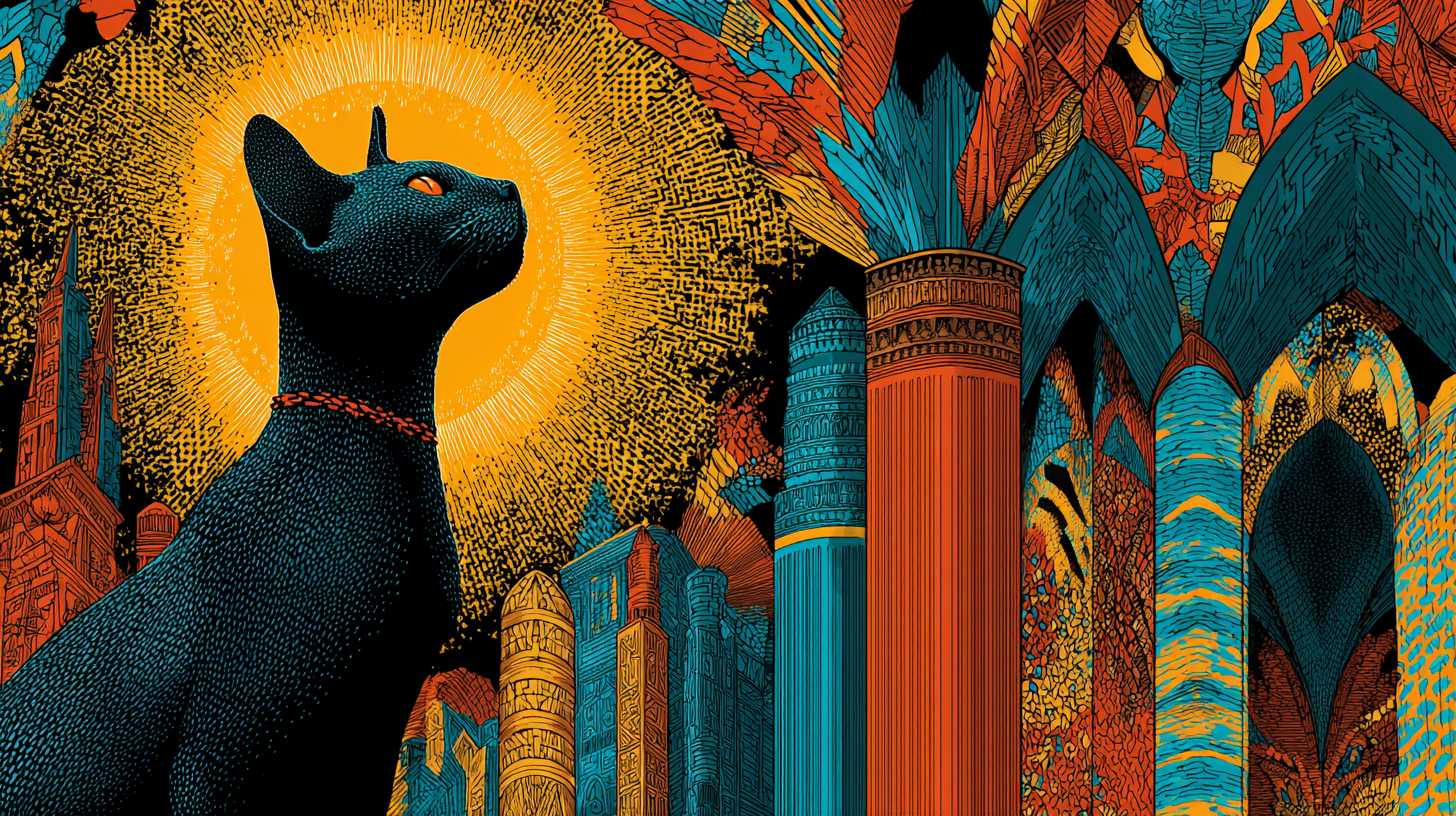
There is a scene that plays out millions of times a day on screens across the world. A cat pushes a glass off the edge of a table, stares at the camera, and walks away. The humans watching laugh. Nobody punishes it. Nobody quite understands why. What is called “cat culture on the internet” is not a trivial phenomenon or a distraction without consequence, it is the latest episode in a history that has been repeating itself for five thousand years, one in which every civilisation has projected onto this animal what it could not say about itself. The cat was never domesticated in the way the dog or the pig were. It came in on its own terms, stayed out of mutual convenience, and has functioned as a mirror ever since. The trouble is that the mirror shows things we would rather not see.
The glass that falls
Garfield appeared in 1978, created by Jim Davis for an American middle-class audience that was beginning to feel the weight of a culture of effort without visible reward. Davis’s cat is obese, lazy, sardonic, devours lasagne and holds Mondays in contempt with a conviction no human character of that era could have expressed without consequences. His owner Jon is the perfect modern worker, anxious, lonely, without time, a true believer in productivity as a value in itself. The joke is not that the cat is likeable. The joke is that the cat is right. Forty years later, internet memes reproduce exactly the same structure, the cat as a figure of passive resistance, of sovereign indifference to the demands of the productive world. Ernst Blofeld, James Bond’s arch-villain, strokes his white Persian in silence while plotting global chaos. The image works because it distils something the viewer recognises without being able to name it, coldness as a form of power.
What is striking, if one stops to think about it, is that this same mechanism has been operating since the Neolithic. The cat’s nature has not changed. What has changed is the use each era has made of it.
The granary and the tacit agreement
It all begins with a storage problem. When the first farming communities of the Fertile Crescent, the arc that today spans parts of Iraq, Syria, Turkey and Lebanon, began storing enough grain to survive the winter, they unknowingly created the perfect ecosystem for rodents. The mice came, and in their wake came something that hunted them. The African wildcat, known scientifically as Felis silvestris lybica, was less wary than its European cousins, more willing to approach human settlements without fleeing. The first farmers did not trap or breed it; they simply let it in. It was a wordless agreement, based solely on a coincidence of interests. It is not domestication in the technical sense, which implies deliberate reproductive selection. It is something else, closer to a negotiated cohabitation between two species that found living together cost them less than living apart.
The archaeological evidence for this process is sparse but eloquent. In the early 2000s, a team from France’s CNRS excavated a Neolithic settlement in Cyprus and found the remains of foxes, dogs and cats dating from the eighth millennium before our era. What mattered was not the bones themselves, but the context, a human grave with a cat’s grave just a few centimetres away, aligned in the same direction, as though whoever ordered that burial had wanted the two to travel together. It is not proof of domestication in the strict sense. It is something more diffuse, a signal that for some of our ancestors, the cat already occupied a place that was not that of other animals.
During excavations at Shillourokambos in Cyprus, Jean-Denis Vigne’s team discovered in 2004 the remains of a cat buried alongside a human being, dated to approximately 9,500 years before our era, the oldest known evidence of an intentional relationship between humans and domestic felines.
Bastet, or the animal that became a god
In Egypt, where grain storage was a function of the State and granaries were political infrastructure, the cat found its first genuine institutional niche. It killed snakes, and that carried specific weight in a culture where the serpent Apophis embodied the primordial chaos that threatened each night to devour the sun god Ra on his journey through the underworld. An animal capable of defeating that reptile was not simply useful, it participated symbolically in the maintenance of cosmic order. From that logic was born the cult of Bastet, a feline deity representing the protection of the home and fertility, a domestic counterweight to Sekhmet, the lioness goddess of war. From the tenth century BCE, when the pharaohs of the XXII Dynasty, native to the city of Bubastis, actively promoted her cult, Bastet spread throughout Egypt and became one of the most popular deities of the first millennium. Herodotus recorded the festivals held in her honour, which he described as occasions of music, dancing and immoderate consumption of wine.
The sacralisation reached the point where killing a cat could cost you your life. Diodorus Siculus reported the case of a Roman merchant lynched in Egypt for that reason, despite the protection of the pharaoh. The anecdote fits the context, a society under foreign domination reaffirming its identity through its symbols. But there is another detail that complicates the edifying picture. The temples bred cats, sacrificed them at a young age and mummified them in bulk to sell as offerings to the faithful. Surviving mummies show fractured skulls or signs of strangulation. The veneration and the industrial exploitation of the venerated object coexisted without apparent contradiction, which is a mechanism that late capitalism would recognise without difficulty.
According to archaeological records, some shipments of cat mummies sent to Europe during the nineteenth century contained more than 180,000 specimens in a single consignment. Most were destroyed and used as agricultural fertiliser. Surviving mummies show that temples mass-produced sacrificed felines to meet demand for religious offerings.
The household devil and the prophet
The Greco-Roman world regarded that devotion with contempt. Greeks and Romans preferred small birds as pets, and the cat, which hunted precisely those creatures, did not inspire spontaneous sympathy. Aristotle noted with disapproval what he considered an excessive sexuality in the female feline. It was useful, it was present, but it never achieved in the ancient Mediterranean the status it had held in Egypt.
The Islamic world constructed a radically different relationship. The scholar Al-Jahiz, in his Book of Animals from the ninth century, drew a sharp distinction between the dog, considered impure and to be avoided, and the cat, which one may let sleep in one’s bed. The hadiths, collections of sayings attributed to the Prophet Muhammad, are unequivocal in the cat’s favour. One tradition ascribed to him a cat named Muezza, for whom he would rather have cut the sleeve of his robe than wake it. That is the fixing of a hierarchy of values in which disturbing a feline’s sleep matters more than the integrity of a garment. In Western Europe, meanwhile, the ecclesiastical writers of the Middle Ages were building exactly the opposite hierarchy. The cat does not appear in the Bible, which was already a problem in a mental universe where the legitimacy of living creatures depended on the sanction of the sacred text. It was progressively associated with the sins of the household, sloth, gluttony, lust and pride, and from the twelfth century the association with heresy became systematic. The black cat that brings bad luck, the witch who transforms into a feline, all that repertoire still circulating in popular culture has its roots in that period.
The emblem of those who sabotage
The Western rehabilitation came by two routes. In the eighteenth century, educated circles began importing oriental breeds and the cat became an accessory of intellectual distinction. In 1727, the Frenchman Moncrif dedicated a treatise to it presenting it as a model of independence and reason. The Romantics of the nineteenth century adopted it for opposite but equally weighted reasons, seeing in it mystery and domestic danger. Baudelaire dedicated three poems to it in The Flowers of Evil. But the most unexpected turn came in the United States at the beginning of the twentieth century, and it is the one that says most about how this mechanism of projection works.
The IWW, the Industrial Workers of the World, a union founded in 1905 by socialist and anarchist activists who did not hesitate to threaten employers with sabotage if they failed to improve working conditions, adopted the black cat as its emblem around 1913. The choice came from Anglo-Saxon maritime tradition, where the chained black cat was already the symbol of sabotage, the tool of the worker who slows production without showing his hand. The illustrations in the IWW’s newspaper showed a gigantic cat crushing tiny, ridiculous bosses beneath its weight. The animal that had protected the granaries of the Fertile Crescent, that had been a god in Egypt and a devil in medieval Europe, was becoming the icon of those who wanted to destroy the system that exploited them. In 1968, the cartoonist Siné wrote that he preferred cats to dogs because there were no police cats. The phrase circulated for decades attributed to Jacques Prévert. It hardly matters who said it. What matters is that everyone understood immediately why it made sense.
What the mirror shows
The constant across five thousand years is not the cat. It is the human need to find a receptacle for what cannot be said directly. Pharaonic Egypt needed to believe in a cosmic order and projected it onto the animal that killed snakes. Medieval Europe needed to locate transgression and projected it onto the animal that did not appear in its sacred texts. The Enlightenment needed a symbol of rational autonomy and found it in the animal that does not obey. The labour movement needed a figure of silent resistance and chose the animal that acts without declaring it. The hyperconnected society of the twenty-first century needs to imagine that there exists a form of life without performance metrics, without the constant pressure to be productive and visible, and projects that fantasy onto the animal that pushes the glass off the edge of the table and walks away without looking back. What is revealing is not that this projection exists. It is that it has never stopped existing, that every era has needed it with the same urgency, and that the animal chosen to bear it is always the same, indifferent, impeccably alien to everything attributed to it…
G.S.
Sources
- Nota Bene – L’histoire des chats (Benjamin Brillaud, YouTube)
- Jean-Denis Vigne et al., “Early Taming of the Cat in Cyprus”, Science, 2004
- Diodorus Siculus, Library of History, Book I (1st century BCE)
- Al-Jahiz, Kitab al-Hayawan (The Book of Animals), 9th century
- The British Museum – Gayer-Anderson Cat
- Charles Baudelaire, The Flowers of Evil (1857)
- IWW – Sabo-Tabby history
Updated April 30, 2026