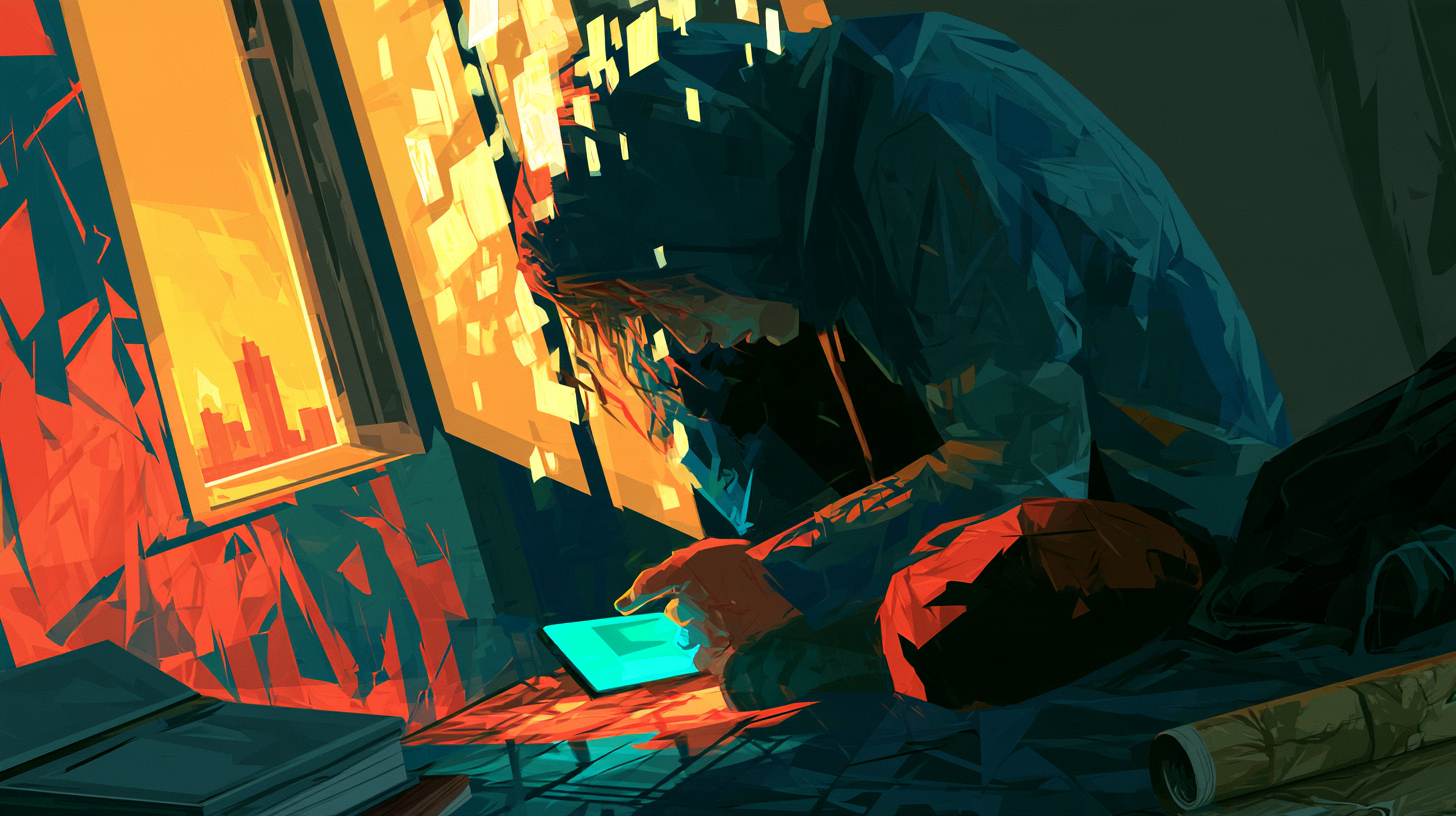
It is often enough to spend a while in a room where teenagers and people in their twenties happen to be together to see it, the thumb rises and the screen changes while the face stays the same. Asked about the future, they answer without drama and without resentment, with a short formula that serves for everything, what is the point. What is the point of studying, what is the point of learning where a country lies that they will never visit. More than eighty years ago Sartre argued that a human being exists first and is defined afterwards by what he does, and that idea, repeated until it wears thin, changes meaning when it is applied to the young, or to that part of them that has grown used to doing very little. This essay argues that the formula has been misread and that the misunderstanding benefits those who administer the screen.
The formula and its misunderstanding
In 1943, with France under German occupation, Jean-Paul Sartre published Being and Nothingness, a treatise that distinguishes two modes of being. The in-itself designates things, what is fully what it is, a table, a stone, something with no distance from itself. The for-itself designates human consciousness, which coincides with nothing it has been and can therefore project itself towards what it is not yet.
Its condensed formula, existence precedes essence, appears in that book and returns in the lecture Existentialism Is a Humanism, delivered in Paris in 1945 and published the following year. A manufactured object has its essence before it exists, because someone conceived it for a use. A human being begins by simply being there, with no prior blueprint, and is defined only afterwards by what he chooses. From the formula follows the other, the most famous and the worst read, that man is condemned to be free. Condemned, because nobody chose to be so and because there is no way of ceasing to be so, since in his logic abstaining from choice remains a choice, that of letting circumstances or other people decide in one’s place. The word carries a weight that the lighter versions omit, because this freedom resembles an obligation with no expiry date more than it resembles a gift.
The popular Sartre, the one found in many summaries and self-improvement speeches, stops there and concludes that no determinism exists and that every excuse is bad faith. It is a comfortable and false reading. The same book describes a freedom that is always exercised in situation, tied to a past and a world it did not choose, and that is realised only in projects and acts, without which it is nothing. Sartre calls facticity this necessary connection of the for-itself with the world and with its own past. What he describes is a margin, sometimes wide and sometimes narrow, which has to be measured before it is exercised. Someone who inherits a student debt and a closed rental market has a smaller margin than someone who inherits a house and a network of contacts, and no attentive reader of Sartre can pretend otherwise.
Reducing him to an imperative of performance, according to which each person is solely responsible for what happens to him, makes him say the opposite of what he wrote. It also does a precise service to those who, out of convenience or habit, tend to explain to a young person that his failure is a private matter.
A label assigned before the act
What follows applies that distinction to something Sartre never knew, the screen. In this section and the next two, except where I cite data, I offer my own reading and not a finding, and it should be read with that warning.
The recommendation system of a social network classifies its user from minimal traces, a pause of a couple of seconds over an image, a video watched to the end, and returns to him a version of himself made of categories, what he likes and what he will want to see next. The formula “for you”, which titles the main feed of several social networks, sums up the operation with an almost involuntary precision. In Sartrean terms, the subject receives an essence, in everyday language a label, built without his having chosen anything, and he receives it moreover as a mirror, that is, as a portrait he recognises at once. The result is then sold as personalisation, as if the label were the discovery of everyone’s personality and not its manufacture. The for-itself, which exists only by projecting itself, is treated as an in-itself, identical to itself, predictable, classifiable, saleable in packets of attention to whoever will pay for them.
There is a second operation, which Sartre described without knowing screens. In Being and Nothingness, the mere possible presence of another person makes one look at oneself as an object and see one’s world as it appears before the other. Social networks turned that gaze into a counter. Every post receives a figure and every figure works as a verdict, so that the gaze of others, which in Sartre was an intermittent and often shameful experience, becomes a permanent condition of the environment.
To these two operations a third is added, more practical, which is that the feed never ends. A book has a last page and a library closes at its hour, and at each of those edges someone can decide what to do next. The continuous feed removes that moment. What passes through it may be a cooking video or a thirty-second joke, and none of those pieces demands anything of the person watching, so that attention is consumed leaving no trace other than the lost hour.
For that combination the Sartrean tradition has a name.
Sartre calls bad faith the self-deception about one’s own freedom and describes it in two forms, that of denying what one is and that of reducing oneself to an object, like someone who identifies entirely with his job, in order to deny that he can choose. The screen imposes neither. It simply offers, at any hour and at no apparent cost, a comfortable place to live as a thing, without having to decide it. Nobody resolves to stop learning on a Tuesday afternoon. The abandonment happens by accumulation of surrendered hours, and by the time it is noticed it already looks like a trait of character.
Disenchantment as a reading of the situation
In the conversations I have had with teenagers and people in their twenties, the most frequent answer to a question about study or reading is a variant of what is the point. They speak of a future they perceive as closed. Geography interests them little and history less, and by dint of repetition the finding stops surprising. It is an observation from conversation and not a statistic, and it should be read as such.
The disenchantment, however, does not arise from the telephone alone.
According to a survey published in The Lancet Planetary Health in December 2021, 75.5% of 10,000 young people aged 16 to 25 in ten countries considered the future frightening, and 58.5% felt that governments were betraying them or future generations. (Hickman et al., 2021)
The study focused on climate anxiety and relied on an online panel that its authors acknowledge is not fully representative, so it does not measure the general mood of a generation. It shows, on the other hand, that fear of the future was for a majority of those young people a shared position and not an individual oddity, and that a little over half felt betrayed by those who govern. A “what is the point” uttered from there cannot be dismissed as laziness.
The data on learning add a clue of another order, that of what students achieve and not of what young people feel. In the PISA 2022 results, as summarised by the World Economic Forum from the OECD, the average of member countries fell by about ten points in reading and almost fifteen in mathematics compared with 2018. Andreas Schleicher, of the OECD, warned that the pandemic may have played a part but should not be overstated, because deeper structural factors exist. PISA assesses fifteen-year-old students in reading, mathematics and science. It measures skills and not curiosity, and the distance between the two is precisely the terrain of this essay.
Between 2004 and 2023, the proportion of Americans who read for pleasure on an average day fell from 28% to 16%, according to an analysis of the American Time Use Survey published in iScience in 2025. (Bone, Sonke et al., iScience, 2025)
The analysis covers more than 236,000 participants in an American survey and is observational, so it establishes no cause and does not allow anyone to blame social networks for that decline. Its authors point to several possible factors, the expansion of digital media, economic pressures, the reduction of free time and unequal access to books and libraries. None excludes the others.
What remains, then, is a real situation, with documented fears and a margin of action that many young people judge narrow, a judgement that has some foundation even if whoever voices it has not always measured it. Bad faith appears a step further on, when the narrow margin is declared null and one concludes that nothing one does will change anything. It is a half-truth, and half-truths are the most resistant because they keep the part of reason that makes them credible. A young person who has concluded that no effort will change his situation does not need to stop finding that conclusion reasonable in order to keep it, it is enough not to put it to the test, and the screen spares him the test. What is specific to the age is that the passage from half-truth to total renunciation no longer requires any effort of conviction, not even a decision, since the environment offers at every minute an alternative to action that does not require deciding for it either.
Choosing without guarantees
Sartre promises nothing. The freedom he describes generates anguish because it faces nothingness, an emptiness that only its own acts fill, and no authority, neither history nor the market, guarantees that those acts will be rewarded. Whoever asks what is the point of learning is asking, at bottom, for a guarantee, and asking for it on ground where no project has ever had one in advance. For Sartre, anguish accompanies freedom when it is perceived without disguise, and that is why the screen, which calms it without resolving it, works as an anaesthetic.
It is possible that earlier generations lived, at least some of them and for a time, inside a social promise according to which certain paths led to certain places, and that this promise has been broken for many. I say it in the conditional because I have not documented it here, and whoever asserts it should do so with figures. Even if it were true, the breaking of the promise does not carry away the reason to learn. A commitment to one’s own future never depended on the future confirming it, it depended on someone deciding to give it to his life.
There is a more concrete argument in favour of what young people say they do not want to learn. If freedom is always exercised in a situation, and if the situation includes the world and the past of the one who acts, then knowing history and geography amounts to knowing the dimensions of one’s own margin. Whoever ignores how the order around him came to exist and how many others have acted in worse conditions has few means of judging whether his margin is narrow or merely unknown. Curiosity, seen this way, works as an instrument of measurement, the only one available to tell impossibility from ignorance. Whoever learns something, however little and without immediate application, changes somewhat the definition of what is possible for him, and that change, small and verifiable, is the only answer to the label that does not involve arguing with it.
None of this offers consolation, and Sartre did not intend it to.
The margin exists as long as someone exercises it. The margin that nobody exercises ends up resembling the absence of margin, but it is not the same thing. Responsibility marks the difference, the absence of margin can be attributed to others, the unexercised margin only to whoever failed to exercise it. That difference, uncomfortable and without remedy, is the only thing Sartre’s phrase guarantees to whoever reads it today, telephone in hand and thumb still moving…
G.S.
Sources
- Jean-Paul Sartre, Being and Nothingness (1943)
- Jean-Paul Sartre, Existentialism Is a Humanism (lecture of 1945, published in 1946)
- Jean-Paul Sartre, Stanford Encyclopedia of Philosophy
- Climate anxiety in children and young people and their beliefs about government responses to climate change, Hickman et al., The Lancet Planetary Health, December 2021
- The decline in reading for pleasure over 20 years of the American Time Use Survey, Bone et al., iScience, August 2025
- Proportion of Americans reading for pleasure fell by 40% over 20 years, University College London, August 2025
- OECD PISA results, maths and reading skills in unprecedented drop, World Economic Forum, December 2023