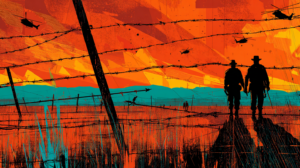
Every guerrilla is born of the same refusal, that of resolving by law what the countryside has demanded for generations. But the refusal produces different grammars. The ELN inherited from the priest its discipline of armed catechism. The M-19 inherited from electoral fraud its vocation for spectacle. Two answers to the same unanswered question, two destinies that time eventually pulled apart.
I. Simacota, or War as Liturgy
In 1964, while peasant resistance was consolidating at Marquetalia under the name it would take a year later, FARC, another group was organising itself along a different logic in the mountains of Santander. The Vásquez Castaño brothers, Fabio, Manuel and Antonio, had passed through Cuba at the height of revolutionary fervour and returned convinced that Colombia needed its own guerrilla foco, one that combined military discipline with an ideological profile more Christian than orthodox Guevarism. They were not alone in that conviction, those same years saw similar focos sprouting in Venezuela, Guatemala and Peru, a continental generation that read in the Cuban Revolution the proof that power was taken with rifles rather than ballot papers, and that found in Colombia a ground already prepared by the persistence of bipartisan violence from the preceding decades. Around them gathered students sent by the Communist Party, young members of the Liberal Revolutionary Movement’s youth wing, and militants of the Worker, Student and Peasant Movement, a generational alliance that reflected the disillusionment of a university-educated middle class with the bipartisanship of the National Front, the pact between Liberals and Conservatives that since 1958 had shared out power while excluding any third electoral path.
The march on Simacota had begun in December 1964, under the aliases Andrés, Alberto, Wilson, Camilito, Ricardo, Libardo, Alí and Mariela, the latter the nom de guerre of Paula González Rojas, known as La Mona, the first woman attached to the organisation. On 7 January 1965 the group took the town, raided the local branch of the Caja Agraria and read aloud the document that gave public name to the National Liberation Army. The commander of the operation had chosen Simacota for its symbolic weight, it was there that the Comuneros had risen against the Spanish crown in 1781, a rebel genealogy the organisation claimed for itself from its very first communiqué. In the exchange of fire died Pedro Gordillo, alias Parmenio, posthumously promoted to captain and turned into the first martyr on a list that would grow interminable over the years.
What distinguished the ELN from the outset was not its military tactics, modest and learned from Guevarist manuals, but the calibre of its founding cadres. Months after Simacota it was joined by Camilo Torres Restrepo, priest, sociologist and chaplain of the National University, one of the most influential intellectual figures of his generation. Torres had already exhausted the path of the Frente Unido, a mass movement that filled squares across the country and dissolved amid internal divergences and police repression. Convinced that the country’s legal channels were closed, he exchanged the cassock for the rifle. He died in his first combat, on 15 February 1966, near San Vicente de Chucurí. The organisation turned that early death into a founding myth, and the myth proved more durable than the man.
The Manifesto of Simacota proclaimed as its objectives the seizure of power for a socialist state, agrarian reform, a housing programme and a popular credit system, the same repertoire of demands the country had been postponing by parliamentary means for decades.
II. The Priest and the Pipeline
The ELN chose its geography with a sense that was symbolic as much as material. Santander, Arauca and southern Bolívar were not merely mountain corridors, they were also the territory of Colombia’s nascent oil industry, with Barrancabermeja as its working-class refining capital. Attacking a pipeline carried the same weight as attacking a barracks, it struck the state in its revenue and the multinational in its infrastructure, two enemies the organisation treated as one. That territorial choice marked a fundamental difference from the FARC, whose base was agrarian and peasant, while the ELN combined peasantry with oil worker and university student, a cross-class alliance that the language of liberation theology, the Latin American Catholic current that read poverty as structural sin and liberation as historical task, knew how to articulate better than any orthodox pamphlet.
Camilo Torres’s death did not close the organisation’s religious chapter, it opened it. Years later it was joined by two Spanish priests, Manuel Pérez Martínez, known as the priest Pérez, and Domingo Laín, both formed in the same combative reading of the Gospel, and the former went on to hold the organisation’s supreme command for almost two decades, an anomaly without equivalent in any other guerrilla on the continent, a priest at the head of an army. That clerical continuity produced an internal culture that deserves the word liturgical, prolonged assemblies in which decisions were reached by collective consensus rather than vertical hierarchy, cadre training schools, communiqués that read like homilies, a discipline of conversion rather than military obedience.
That same structure explains both its persistence and its fragility. Persistence, because an organisation that thinks of itself as a community of faith withstands military blows better than one that thinks of itself as a conventional army. Fragility, because command federated across regional fronts with a high degree of autonomy produced the same scene again and again, national negotiations disavowed by a regional front through a single attack. The pattern repeated under governments of opposing colour, the Caracas and Tlaxcala dialogues of the nineties, the failed attempt under Pastrana, the definitive rupture with Duque in 2019 after the bombing of the Police Cadet School, and the table opened by Petro in 2022 that ended up declared broken in mid 2025 without government and guerrilla even agreeing on who had failed first. The organisation’s financing, which mixed levies on businesses with kidnappings, and which this series will examine in detail in its next episode, ended up eroding the moral legitimacy that Camilo Torres’s cassock had lent it in its early years.
III. The Fraud of the Nineteenth of April
While the ELN grew in the hills, another wound was opening in the cities. On 19 April 1970 Colombia voted in a presidential election pitting the Conservative Misael Pastrana Borrero, candidate of the National Front, against General Gustavo Rojas Pinilla, military dictator between 1953 and 1957 reinvented as the populist leader of the National Popular Alliance, a heterodox coalition of Liberals, dissident Conservatives and left-wing militants that appealed directly to the popular sectors the bipartisan system had left without representation. The count was carried out with precarious transmission technology, regional results were slow to reach Bogotá, and when Pastrana was declared the winner by a narrow margin, a large part of Anapista Colombia, including the general’s own daughter, María Eugenia Rojas, remained convinced the presidency had been stolen from them. The old soldier, deposed in 1957 by an agreement among bipartisan elites who feared his populist drift, had returned to the electoral arena as a tribune of the urban poor and of the migrant peasantry that the accelerated urbanisation of the sixties had expelled from the countryside without offering it anything in the city. Anapo grew under the symbol of two opposing triangles, a geometry the M-19 would inherit as its own logo, with a discourse that blended Catholic nationalism, authoritarian nostalgia and promises of housing and employment that bipartisanship had never delivered.
From that fraud, never proven before any tribunal but settled as popular certainty, came the name of a movement. Its founders came from three distinct sources, the youth wing of Anapo led by Carlos Toledo Plata, a former Conservative congressman turned insurgent, the priestly group of Golconda, a Colombian current of liberation theology distinct from and more urban than the one that had marked the ELN, and a nucleus of former FARC and Communist Party militants seeking a guerrilla less rural and more media-savvy, among them Jaime Bateman Cayón, the charismatic commander of the early years, Iván Marino Ospina and Andrés Almarales. Between December 1973 and January 1974 a series of advertisements appeared announcing the arrival of something called M-19. On 17 January 1974 the group stole Simón Bolívar’s sword from the Quinta de Bolívar Museum in Bogotá, its first action and also its declaration of principles, a gesture that turned Colombian nationalism’s most sacred symbol into a weapon of the poor against the very people who claimed to venerate it. The theft, far from provoking rejection, drew queues of young people seeking to enrol in a movement whose name was barely known, the group grew from thirty militants to nearly two hundred within weeks. The sword remained seventeen years in the organisation’s hands, first as a travelling trophy and later as a symbolic hostage of a conflict that the 1990 disarmament would eventually return to the state. The M-19 was born nationalist, Bolivarian, anti-imperialist, urban to its marrow, an organisation that understood politics as dramaturgy before it understood it as doctrine.
IV. The Theatre of the City
Where the ELN produced communiqués with the cadence of a sermon, the M-19 produced operations with the cadence of a film script. On 1 January 1979 a commando made off with nearly five thousand weapons from the Cantón Norte military depot in Bogotá, digging a tunnel under the army’s nose, a humiliation the high command never forgave. In 1980 another commando seized the Dominican Republic’s embassy during a diplomatic reception and held several ambassadors hostage, including that of the United States, for two months, a siege that ended without a single shot fired and that made the organisation the protagonist of national curiosity more than national fear. But the theatre also had its dark side. In 1976 an internal tribunal of the organisation condemned and executed the union leader José Raquel Mercado on charges of betrayal, an episode that foreshadowed the darkest dimension of the revolutionary justice the organisation claimed to represent.
Between December 1984 and January 1985 the M-19, under Carlos Pizarro’s command, resisted the army’s assault at Corinto, Cauca, in what became known as the Battle of Yarumales, the longest engagement recorded on Colombian soil since the nineteenth century. In 1988 another commando kidnapped the Conservative leader Álvaro Gómez Hurtado, released weeks later, an episode that opened informal channels of dialogue with sectors of the establishment. That formula, spectacular violence combined with intermittent political openness, was what best described the M-19 for a decade, and it was also what stopped working on 6 November 1985.
That day a commando of thirty-five guerrillas, under the command of Andrés Almarales and Luis Otero Cifuentes, seized the Palace of Justice in the centre of Bogotá by force of arms, seat of the Supreme Court and the Council of State. The organisation sought a political trial of Belisario Betancur’s government for breaching an earlier truce. What it found was the army’s decision to retake the building by force, without effective negotiation, with tanks entering through the main door while the Palace burned. Among the dead was the Chief Justice of the Supreme Court, Alfonso Reyes Echandía, and the fire destroyed entire judicial archives along with the lives of magistrates, guerrillas and civilians.
The assault on the Palace of Justice left eleven people disappeared, among them cafeteria workers who did not even belong to the guerrilla organisation, a figure that Colombian justice and the Inter-American Court of Human Rights have confirmed in proceedings that remain open.
V. Two Destinies
The Palace of Justice marked, for the M-19, the end of its unpunished theatre. The organisation lost at a stroke the symbolic capital accumulated over a decade, was driven back into the hills, and in 1986 attempted a larger-scale military offensive in Cauca that likewise failed to bear the fruit it sought. What followed was, paradoxically, its most lucid decision. Under Carlos Pizarro León-Gómez’s command, the M-19 negotiated with Virgilio Barco’s government and laid down its arms on 8 March 1990, transforming itself into the Democratic Alliance M-19 party. Pizarro paid for that decision with his life, assassinated on 26 April 1990 while campaigning for the presidency, one of three left-wing candidates killed that same year alongside Luis Carlos Galán and Bernardo Jaramillo. Antonio Navarro Wolff took up his banner and led the fledgling Democratic Alliance to a result no analyst had expected, nineteen delegates out of seventy at the 1990 National Constituent Assembly, the country’s second force just behind the Liberal Party, large enough to share with Liberals and Conservatives the Assembly’s tripartite presidency that drafted the 1991 Constitution, the text that extended the rights and participatory mechanisms the National Front’s bipartisanship had kept closed for three decades.
The ELN never had a Palace of Justice to force it into a comparable decision. Its federated structure and liturgical identity, which allowed it to survive every military blow, also prevented it from producing the single, recognisable gesture a negotiation needs to become irreversible. Sixty years after Simacota, the oldest guerrilla in the Americas remains sitting down and standing up from dialogue tables in the same motion, most recently in 2025, with no government yet having achieved the closure the M-19 found in a single year. The difference is one neither of courage nor of sincerity, it is one of organisational architecture. An urban guerrilla that lives on visibility finds in politics its natural stage, to the point that one of its former militants, Gustavo Petro, would go on to occupy the presidency of the Republic in 2022, forty-eight years after the theft of a sword from a museum. A rural guerrilla that lives on territorial dispersion finds in every national agreement a ceiling its regional fronts are not always willing to respect.
Conclusion
The two organisations were born of the same structural refusal, a country that preferred the cudgel to agrarian reform and repression to early negotiation. But refusal, once turned into war, does not produce a single language. The ELN inherited the discipline of catechism and the persistence of the martyr, a guerrilla that even today negotiates and breaks off with the cadence of one who mistakes resistance for salvation. The M-19 inherited the logic of spectacle, paid a heavier price for it than it had calculated at the Palace of Justice, and yet found in that same logic the exit the country demanded of it after the horror. Sixty years after Simacota, Colombia is still waiting for the agrarian question to be resolved by law rather than by the two liturgies these pages describe, that of the rifle that fires and that of the rifle that surrenders…
G.S.
Sources
- Toma de Simacota, Wikipedia
- Ejército de Liberación Nacional, Wikipedia
- Camilo Torres Restrepo, su historia revolucionaria, Indepaz
- El robo de la espada de Bolívar y los 50 años del M-19, El Espectador
- Movimiento 19 de abril, Wikipedia
- Toma del Palacio de Justicia, Wikipedia
- M-19 cumple 25 años después de la desmovilización, La Patria
- A 32 años del fallecimiento de Carlos Pizarro, Señal Memoria
- La Alianza Democrática M-19 y la Constitución de 1991, Señal Memoria
- El ELN propone al próximo Gobierno de Colombia un acuerdo nacional, Infobae
Updated August 15, 2026