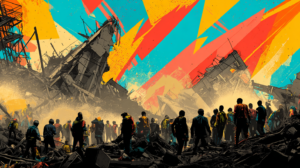
On Monday 21 September, José Luis Pérez Villanueva, known as Cholo, died during a Public Force operation in the Sierra Nevada. He was regarded as the second in command of the Autodefensas Conquistadoras de la Sierra Nevada, an armed group known as Los Pachenca. That night the group announced an armed strike in Magdalena and La Guajira. An armed strike is not decreed by the State. The armed men impose it with threats, so that people do not leave their homes and businesses do not open. According to the group’s own statement, it would end at 7 in the morning on Friday 25. The governor of Magdalena, Margarita Guerra, confirmed that it did.
On Wednesday 23, the taxi driver Antonio Ochoa Díaz left his home in Santa Marta afraid. He went out, he told the news agency The Associated Press, because “you go out to get supplies”. At least three vehicles had been set on fire, among them a taxi and a public transport bus. In the supermarkets that opened, police officers with long guns stood at the door. The public market remained closed.
On the beach, meanwhile, hundreds of tourists were drinking beer in front of the sea. All around them, many restaurants had their doors shut.
In the following days the blow could be measured. The Magdalena hoteliers’ association said that occupancy in the city’s hotels had fallen to about 33%. In other words, of every three rooms, only one had a guest. In the eco-hotels of the Sierra Nevada it fell to about 14%, and in the rural area towards Tayrona and Palomino a quick WhatsApp survey of hoteliers gave an average of 15%.
The Santa Marta Chamber of Commerce calculated that the city lost 39,590 million pesos on the first day of the strike, and more than 42,000 million if Ciénaga and the Zona Bananera are included. Later estimates do not agree. They range from about 81,000 million to more than 118,000 million, depending on who counts and how many days and municipalities they include. October was the month hoteliers were counting on, with the families who travel to the Caribbean during the school holiday week. Their president, Omar García Silva, had hoped to reach 70% occupancy between 2 and 12 October, as he told Blu Radio. He had told Portafolio that groups and families were already cancelling.
A country that was rarely visited
To understand what is at stake, one has to look at where Colombian tourism comes from. In 2010, 2.6 million foreign visitors arrived, according to the Ministry of Commerce. In 2017, a year after the signing of the Havana peace agreement, 6.5 million came. That is more than double in seven years. Mesetas, in Meta, shows it on a small scale. The guerrilla that had roamed those mountains for more than forty years handed over its last weapons there in 2017. That department received 2,667 international tourists in 2012 and 4,700 in 2018.
The growth had begun before the signing. An academic study records that arrivals were already rising before the agreement and calculates that the signing added a further increase of more than 27%.
In 2016 the Minister of Commerce, María Claudia Lacouture, said that peace allowed the world to see another Colombia. That year 5,092,004 foreign tourists arrived. Between 2010 and 2016, according to the Ministry, foreign tourists rose by 95%, hotels by 49.5% and employment in the sector by 24%.
What peace let in
That growth lasted until 2025. The Tourism Satellite Account, calculated by the official statistics body, recorded that year spending of 13,498 million dollars by international tourists, 10.8% more than the year before. Tourism contributed 9,699 million dollars to the economy and provided almost a million jobs. Tourists are not spread evenly. Between January and September 2025, Bogotá received 38.5% of foreigners, Antioquia 26.9% and Bolívar, where Cartagena is located, 16.7%. Magdalena, where Santa Marta is located, is not in that group, but the Ministry of Commerce recorded that its visitors grew by 24% that year.
The figures were not as bright as they look. In 2025, 4,677,267 foreigners arrived, 3.8% more than in 2024. But the total number of visitors who do not live in the country fell by 8.1%, to 6,496,458, because 33.7% fewer Colombians resident abroad came, according to the travel agencies’ association.
In 2026 the pace slowed further. Between January and May, foreigners grew by only 0.5% and the total fell by 1.6%. Formal hotels had been doing badly for longer. In the first quarter occupancy was 49.1%, the third consecutive fall. Real income dropped by 5% and staff employed fell by 3.8%, according to the hotel association, using data from the official statistics body. That association blamed a large part of the problem on informal lodging, which grows without effective controls, such as the 226 tourist homes with more than a hundred rooms.
When the strike came, the sector had already been falling for three quarters.
The pact that broke
An international observatory of political violence, cited by Bloomberg Línea, describes a non-aggression pact between Los Pachenca and the Clan del Golfo, the largest armed group in the country. That pact limited violence in the Sierra Nevada and let tourism grow. Between 2019 and 2021 the two groups fought over Santa Marta and its surroundings. Afterwards the fight moved to La Guajira. Since 2025, their attempts to reach Catatumbo have spread it to Cesar and Santander. None of the sources consulted dates the moment when the pact stopped containing the violence. What they do show are the effects.
The observatory counted the incidents. In 2018, Cesar, La Guajira and Magdalena accounted for 4% of the country’s armed group violence. So far in 2026 they account for 12%. Compared with the first seven and a half months of 2025, violence in those three departments rose by 28%.
At the end of February, fighting between the Clan del Golfo and Los Pachenca in Aracataca left at least five dead and hundreds displaced. Tayrona Park closed temporarily. In June, after a military operation, Los Pachenca confined communities and blocked the Troncal del Caribe, the road that links Santa Marta with La Guajira. Tayrona closed for a second time. Hundreds of tourists were left stranded.
In April 2025, the observatory recorded the kidnapping of the owner and four employees of a well-known hotel inside Tayrona Park.
None of this happens in a still country. The Peace and Reconciliation Foundation counted armed presence in 212 municipalities in 2019, in 428 when Iván Duque’s government ended and in 518 in 2025. This year there are 527.
The Ideas for Peace Foundation calculates that armed groups went from 15,120 members in December 2022 to 28,802 in July 2026. They almost doubled. The Clan del Golfo rose from 4,061 to 10,268. In November 2025 the same foundation had already concluded that neither Duque nor Gustavo Petro managed to halt that growth. The Peace and Reconciliation Foundation described the moment like this.
the worst humanitarian crisis since the signing of the 2016 Peace Agreement
The government of Abelardo de la Espriella closed all the peace negotiations that Petro had opened. Among them was the one with Los Pachenca, according to The Associated Press. On Tuesday 22, with the strike under way, the president ordered the militarisation of Santa Marta and said that “nobody is going to hold an armed strike in the era of the Tiger”. According to Mayor Carlos Pinedo, 600 police officers and 500 soldiers were deployed. The observatory reads the government’s security strategy, based on more military pressure and no negotiation, as the continuation of an earlier trend of greater security force activity.
Tiziano Breda, the observatory’s regional expert, warns that operations could concentrate in other areas for the rest of the year, and that the earthquake of 10 August drew the government’s attention to Chocó, Valle del Cauca and Risaralda. For the Sierra Nevada, the observatory projects more escalation and new blockades of tourist routes like the one in June.
Who pays first
The strike and the fall in bookings are felt first by those who live on the day’s income. Santa Marta has some 22,000 companies and establishments, and some 110,000 people tied to them, according to the Chamber of Commerce. More than 48,000 work in commerce, 26,000 in transport and nearly 25,000 in hotels, restaurants and bars. The president of the Chamber, Carlos Jaramillo, calculates that 51% of what the city produces depends on tourism and that about 60% of its economy is informal. That means, he explained, people who need the day’s takings to carry home. El Tiempo reported that the blow reaches informal workers who live from daily sales in El Rodadero, the Historic Centre and Taganga.
Across the country, accommodation and food service bring together 1.7 million workers. Of every hundred, almost 75 work informally, that is, without a contract or labour protection. In microenterprises the figure rises to 85%, according to a report by the travel agencies’ association using data from the official statistics body.
The 33% occupancy that was repeated in the headlines measures only the formal hotel sector.
Ochoa, the taxi driver, told the agency that people take care about going out and obey orders out of fear, because in his city the law is that of the armed groups. He doubted that the military deployment is a lasting solution and feared what will happen when the soldiers leave. The governor walked through the public market with leaflets against extortion to persuade traders to reopen. She acknowledged that recovering trust is hard after decades of violence. On Tuesday, a street vendor advised a 64-year-old tourist to look for somewhere to take shelter.
García listed those who depend on rooms being occupied. Restaurants, tour operators, carriers, guides, vendors, suppliers. He told Portafolio that no sector suffers more than tourism when there are security problems.
On Monday 28 the cruise ship Freewinds was due to arrive in Santa Marta, one of the first of the 2026-2027 season. The shipping line changed its itinerary. Santa Marta had the operation ready to receive the international passengers, and the vice-president of the Caribbean travel agencies’ association, Jackeline Vives, said there was already concern about that arrival. Each cruise ship leaves income for carriers, guides, restaurants, traders and artisans. The next one is scheduled for November.
The United States Embassy issued a security alert for its citizens that includes Santa Marta, the Troncal del Caribe, the access roads to Tayrona Park and the Zona Bananera. It asked them to avoid areas of unrest and blockades.
The Ideas for Peace Foundation calculates that Los Pachenca extort 95% of the hotels, restaurants, tour operators and traders in the area. In its editorial of 28 September, El Tiempo wrote that sometimes a WhatsApp message is enough for a trader to close or pay. On 18 September, three days before the death of alias Cholo, the president posted on the social network X the report of an arrest against the same organisation.
A resounding blow to the narcoterrorist group Autodefensas Conquistadoras de la Sierra Nevada!
That message reported that the Army and the Police had captured five members in La Esperanza, Norte de Santander, among them alias Miguel, a squad leader in charge of coordinating extortion.
According to the observatory, violence in the area predominantly targets civilians considered close to rival groups or who do not follow the rules of the armed men. Victims include Indigenous communities, park rangers and local business owners. Violence inside Minca, Palomino, Ciudad Perdida and Pico Cristóbal Colón remains infrequent, but the groups have attacked businesses linked to tourism, among them transport companies.
The Magdalena hotel association asked that the accompaniment of the Public Force be permanent and not limited to emergencies or high seasons. Authorities and trade bodies drew up a strategy to recover the image of Santa Marta, with a mission to the international tourism fair in Argentina and promotion until Holy Week 2027. The observatory foresees new blockades on the tourist routes of the Sierra…
A.B.
Sources
- El Espectador, Paro armado de Autodefensas de la Sierra Nevada en Santa Marta completará casi una semana
- Cambio, ACSN anunció el fin del paro armado en Santa Marta y cuestionó la muerte de alias Cholo
- The Associated Press, Militarizada y con comercios cerrados, la violencia golpea a ciudad turística de Colombia (Yahoo Noticias)
- El Heraldo, Santa Marta registra un 33 % de ocupación hotelera luego de dos días del paro armado
- El Tiempo, Santa Marta sale a recuperar los turistas que espantó el paro armado
- Portafolio, Ya están cancelando, paro armado desploma al 15 % la ocupación hotelera en la zona rural de Santa Marta
- Vanguardia, Santa Marta calcula millonarias pérdidas tras jornada de violencia
- Blu Radio, Santa Marta, comerciantes calculan pérdidas de $40.000 millones por acciones criminales
- El Tiempo, Paro armado golpea al turismo en Santa Marta
- El Tiempo, La millonaria factura del paro armado en el Caribe
- Contexto Ganadero, Santa Marta ya paga caro el paro armado
- Infobae, declaración de la asociación hotelera a Blu Radio sobre la ocupación esperada de 70 %
- Semana Rural, El turismo que despertó en el Meta tras el Acuerdo de Paz
- Redalyc, Colombia en posconflicto, turismo para la paz o paz para el turismo
- El Tiempo, Más de 5 millones de extranjeros visitaron Colombia en 2016
- Portafolio, Cuenta Satélite de Turismo 2025
- El Tiempo, Entre enero y septiembre de 2025 Colombia recibió 4,8 millones de viajeros no residentes
- Ministerio de Comercio, Cifras del turismo 2025 y aumento en Magdalena
- Asociación de agencias de viajes, La llegada de extranjeros no residentes a Colombia aumentó 3,8 %
- La Opinión, Salidas de colombianos crecen mientras llegada de visitantes cae
- Portafolio, Ocupación hotelera cayó a 49,1 % en el primer trimestre de 2026
- El Tiempo, Hoteles alertan por deterioro del sector
- Bloomberg Línea, La violencia amenaza el turismo en algunos de los destinos más visitados de Colombia
- Fundación Paz y Reconciliación, Tiempos violentos
- El Tiempo, Cada 8 días un municipio es colonizado por los grupos armados
- El País, Cifra de integrantes de grupos armados en Colombia creció 90 % en los últimos cuatro años
- Agencia EFE en SWI swissinfo, Grupos armados en Colombia tienen más de 25.000 miembros
- El Tiempo, Editorial, Rodear a Santa Marta
- Asociación de agencias de viajes, La informalidad continúa siendo el talón de Aquiles del turismo
- El Tiempo, Cancelación del crucero Freewinds tras la crisis de seguridad en Santa Marta
- Seguimiento, Cancelan llegada del crucero Freewinds a Santa Marta
- La FM, Crucero cambia su itinerario y no llega a Santa Marta
- Agencia EFE en La Prensa, EEUU alerta a sus ciudadanos por disturbios en Santa Marta