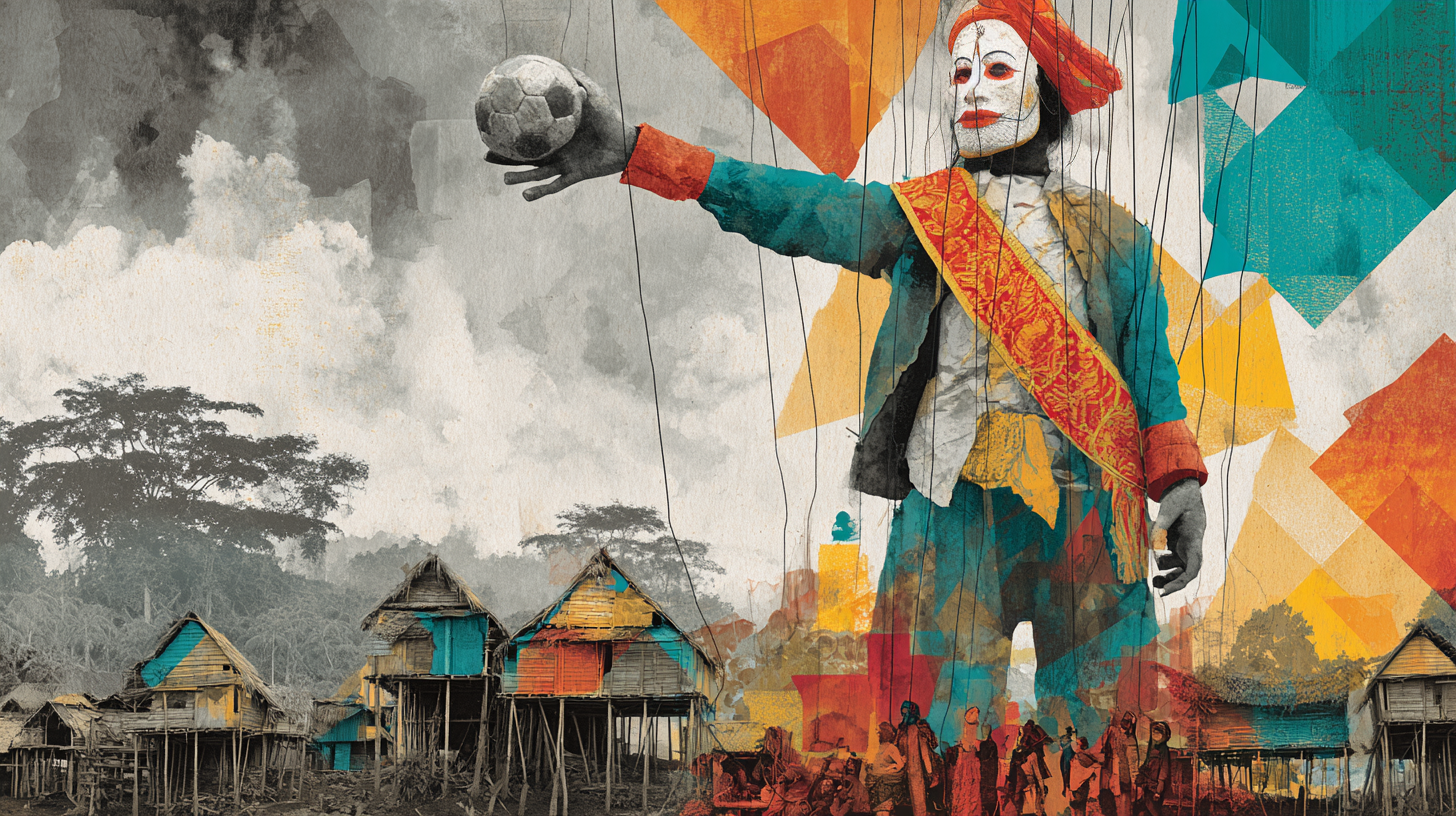
The first piece on this government described a hierarchy revealed in the first seventy-two hours of the emergency, who receives rescue and who receives abandonment. A week later, with the country still counting its dead and its missing, the same administration adds two chapters to the file. The first opens national territory to foreign military contingents, Israeli first, American after, without Congress, the only power constitutionally entitled to authorise that presence, having been consulted with any precision. The second turns humanitarian aid into advertising material for the president's own political movement. Neither episode is an isolated accident. Both share the logic already identified the previous week, decide first, explain later, if at all.
The delegation in military uniform and the constitutional void
On Friday 14 August, five days after the earthquake, eighty-two members of the Israel Defense Forces landed in Cali. The mission, led by Brigadier General Yossi Pinto, arrived as technical support for the search operation at the Vanessa building, where Colombian, American and Mexican teams had already been working for days. Its spokesman, Captain Roni Kaplan, an adviser to the Israeli Ministry of Foreign Affairs for nearly fifteen years, immediately became the public face of the contingent.
The arrival did not pass without objection. Senator Carolina Corcho, of the Pacto Histórico, recalled that the Colombian Constitution reserves to Congress, and Congress alone, the power to authorise a foreign military presence on national territory, and asked the president to explain under what legal conditions the delegation was entering the country. No detailed public answer followed. Gustavo Petro raised the same doubt from another angle, he asked whether what was arriving in Cali was humanitarian aid or soldiers of war.
Senator Carolina Corcho warned that the contingent that arrived in Cali is implicated in atrocious crimes, including genocide, the killing of civilians, children and women in Palestine. (La Opinión, 14 August 2026)
The objection does not spring from an isolated opinion. It rests on an international judicial record that already exists, dated and signed. The International Criminal Court issued arrest warrants on 21 November 2024 against Prime Minister Benjamin Netanyahu and former Defence Minister Yoav Gallant for war crimes and crimes against humanity, warrants that remain valid and unexecuted in 2026. In June of this year, the United Nations International Commission of Inquiry concluded that Israel is committing genocide by deliberately targeting Gaza's children. Captain Kaplan himself, born in Uruguay before joining the Israeli armed forces, was criminally denounced in June by Uruguayan social organisations, including the PIT-CNT trade union confederation, for alleged war crimes, crimes against humanity and genocide. The complaint requests a prosecutorial investigation. It is neither an arrest warrant nor a conviction, a distinction that much of the Colombian digital outrage erased these past days by turning an ongoing complaint into an already resolved judicial manhunt. The underlying fact needs no exaggeration to remain uncomfortable. A spokesman denounced for genocide became the face of the rescue in Cali.
Captain Kaplan did not leave the accusation unanswered, even though most of the criticism was aimed at the Israeli state rather than at him personally. He stated, according to Infobae, that his team was working side by side with Colombian firefighters, and praised in particular what he called the professionalism of the country's fire brigade. On Sunday the 16th, the same source reported that the delegation had taken part in the extraction of four bodies from the Vanessa building, a fact disputed by neither Petro nor Corcho. The Colombian controversy, then, is not about the contingent's technical effectiveness. It is about something else, more uncomfortable, whether that effectiveness is enough to suspend the constitutional question of who authorises its presence, and whether the government can keep dodging that question while displaying operational results as if they answered it.
Added to that tension is a further episode, reported so far by a single outlet and without the independent corroboration this file requires before treating anything as established, describing Colombian volunteer rescuers intercepted by Israeli personnel at the Vanessa building for carrying Palestinian flags, with crossed accusations of verbal aggression. It is recorded here as an allegation awaiting verification, not as a proven fact.
Washington comes in through Panama with nobody explaining under whose command
Two days before the Israeli delegation touched down in Cali, US Defence Secretary Pete Hegseth announced, at a meeting of the Coalition of the Americas Against Cartels held in Panama, that Colombia had requested joint military operations with Washington against narco-terrorism. Colombia's Defence Minister, Jorge Mora, formalised that same day the country's entry as the nineteenth member of the coalition known as the Shield of the Americas, an initiative born of the summit convened by Donald Trump in March.
Nobody explained the terms. An editorial in El País summed up that void with the question that titles its own text, under what command. Cooperating on intelligence against drug trafficking is a decades-old practice between the two countries. Talking about joint operations is something else, and the editorial makes the point precisely, who takes responsibility for whatever decisions are made, whether the plan involves deploying American troops on Colombian soil, warships in its waters or combat aircraft in its airspace. Hegseth broke the news. He did not give the details. Neither has De la Espriella.
The door did not open overnight. According to Las2orillas, an earlier meeting between Minister Mora and his counterparts in Panama had already prepared the ground, as part of the same military exercises with which Washington secures the interoceanic route under Hegseth's direct oversight. Colombia thus joined a regional arrangement already under way, not a new bilateral initiative, a nuance no official Colombian statement has bothered to clarify.
Nobody in government spelled out the timing as a plan, and yet there it is. In the same week that a barely installed government opens its airspace to a military coalition led by Washington, that same government receives, without any parliamentary debate, an Israeli military contingent. The two episodes share an identical void, the absence of Congress from a decision the Constitution reserves exclusively to it.
The football with the party's logo and the staged scene in El Cairo
On Saturday 15 August, as the Colombian Geological Survey recorded a fresh magnitude 2.7 aftershock in Istmina, Chocó, national government officials were handing out footballs and yellow t-shirts in Buenaventura printed with the logo of Defensores de la Patria, the political movement that carried De la Espriella to the presidency. One resident of the port, filmed as the handout took place, asked how it was possible to give away footballs when people there were going hungry. Gustavo Petro seized on the scene to say the government had confused a humanitarian emergency with a football match.
The line, even coming from a declared political opponent, describes with precision what the photograph released that same day shows, a brand new ball in the hands of a homeless family, in a port where twenty-six schools were destroyed by the earthquake, according to Publimetro.
The official toll recorded 289 dead and 143 missing across the country, six days after the magnitude 7.4 earthquake of 10 August. (cwmas.com.co, 16 August 2026)
The contrast with the Buenaventura football grows starker once one looks at the real scale of what remains undone. By the government's own reckoning, through the fund announced on 12 August and officially named Plan Milagro on the 15th, rebuilding more than four hundred affected municipalities could take up to six years, at a cost per victim that El Tiempo put at around seven thousand dollars. That fund has existed on paper for barely a few days. It still has no public timetable. In that administrative void, a new football handed over in front of a camera occupies the space a road map should occupy.
Three days earlier, in El Cairo, a municipality in Valle del Cauca devastated across eighty per cent of its area, a video released by Publimetro showed residents welcoming the president with their hands raised, a gesture an off-camera voice seemed to order before De la Espriella stepped out of the vehicle. The town, home to barely a few thousand people, had gone days without electricity or internet, and much of its housing had not withstood the week's second tremor. Against that backdrop of rubble-covered streets, the raised-hands gesture was filmed, a piece of stagecraft no real emergency explains. Senator Ariel Ávila publicly questioned the scene. It was not the first time that week presidential communications had raised that kind of doubt. Cali's mayor, Alejandro Eder, had already been welcomed with thrown stones on two separate visits, on the 10th and the 12th of August, by residents shouting that they did not want him there. The pattern was written before Buenaventura and before El Cairo. Both episodes merely stamp it with a watermark, a party's logo over the body of the emergency.
While the government handed out footballs, citizen self-organisation once again filled the space the state apparatus left empty, a scene this same file had already recorded the previous week with the collection centre set up by ONIC outside any official channel. The pattern repeats itself. Every time the institutional response fails, it is communities that end up delivering what the state promises and does not.
The same arithmetic, one week on
The first piece on this government closed on a simple idea, a government does not reveal its real hierarchy in an inauguration speech but in the decisions taken under pressure, once there is no room left to fake priorities. A week on, that same test repeats itself with different material. It is no longer a question of choosing which country gets rescued first. It is a question of deciding who enters national territory armed without Congress knowing precisely, and of deciding which image the camera receives while thousands of families remain without a roof.
The new government's machinery, meanwhile, has not been idle. In these same days, its anti-corruption team filed complaints with the Attorney General's Office, the Comptroller General and the Inspector General against the outgoing administration over alleged irregularities exceeding 370,000 million pesos, including a disputed purchase of anti-drone systems. That is legitimate work. It demands, however, the same institutional energy that the reconstruction of Chocó still does not receive, and that too is a choice, not an accident of scheduling.
No public statement from the Presidency was found, as of this edition's close, on the legal terms under which the Israeli delegation entered the country or on the exact scope of the agreement with Washington revealed by Hegseth. Should such a statement appear, it will be incorporated with the same attention as the rest of this file.
Sovereignty is surrendered at one end of the picture. A party's logo is stamped at the other. Between the two extremes sits the real country, the one counting its dead while someone hands out new footballs…
G.S.
Sources
- El Universal, 82 rescatistas israelíes se despliegan en Cali para atender la emergencia
- El Expediente, Roni Kaplan, el portavoz de Israel que llegó a Colombia
- La Opinión, Llegada de equipo de rescate de Israel a Colombia desata críticas de congresistas de oposición
- El Universal, Petrismo critica llegada de equipo de rescate israelí a Colombia
- teleSUR, Colombia, autogestión ciudadana tras el sismo, controversia por ayuda israelí
- Wikipedia ES, Órdenes internacionales de arresto contra Benjamín Netanyahu y Yoav Galant
- France 24, La CPI emite órdenes de captura contra Netanyahu, Gallant y un líder de Hamás
- Noticias ONU, Israel comete genocidio al atacar deliberadamente a niños palestinos, concluye comisión de investigación de la ONU
- Portal PIT-CNT, PIT-CNT y organizaciones sociales presentaron denuncia penal contra el militar uruguayo-israelí Roni Kaplan
- la diaria, Organizaciones sociales uruguayas denunciaron penalmente a portavoz del ejército israelí por crímenes de lesa humanidad
- Resumen Latinoamericano, militares israelíes acosan a rescatistas colombianos por llevar la bandera de Palestina, single source, not independently corroborated
- Vanguardia, Abelardo De La Espriella autoriza operaciones militares conjuntas con Estados Unidos en Colombia
- CNN, Hegseth anuncia operaciones conjuntas de EE.UU. con Colombia contra el narcoterrorismo
- El Imparcial, Hegseth afirma que Colombia pidió operaciones militares conjuntas y anuncia su incorporación al Escudo de las Américas
- El País, reproduced on Confirmado.net, Injerencia de EE UU en Colombia
- Las2orillas, La reunión del ministro de Defensa Mora en Panamá que le abrió la puerta a la llegada de tropas gringas a Colombia
- Infobae, Portavoz de las Fuerzas de Defensa de Israel, capitán Roni Kaplan, destacó el profesionalismo del cuerpo de bomberos colombiano
- El Tiempo, Reconstrucción de Colombia tras el terremoto tardaría hasta seis años, el costo por damnificado podría alcanzar los US$ 7.000
- Vanguardia, Gobierno lanzó el Plan Milagro de Reconstrucción para zonas afectadas por el terremoto
- Infobae, la ONIC reportó 68.583 indígenas afectados y habilitó centro de acopio en Bogotá
- El Espectador, Equipo anticorrupción de De la Espriella denuncia irregularidades por COP 370 mil millones
- Publimetro, Los niños se están es muriendo de hambre, habitante de Buenaventura le cantó la tabla al gobierno por llegar a repartir balones
- cwmas.com.co, Terremoto en Colombia, 289 fallecidos y 143 desaparecidos
- Publimetro, Manos arriba para recibir a De La Espriella, la escena con habitantes de El Cairo que desató indignación
- El Tiempo, Así quedó El Cairo, el municipio que resultó devastado en un 80 % tras terremoto
- Infobae, Alcalde de Cali Alejandro Eder fue agredido durante un recorrido por zonas afectadas por el terremoto
- El Universal, Alejandro Eder es abucheado y evacuado por segunda vez en Cali
- Screenshot supplied directly by Gabriel Schwarb, tweet by Mafe Carrascal Rojas (@MafeCarrascal) on the footballs and t-shirts branded with Defensores de la Patria, not independently located during this session