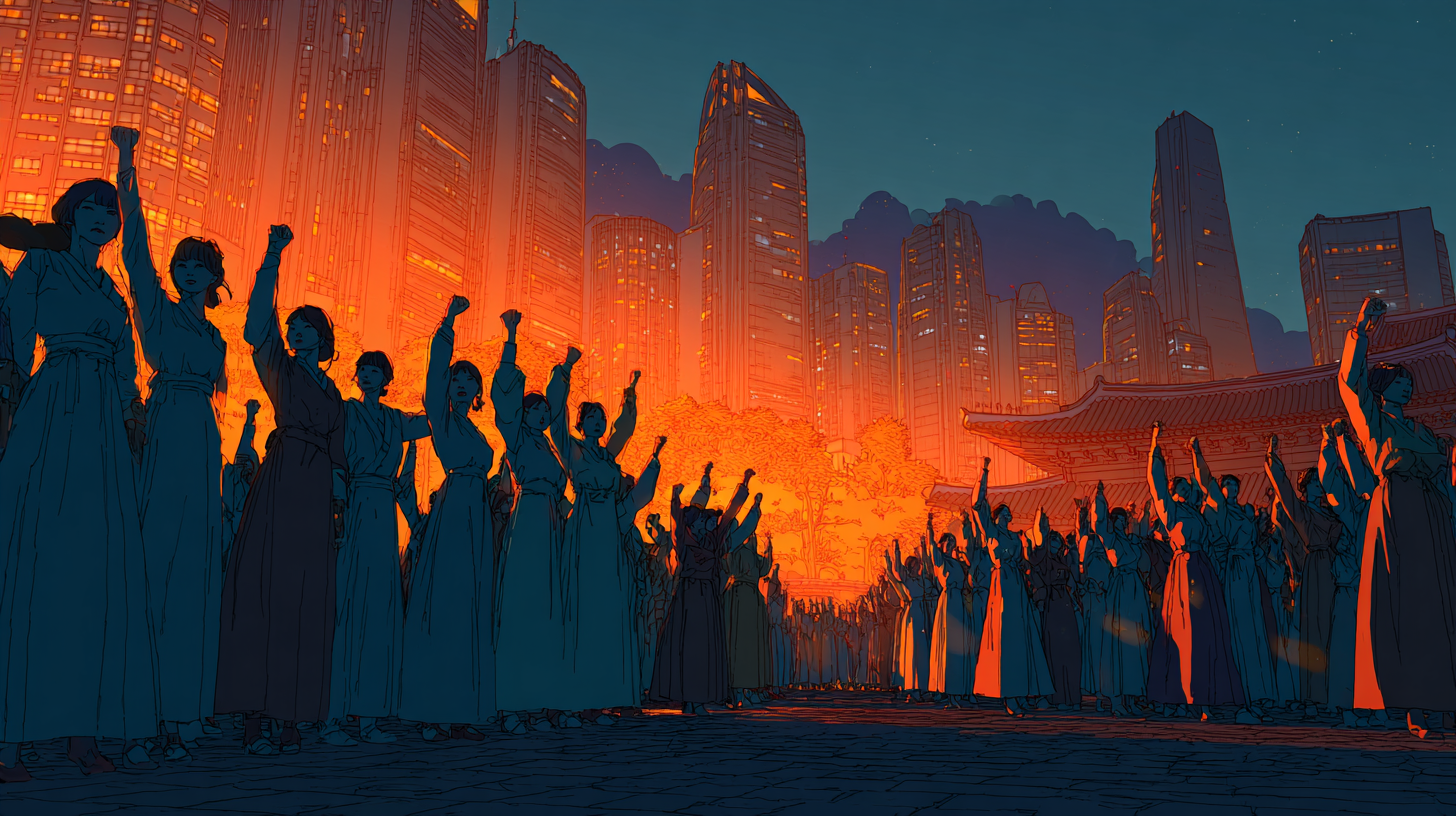
There is a feminist movement in South Korea that decided to answer violence and inequality with a flat refusal, no marriage, no dating men, no sex with them, no children. They call it 4B, four negations that in Korean all begin with the syllable bi, and although today it sounds like a viral slogan, it was born from something far more concrete, the murder of a 23 year old woman near Gangnam station in May 2016, a crime whose perpetrator explained by saying that women always ignored him. The man was not prosecuted for a hate crime despite that confession, and that judicial decision finished convincing a section of South Korean women that the system was not going to protect them. The term itself took a little longer to appear, it emerged between 2017 and 2018 in radical feminist circles on Twitter and on the WOMAD site, already carried by the echo of the international MeToo movement and by the Escape the Corset hashtag that had been circulating since the year before, when thousands of women started cutting their hair and burning their makeup on camera, tired of being told how to look and how to behave in order to be accepted. Out of those two angers, the one over a watched body and the one over a threatened life, came the 4B, and it has not stopped growing since, spreading well past the radical forums where it was first named, nor has it stopped leaving on the table the question of how advanced a country can really be called, on paper one of the wealthiest democracies in Asia, when it keeps producing these figures year after year.
The violence that could no longer be ignored
The Gangnam murder was the visible eruption of a violence that Korean women had already been denouncing on another front, the digital one. South Korea ranks among the most advanced economies on the planet, with a technology industry that exports to the entire world, yet this same society has spent more than a decade living with a practice its own authorities have recognised as an epidemic, the clandestine installation of cameras to film women without their consent, a phenomenon widely known there as molka. Since 2011 the complaints have not stopped rising, and by 2018 they already added up to 6,800 cases a year according to police figures, an average of roughly eighteen complaints filed every single day. Between 2012 and 2017 more than 16,000 people were arrested for crimes linked to these cameras, 98 percent of them men, while 84 percent of the victims were women. And of those tried for these same crimes during those years, only 8.7 percent received a prison sentence, a figure that on its own explains why so many South Korean women stopped believing the system would protect them. The most brutal confirmation of that distrust arrived between December 2018 and March 2020, when the case known as Nth Room broke, a network of Telegram chat rooms where its ringleader, Cho Ju-bin, extorted women and minors into filming themselves in situations of sexual abuse, then sold access to those videos to a base of more than 260,000 subscribers. At least 74 victims were identified, sixteen of them minors, some of them secondary school students lured through fake job offers, others contacted through fake social media profiles posing as other teenage girls their own age. Cho was sentenced to 42 years in prison and to wearing an electronic bracelet for three decades after his release, a severe sentence that nonetheless did not reach the majority of the 260,000 men who paid to watch the content, of whom only a handful faced formal charges. For the South Korean women who followed the trial, the message was clear, being a victim of this kind of crime was an everyday statistical risk, while being complicit as a consumer rarely carried any consequence at all, an asymmetry the sentencing tables kept confirming case after case.
In 2021 Human Rights Watch documented that South Korea led the world in the use of spy cameras for digital sex crimes, a phenomenon its own victims and local organisations named molka.
An inequality the OECD has been measuring for years
And then there is money, which is where it shows most clearly how much a woman is valued in the labour market. The OECD ranks South Korea first in the gender wage gap among all its member countries, with a 31.4 percent difference between what a man earns and what a woman earns, the highest since the indicator has existed. Of that gap, only 38 percent is explained by reasonable variables such as education or years of experience, the remaining 62 percent has no explanation other than direct discrimination. Female labour participation sits twenty percentage points below male participation, and even single women without children, who cannot be blamed for motherhood as an excuse, earn 20 percent less than men in similar industrial jobs. There is no need to look much further to understand why South Korea’s fertility rate fell to 0.72 children per woman, the lowest in the world and well below the 2.1 children needed to sustain population replacement. Raising a single child to adulthood in South Korea costs, on average, the equivalent of nearly eight years of per capita income, according to estimates cited by analysts of the phenomenon, a figure that turns motherhood into a financial decision, weighed against rent, tuition and career interruption, before it is ever a sentimental one. The state has responded with stipends for new parents, extended maternity leave and fertility maps by region published since 2016 to pressure women into comparing their birth rates with those of their neighbours, county by county, as though the decision to have children or not could be settled through local competition. That same mapping was one of the triggers that hardened the 4B’s rejection of natalist policies, a strategy much of the movement reads not as genuine support for families but as a persistent reminder that the state still sees the female body as a demographic resource before it sees it as a life with its own decisions.
The ministry every government puts back on the table
Inequality also carries an institutional name. In 2022, during his campaign, Yoon Suk-yeol promised to eliminate the Ministry of Gender Equality and Family, arguing that South Korean women no longer suffered systemic discrimination, a claim that cost him a large share of female support and one Amnesty International called an attempt to erase decades of hard won progress. Yoon ended up removed from office in April 2025, after declaring martial law for a few hours, an episode that had nothing to do with gender but that left the fate of the ministry in his successor’s hands. Lee Jae-myung took the opposite path and promised to expand the portfolio rather than scrap it, although, according to a report by the EFE news agency, he avoided making gender equality a central theme of his campaign until its final stretch, in an election where, for the first time in nearly twenty years, every presidential candidate was a man. Once in power, the shaping of his cabinet confirmed just how uneven the ground still was, on 20 July 2025 he withdrew Lee Jin-sook’s nomination as education minister, and three days later the very candidate for minister of Gender Equality and Family, lawmaker Kang Sun-woo, resigned before even taking office, leaving the portfolio without a confirmed head at the very start of the new administration. As things stand, South Korean women’s access to an institution meant to defend them keeps depending, election after election and appointment after appointment, on a political calculation drawn up mostly by men, one that rarely places them as a central priority regardless of who happens to be running the country that year.
Amnesty International documented that South Korean women hold less than 20 percent of the seats in Parliament and earn on average almost a third less than men, a gap that persists despite South Korea’s 1984 ratification of the Convention on the Elimination of All Forms of Discrimination against Women.
A generation that learned 4B on a screen
None of this would have crossed borders without TikTok. Outside South Korea, the 4B first arrived as a short subtitled video, not as a pamphlet or an assembly. When Donald Trump won the November 2024 election, young women users in the United States began citing the movement on social media in response to a president found liable for sexual abuse in 2023 and with a long record of objectifying comments, on top of having appointed the judges who in 2022 overturned federal abortion protection in the Roe v Wade case. Within days, videos tagged 4B racked up hundreds of thousands of views and Google searches about the movement rose 450 percent, while the hashtag #4bmovement alone gathered 28,000 posts and its videos passed 100,000 combined views. A 36 year old user in the United States, Ashli Pollard, told the press she had gone without dating or having sex with men since 2022, inspired by the South Korean 4B, and that seeing other young women react after Trump’s victory confirmed to her that she was not alone in that choice. The generation now aged between 18 and 30, the most native to TikTok and Instagram, found in the 4B a ready made language to name an exhaustion that previously had nowhere to land, and it did so without waiting for any political party, columnist or academic conference to translate it for them first.
Neither inside South Korea nor in its exported version has the 4B ever been a consensus. Researchers such as Ju Hui Judy Han, of the University of California, Los Angeles, have publicly doubted the movement could become massive outside its country of origin, given the enormous diversity of contexts running through American women’s lives. Inside South Korea, the term’s own origin on the WOMAD site, described by observers as a space openly hostile to men, gay people and trans people, has given its critics grounds to question the real reach of a cause born tied to an already polarised digital environment. Alongside this, the country is living through an organised backlash from young men who feel harmed by demands for equality, a resentment that in 2022 found direct representation in Yoon Suk-yeol’s presidential campaign. That collision of forces, digital feminism on one side and electoral masculinism on the other, plays out daily in comment sections, dating apps and parliamentary debates alike, and is today as decisive for understanding South Korea as any of the economic figures that place it among the world’s great powers.
From Seoul to the rest of the world
The movement itself acknowledges it was never a majority, not even within South Korean feminism, unverified estimates of its number of active participants range from 500 to 4,000 women, a tiny figure against more than 25 million South Korean women of reproductive age, fewer people than fill a single Seoul football stadium on a good Saturday. Its real influence is therefore not measured by the size of its ranks but by how many times it has forced governments, media outlets, employers and ordinary social media users to publicly discuss why it exists at all. And there lies the real question behind all of this, not whether the 4B is a radical movement or not, but why, well into 2026, in Seoul and in Los Angeles, on TikTok and at the ballot box, thousands of young women, with no leader, no headquarters and no membership card, keep finding in refusal the only way they know to feel safe.
A.B.
Sources
- ¿Qué es el Movimiento 4B?
- Movimiento 4B, Wikipedia
- Molka, Wikipedia
- Corea, Israel y Letonia, con las brechas salariales más grandes
- Salva el Ministerio de Igualdad de Género en Corea del Sur, Amnistía Internacional
- “Escuchadnos rugir”, Amnistía Internacional
- El ascenso y caída de Yoon Suk-yeol, Infobae
- La campaña presidencial de Corea del Sur esquiva el debate de la igualdad de género, Infobae/EFE
- El progresista Lee Jae-myung ganó las elecciones, Infobae
- 4B movimiento Trump feminista, Factchequeado
- La epidemia molka, Xataka