Nearly nine centuries ago, the Cordoban philosopher Ibn Rushd condensed the darkest geography of the human soul into a single sentence. Ignorance leads to fear, fear leads to hatred and hatred ends in violence. The equation, formulated by Averroes, remains valid because it describes a mechanism humanity repeats with a fidelity bordering on ritual, generation after generation, without material progress managing to defuse it. The twenty-first century promised to bury ignorance under the weight of available information. Instead it multiplied ignorance, dressed it up as knowledge and made it undetectable even to those who carry it with total conviction. Never has access to the knowledge accumulated by our species been so wide. Never has it been so difficult to tell it apart from its cheapest imitation.
The shipwreck of discernment
Ibn Rushd, known in the West as Averroes, devoted much of his work to defending philosophical reason against those who demanded it be entirely subordinated to the letter of sacred text. His commentary on Aristotle shaped European thought for centuries, and his insistence that rational truth and revealed truth could never truly contradict one another cost him, at more than one point in his life, exile and the public burning of his books, ordered by the very caliph who had once protected him. The historical irony is plain, the man who defended method over dogma ended up silenced by the same crowd that preferred comfortable certainty to demanding doubt. The same abundance that promised emancipation delivered, instead, a permanent state of unverified suspicion.
We linked continents with fibre optic cables, handed our libraries over to remote servers and placed the entire world in the palm of a hand. The promise was simple, more information, less ignorance. The opposite happened. Ignorance stopped being the absence of data and became the inability to separate fact from opinion, science from narrative, the true from the merely plausible.
For centuries, the obstacle to knowledge was access. Books were expensive, universities filtered entry, travel took months. That obstacle vanished almost entirely within two decades, and with it vanished the comforting illusion that opening the door to knowledge was enough for reason to walk through on its own. The door was left wide open. Through it came everything, without distinction of quality or origin, and the visitor arrived without the tools to tell the legitimate guest from the impostor.
The last century fought a different battle, universal literacy, and won it across most of the planet. Being able to read stopped being the privilege of a minority. But reading is not the same as understanding, and understanding is not the same as discernment. School taught people to decode letters, not to audit sources, and that gap, invisible while information remained scarce, became a structural fault line the moment information became infinite.
The information river makes no distinction between currents. A scientific finding reviewed for years by peers travels at the same speed, and often with less reach, than a lie fabricated in an afternoon. Twitter, now X, was the unwitting laboratory where three MIT researchers measured that asymmetry with uncomfortable precision.
Vosoughi, Roy and Aral analysed 126,000 news cascades verified by six independent organisations, spread on Twitter between 2006 and 2017. False stories were 70% more likely to be retweeted than true ones and reached a thousand users six times faster. (Science, 2018)
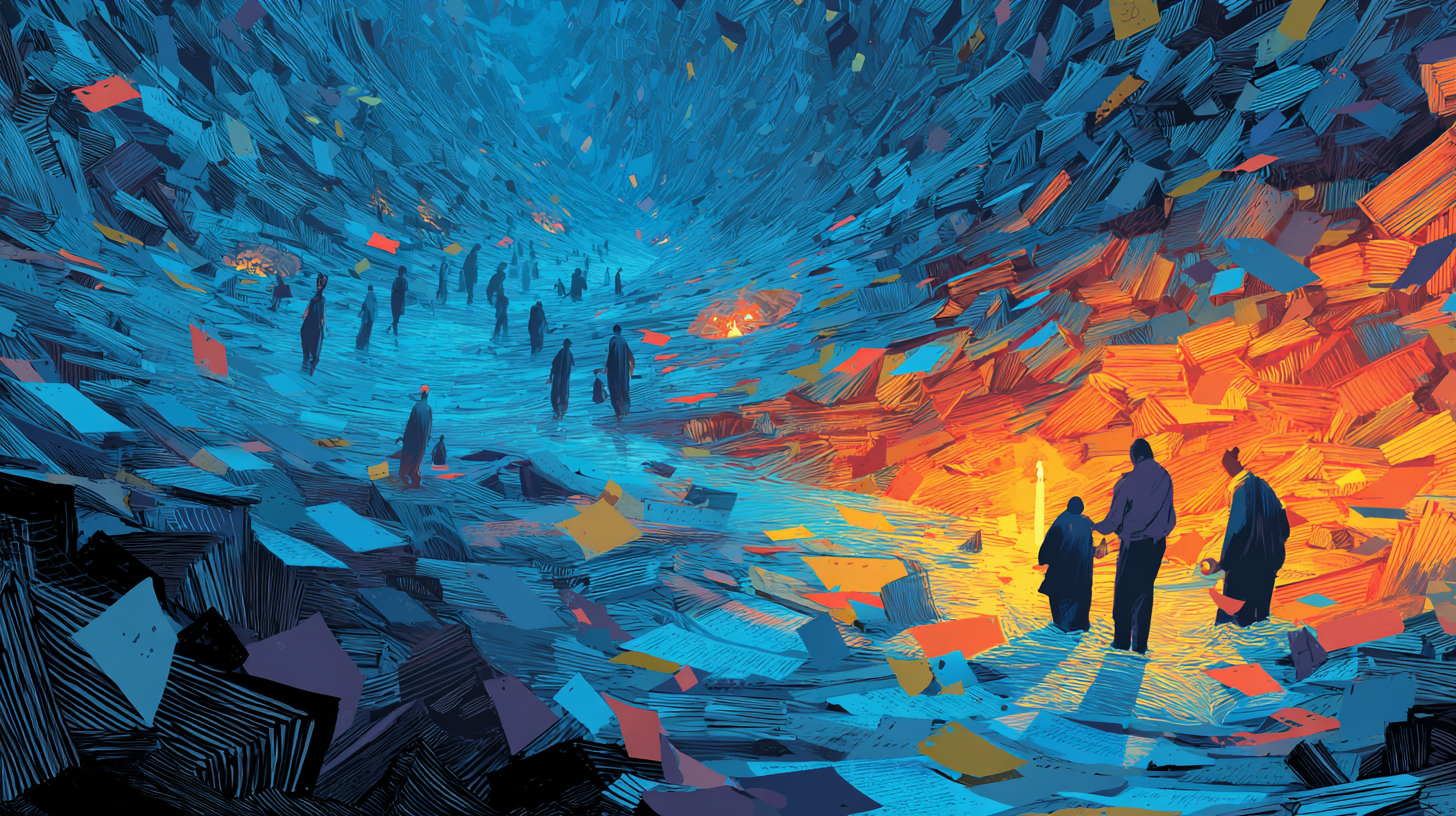
The figure does not measure human stupidity. It measures something more precarious, the brain’s structural preference for the surprising over the proven, for the vivid anecdote over the cold statistic. The algorithms that order what we see were not designed to inform, they were designed to hold attention for as long as possible, and they discovered, without meaning to, that outrage holds attention better than nuance. From hearing everything, we stopped listening to anything in particular. From seeing everything, our gaze became unable to settle on what actually matters. That saturation, not any shortage of schools or libraries, is the ignorance Ibn Rushd would have recognised in our century, an ignorance of excess rather than of want.
Fear as a business
Out of that confusion fear is born, fear of the unknown other, of a future that stopped being legible with the tools inherited from earlier generations. When certainties collapse, the mind reaches for simple answers with the urgency of someone gasping for air, and prefers a false but complete explanation to a true but fragmentary one.
That is where the merchants of certainty thrive, on the carefully cultivated ruins of doubt. They offer culprits instead of causes. They sell slogans instead of reasoning. A minister, a central bank, the board of a news channel, all of them have discovered that well managed fear produces more loyalty, and more audience, than any government programme or any nuanced analysis of reality.
Twentieth century history documented the same pattern on an industrial scale. European totalitarian regimes did not invent fear, they organised it, turning it into state policy through radio, cinema and controlled press, media that seemed as revolutionary then as social networks seem today. The difference lies not in the nature of the mechanism but in its speed and reach, a pamphlet took weeks to cross a border, a viral post crosses it in seconds and without passing through any editorial control.
There is no need to lie outright to sell fear. It is enough to select, to narrow the frame until only the threat remains, to repeat until repetition replaces proof. The technique is old, far older than the internet, but it never had at its disposal an infrastructure this efficient for reaching, simultaneously, billions of people already worn down by information fatigue into accepting the first explanation on offer.
Fear, moreover, follows a precise business model. Every notification confirming a threat generates a measurable reaction, every reaction feeds an advertising algorithm, and every algorithm learns to show more of what already worked. No one consciously designed a system to amplify collective panic, but the result is indistinguishable from what it would be had someone done so on purpose.
Fear, finally, has the advantage of requiring no verification. It is felt before it is reasoned. When reasoning does arrive, it almost always arrives to justify what the body had already decided to feel, not to question it.
Hatred that believes itself reason
Fear breeds hatred, because it is more convenient to point at an enemy than to face the complexity of the world. The foreigner, the scientist, the journalist, the neighbour, or simply whoever thinks differently, become the available faces of an anxiety that has, in truth, neither face nor nationality.
Hatred is not experienced as hatred. It is experienced as clarity. Whoever hates rarely perceives himself as irrational, he perceives himself as finally awake, freed from earlier naiveties he now attributes, retrospectively, to his own past innocence. That is both its effectiveness and its danger, hatred is an ignorance that has ended up convincing itself it is right, and against that conviction no argument can penetrate, because argument requires precisely the doubt that hatred was designed to eliminate.
Social psychology has spent decades describing the same process with different vocabulary. Gordon Allport, in his classic study of the nature of prejudice published in 1954, already distinguished stages running from contemptuous speech to extermination, passing through avoidance, discrimination and physical attack, each one psychologically preparing the ground for the next. Seventy years on, the sequence remains recognisable, only the speed at which a group can move through it has changed. What altered is not human nature but the machinery now available to move a population from one stage to the next within a single news cycle.
Digital platforms invented neither xenophobia nor racism, both predate any screen by centuries. What they contributed was an unprecedented echo chamber, capable of connecting within minutes people who would once have lived and died without ever crossing paths, united only by sharing the same object of resentment.
The mechanism follows a typical, almost universal scene. An unsourced rumour reaches a family WhatsApp group, accompanied by a photograph stripped of context. No one checks its origin. Someone forwards it because it confirms what they already feared, and within the hour abstract distrust of a group finally acquires a specific face to blame. That forward, repeated millions of times a day, targets shifting according to local context, is the minimal unit of contemporary hatred, small enough that no one feels responsible for the blaze it ends up feeding.
The figures document what everyday discourse still conceals beneath the neutral language of opinion.
Spain recorded a record 2,417 hate crimes in 2025, 23.6% more than the previous year, according to figures from the Interior Ministry. Over the same period, the FARO system run by the Spanish Observatory on Racism and Xenophobia detected that reportable hateful content on social media nearly doubled in the third quarter.
Spain is not an exception, it is a sample. Argentina recorded a 70% rise in hate crimes in the first half of 2025 compared with the previous year, according to the organisation Agencia Presentes, which also documents a parallel rise in institutional violence against LGBT people. The pattern repeats with local variations from one continent to another, because the mechanism described by Ibn Rushd knows no borders, no languages and no political systems, only conditions favourable to its spread.
From insult to gesture
Violence rarely begins with weapons. It begins with names. Every insult prepares a gesture. Every caricature of the other deepens a divide. Every refusal to understand moves the shores of peace a little further apart, without any single one of those steps seeming, on its own, decisive.
Civilisations do not collapse only under the blows of external enemies. They erode when their citizens stop talking to one another, when conversation gives way to mutual blocking, when listening to an opponent starts to be seen as a form of betrayal towards one’s own side. History offers more examples of this internal erosion than of sudden conquests from outside.
Faced with this tragic chain, Ibn Rushd still offers something more useful than a decorative aphorism, a method. To know is not to accumulate information, there is already too much of it, no one lacks access any more. To know is to learn to doubt with discipline, to listen before passing judgement, to prefer uncomfortable truth over the passions that flatter one’s own convictions. Above all, it is to resist the temptation of the quick answer when the question deserves time.
None of this requires heroism or exceptional erudition. It requires, at most, the discipline to suspend judgement for one minute longer than the algorithm allows, to ask who benefits from our believing a given version before we share it, to accept that the complexity of a problem does not disappear because someone found a sentence that sums it up in ten seconds.
Clarity is never born of noise. It is always born of the mind’s patient, unwitnessed work, the place where humility, at last, opens the door to wisdom…
G.S.
Sources
- The spread of true and false news online
- Study: On Twitter, false news travels faster than true stories
- Los delitos de odio en España marcan récord, suben un 23,6% y se ceban con los menores
- El discurso de odio en redes sociales se duplica en el tercer trimestre de 2025 según el sistema FARO del OBERAXE
- En 2025 los crímenes de odio aumentaron un 70 por ciento en Argentina
- Ibn Rushd (Averroes)
- Gordon Allport, The Nature of Prejudice, Addison-Wesley, 1954
Updated July 31, 2026