By Gabriel Schwarb
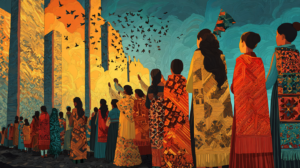
On Saturday 23 May, a boat sailed along the Magdalena river displaying a giant billboard bearing Abelardo de la Espriella’s face. In the night sky above the Gran Malecón in Barranquilla, drones drew the silhouette of a tiger over the crowd. Fifty thousand people looked upward while the music shifted from Joe Arroyo to Shakira, from Totó la Momposina to Argentine football chants. Then the candidate arrived dancing to his own jingle. “The pack has awoken,” he said, and the crowd roared. Nobody asked who paid for the drones. That is what spectacles are for. So that no questions arise.
The spectacle as argument
What happened that night in Barranquilla was not a political rally in the conventional sense of the term. A conventional rally involves speeches, proposals, debates about figures and programmes. What was staged at the Malecón was a high-budget audiovisual production designed to generate specific emotions in a specific audience. Drones that draw animals in the night sky are not spontaneous. They require logistical coordination, flight permits and considerable money. The boat on the Magdalena was commissioned, produced and positioned exactly where cameras would capture it best.
The question is not whether there was production, but what it serves and what emotions it deliberately activates. The tiger in the sky activates something concrete. “The pack” as a collective name activates something concrete. The Argentine football chants, imported from another context, activate something concrete. Each element was chosen by someone who knows precisely what it produces in the body of those who receive it. What they produce together is a feeling of belonging to something larger and stronger than oneself, a group with an identity, a symbol, a leader. That feeling is real. What is manufactured is the mechanism that generates it.
The man behind the Tiger
Abelardo de la Espriella is 47 years old, born in Bogotá and raised in Montería, Córdoba. He is a lawyer by profession and businessman by vocation. Over two decades he built his fortune representing paramilitaries, drug traffickers and fraudsters. This is not an accusation but his professional curriculum, documented and public. Among his best-known clients are individuals linked to the Autodefensas Unidas de Colombia (AUC), the far-right armed groups that operated from the nineteen-nineties through to the mid-two thousands, responsible for thousands of massacres and forced displacements that were never remedied.
In 2023 he obtained United States citizenship. He is now a candidate for the presidency of Colombia holding the passport of another country. This detail rarely appears in headlines, but merits attention. The man who wishes to govern Colombia took the legal precaution of securing a judicial refuge abroad before launching his candidacy. Donald Trump publicly promised him full support if he wins on 21 June. That support arrived accompanied by Daniel Newlin, Trump’s personal friend nominated as ambassador to Bogotá, and by Republican congresswoman María Elvira Salazar, a central figure in the hardest wing of the Republican Party in Washington.
Last week, candidate Iván Cepeda filed criminal complaints with the Colombian Attorney General and with the International Criminal Court, the tribunal based in The Hague that investigates crimes against humanity committed in any country signatory to the Rome Statute, accusing De la Espriella of aggravated criminal conspiracy (membership of a criminal organisation), financing of terrorism and illicit enrichment linked to the AUC. De la Espriella responded that it is a smokescreen. It may be. It is also possible that a lawyer who spent twenty years defending paramilitaries has, at some point, something more than a purely professional relationship with them. Colombians will vote on 21 June without either hypothesis having been judicially verified.
According to the AtlasIntel survey conducted between 5 and 10 June 2026 among 3,681 respondents, De la Espriella records a voting intention of 52.2% against 44.5% for Iván Cepeda, with a margin of error of 2%.
Why it works, and why that is nobody’s fault
In 1967, in a secondary school in Palo Alto, California, a history teacher named Ron Jones tried to explain to his students how Nazism had been possible in Germany. His students did not understand. The idea that a modern society could voluntarily follow a totalitarian regime seemed to them a matter for people less educated or less intelligent than themselves. Jones decided to show them rather than explain. For one week he introduced simple authoritarian rules into the classroom. Stand up to speak, answer in short sentences, do not question the leader. By the third day the movement had spread throughout the school. Students excluded those who did not participate and violence occurred against dissenters. Nobody had noticed what was happening.
At the end of the week, Jones gathered everyone together and explained that they had just reproduced, in miniature and in five days, the exact mechanics of the fascism they believed impossible. This experiment was brought to the screen in 2008 by German director Dennis Gansel in a film titled The Wave (Die Welle), today studied in schools across Europe because its lesson is uncomfortable. It does not say that people are stupid. It says that belonging to a powerful group activates emotional mechanisms older than reason, and that those mechanisms make no distinction between educated and uneducated people, between rich and poor, between young and old.
The tiger drawn by drones above the Malecón is no different, in its function, from the salute that the students of Palo Alto invented to recognise one another. It produces what that salute produced. Cohesion inward, exclusion outward, the certainty of belonging to something others do not understand. The mechanism requires no malice. It does not require the leader to be conscious of what he activates, nor that followers be complicit in anything. It requires only that nobody stops to look sideways. The question is not whether that mechanism was activated at the Malecón. It is what comes after, when it acts.
The catalogue of available endings
Nayib Bukele came to power in El Salvador in 2019 with exactly the same discursive profile De la Espriella displays today. Outsider, businessman, enemy of the traditional political class, iron fist against crime, high-impact visual spectacles, social media as primary channel. In 2022 he declared a state of exception and suspended constitutional guarantees, that is, the fundamental rights that protect any citizen from being detained without evidence. El Salvador today holds more than 80,000 people detained without verifiable judicial process, the highest per-capita incarceration rate in the world, and a president re-elected in 2024 in elections whose transparency was questioned by international observation bodies.
Javier Milei came to power in Argentina in November 2023 with a chainsaw as his campaign symbol and promises of radical reduction of the state, exactly what De la Espriella promises for Colombia. In his first year of government, poverty in Argentina rose from 41.7% to 52.9% of the population, the largest increase recorded in a single presidential term in the country’s recent history. Public services were defunded, subsidies eliminated abruptly and public universities cut to the point of generating mass protests that the government ignored.
Donald Trump has executed for Latin America, across his two presidential terms, a policy that Colombia knows directly. Mass deportations of Colombian migrants, tariff pressure, demands for migration cooperation under threat of economic sanctions. In January 2025, Colombia was the first country to receive a direct ultimatum from Washington when Petro refused to receive military aircraft carrying deportees. Trump responded with 25% tariffs that the Colombian government had to accept within hours. The candidate who today receives Trump’s public endorsement knows exactly what kind of relationship he accepts in doing so.
De la Espriella’s programme includes reducing the size of the state by 40%, building megaprisons, authorising civilian gun ownership and signing a military alliance with the United States and Israel to equip the security forces with advanced weaponry, according to the candidate’s statements to the Reuters agency.
What 21 June actually decides
These are not examples chosen to illustrate a thesis. They are the only available models that share the same discourse De la Espriella uses in Colombia today. There is no version of this political project that has produced different results elsewhere. If one existed, it would be reasonable to consider that Colombia might be the exception. It does not exist. The Malecón spectacle was designed not to be analysed. The drones in the sky, the boat on the river, the roaring pack, everything works better when one looks upward than when one looks sideways.
What lies to the side, in El Salvador, in Argentina, in Washington’s policy toward its southern neighbours, requires not interpretation but attention. On 21 June, Colombia has all the information it needs to decide. The results of this experiment in other countries are documented, public and verifiable. No predictions are required. What is done with that information is, for now, still a free decision…
G.S.
Sources
- The pack has awoken: De la Espriella closes his campaign in Barranquilla
- How De la Espriella’s campaign closing event unfolded at the Gran Malecón
- AtlasIntel poll: De la Espriella 52.2%; Cepeda 44.5%
- Colombia: Cepeda to file criminal charges against De la Espriella over paramilitary links
- De la Espriella, the far-right Tiger threatening to bring Trumpism to Colombia
- Colombia’s outsider candidate De La Espriella vows military crackdown
- The Wave (Die Welle)
- Petro accuses US of allying with drug traffickers after support for De la Espriella