In February 2010, L’Homme qui marche I by Swiss sculptor Alberto Giacometti sold at Sotheby’s in London for 104 million dollars, becoming the most expensive work of art ever auctioned. The sculpture, a 183-centimetre bronze cast in the Swiss canton of Graubünden sixteen years after the end of the Second World War, depicted a man advancing in assumed defeat, without armour, without promise of victory, with the sole programme of not stopping. The paradox went unacknowledged. The most expensive work in history was also the image of the utmost human vulnerability, reaching its highest valuation precisely when the historical conditions that had produced it were beginning, in silence, to dissolve.
The figure and its inversion
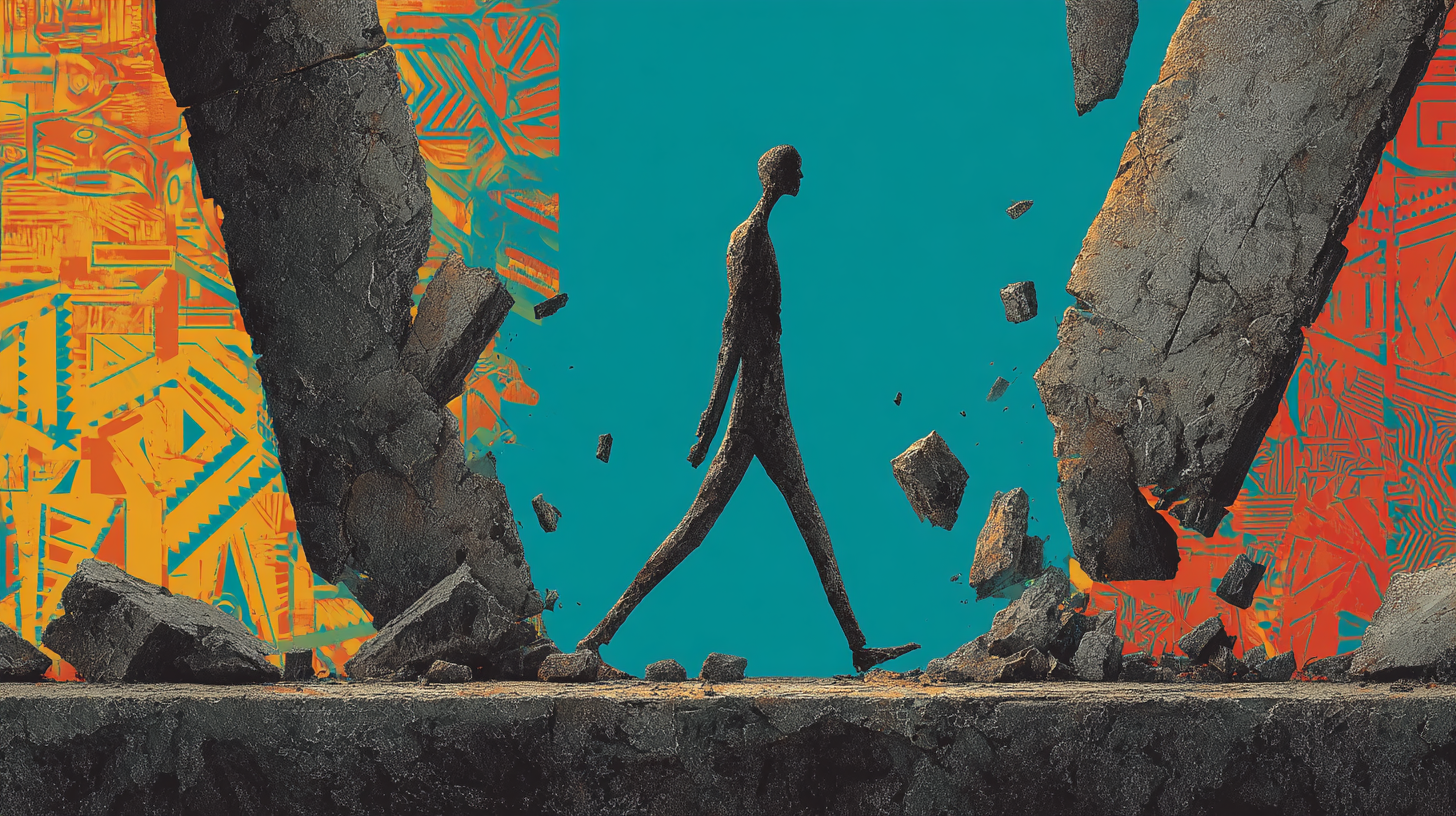
For those who have never seen the sculpture, it is worth pausing. There is nothing heroic about it in the classical sense. The body is long, almost consumed, as if time had been reducing it to its minimal expression; the legs are disproportionately long, the torso compressed to its essentials, the head small and the face barely sketched. The man carries nothing, neither weapons nor flags nor crown. He advances with the posture of one who has traversed something that cannot quite be named, slightly leaning forward as if pushing against a permanent wind. In that gesture, and nowhere else, everything resides.
Giacometti produced these figures as a formal response to what Europe had witnessed between 1939 and 1945. The Second World War, in its most extreme phase, had revealed something without documented precedent on that scale; that a modern society, with its universities and its efficient administration, could organise the systematic extermination of millions of people. The Nazi concentration camps, where approximately six million Jews died alongside millions of others from minorities and political dissidents, were not a savage anomaly but a product of the same industrial rationality that manufactured trains and counted grain.
After that, representing human beings with classical solidity would have been a marble lie. The man who emerges from that experience cannot be sculpted as before. He knows that civilisation can coexist with the abattoir, that administration can transform itself into serial murder without losing its appearance of order. What Giacometti produces is, in that sense, the counter-model; that of a man who has lost his illusions but not his dignity, who moves forward because stopping would be to yield to emptiness.
That figure has a contemporary adversary that does not hide. The adversary is the armoured man, not the strong man of classical imagery with his muscles and his flags, but something more modern and more electorally profitable. He is the man who has turned his identity into a carapace, who interprets any questioning as aggression, who transforms his real economic vulnerability into manageable identity-based rage, who confuses fear with lucidity and empathy with surrender. Between Giacometti and this armoured man there is not simply an aesthetic difference. There is a functional one; one produces institutions, the other consumes them.
The industry of the armoured man
The mechanism is well known, though it is rarely described with the coldness it deserves. In societies suffering sustained economic contraction, inflation, employment deterioration or industrial displacement, vulnerability is a daily and massive experience. That vulnerability could become a demand for social protection, a call for redistribution, institutional pressure on the state. But it requires a political translation process, a language that connects the private experience of dispossession to a recognisable collective action. The radical right has perfected, over the past two decades, an alternative translation; that of identity grievance.
The mechanism consists of taking real economic vulnerability and redirecting it towards a cultural enemy, which may be minorities, immigrants, the press or academia depending on the context and the available electoral market. Economic pain converts into moral indignation, material precarity into symbolic superiority. The voter who has gone three years without a real wage increase discovers that his place in the world is threatened not by the concentration of capital but by those he no longer names as persons but as categories. The armoured man is the final product; his identity functions as armour that does not protect him from real blows but prevents him from recognising them as his own. It is, technically, a political anaesthetic.
The Latin American catalogue
In Brazil, Jair Bolsonaro built his public persona upon a masculinity that researchers described as belligerent, aggressive and exclusionary; exhibited physical strength, virility asserted with scatological frequency, contempt for minorities as a mark of authenticity and permanent readiness for combat as a cardinal virtue. Sexuality was at the heart of his political language, not as a private matter but as a code of belonging. The bolsonarista man recognised himself in that potent masculinity, shared the fear of “deviants” and felt that defending that identity meant defending something real. Vulnerability lay elsewhere; in those who threatened that natural order. The armoured man had no need to recognise his own.
In Argentina, Javier Milei imported a functionally analogous doctrine. His declared intellectual reference is Murray Rothbard (1926–1995), an American economist who wrote in 1992 that libertarians should promote right-wing populism as a political strategy for reaching the people. Milei’s armour is not virility but the market; the certainty that the self-sufficient individual, guided solely by self-interest, needs neither state nor solidarity nor collective protection. Vulnerability becomes a moral failing; whoever cannot sustain himself alone is guilty of his own weakness. The cuirass is ideological, not muscular, but its function is identical.
In El Salvador, Nayib Bukele has carried the logic of the armoured man into the domain of law. On 27 March 2022, following an escalation of homicides attributed to gangs, the government decreed a state of exception that suspended the right to legal defence of detainees, the inviolability of telecommunications and basic procedural guarantees. The term “state of exception” designates a temporary legal regime in which the executive power may suspend constitutional rights that are normally untouchable. The Legislative Assembly, with its ruling-party majority, has renewed this regime more than twenty consecutive times.
The Inter-American Commission on Human Rights (IACHR, an independent body that monitors the respect for fundamental rights across the continent) documented arbitrary detentions, enforced disappearances and systematic torture under that regime. The government’s argument is always the same; security demands that law yield. The armour of the state is built on the suppression of the very guarantees that same state had erected to protect the most vulnerable.
Since 27 March 2022, more than 66,000 people have been detained in El Salvador under the state of exception decreed by the Bukele government. Salvadoran humanitarian organisations and the Office of the Human Rights Ombudsman registered more than 7,900 complaints of violations, the majority for arbitrary detention. The IACHR repeatedly urged the state to restore the suspended constitutional guarantees.
What the armoured man destroys
The pertinent question is not moral. It is structural. The question is not whether the armoured man is good or bad, nor whether his leaders lie deliberately or distort reality with sincere conviction. It is what those structures produce over time, what mechanisms they activate and what collective capacities they erode as they consolidate. Identity populism is not a temperamental phenomenon but a mode of operation, and like all modes of operation it produces documentable effects regardless of the intentions of those who drive it.
The institutions that emerged from the post-1945 period were not philosophical abstractions. They were concrete constructions, built upon the awareness that human fragility requires collective protection; rule of law, independent press, autonomous judiciary, oversight bodies, rights the state cannot unilaterally withdraw. Those constructions were the political response to the discovery that civilisation could coexist with extermination. They were dykes, not monuments.
The data from Reporters Without Borders (RSF, an independent organisation that annually evaluates press freedom in 180 countries) documents their erosion with precision. Every government that manufactures armoured men produces, as a technically foreseeable side effect, the suppression of the mechanisms designed to question power. The armoured man will not tolerate a mirror. Brazil recovered 47 positions in the index since the end of the Bolsonaro government. The correlation does not prove causality, but it is no coincidence; in terms of historical construction, it amounts to dismantling in under a decade what took generations to erect.
In Reporters Without Borders’ 2025 World Press Freedom Index, Argentina accumulated a fall of 69 positions compared with 2022. El Salvador dropped 61 positions since 2020 and 77 since 2018, the year before Bukele came to power. RSF notes that Milei and Bukele are reproducing Donald Trump’s playbook against the media. For the first time since the organisation began publishing its index, in 2002, it warns of a global situation rated as difficult, with press freedom at its lowest level across the entire period of record.
What remains
Giacometti did not sculpt a utopia. He did not sculpt the man as he should be, nor the one that civics textbooks propose as a model. He sculpted the man who had survived the revelation of what was possible, who remained upright not because he believed in progress but because the next moment existed and demanded a step. That posture is neither defeat nor triumph. It is something more difficult; consciousness without anaesthetic, and it is precisely that which the armoured man, in his various Latin American iterations, has decided he cannot bear.
The armoured man manufactured by Bolsonaro, Milei and Bukele builds nothing new. He consumes the structures that protect him without knowing it; the press that could expose the corruption that impoverishes him, the justice system that could defend his rights when the state violates them, the state itself whose redistributive capacity he rejects as socialism but whose absence he will pay for in flesh and blood. The armour is not a solution. It is an analgesic that leaves the wound intact and the patient without the capacity to diagnose it. In the time it takes for the analgesic to lose its effect, institutions dissolve, guarantees are suspended, journalists emigrate or fall silent, and the armoured man discovers that the armour they sold him was too heavy to keep walking…
G.S.
Sources
- RSF World Press Freedom Index 2025 — Americas
- RSF World Press Freedom Index 2025 — Global report
- LatAm Journalism Review — Press freedom in the Americas in sharp decline, May 2026
- WOLA — A year without civil liberties in El Salvador
- IACHR — Report on state of exception and human rights in El Salvador
- IACHR — El Salvador must restore guarantees
- Espacio Público — Bolsonarism, masculinities and resistance
- SciELO — The anti-populist populism of Javier Milei
- openDemocracy — Milei, a libertarian threat to Argentine politics
- Revista de Arte Logopress — L’Homme qui marche I, auction record 2010
- Primo Levi, If This Is a Man, Einaudi, 1947
- Hannah Arendt, Eichmann in Jerusalem, Viking Press, 1963