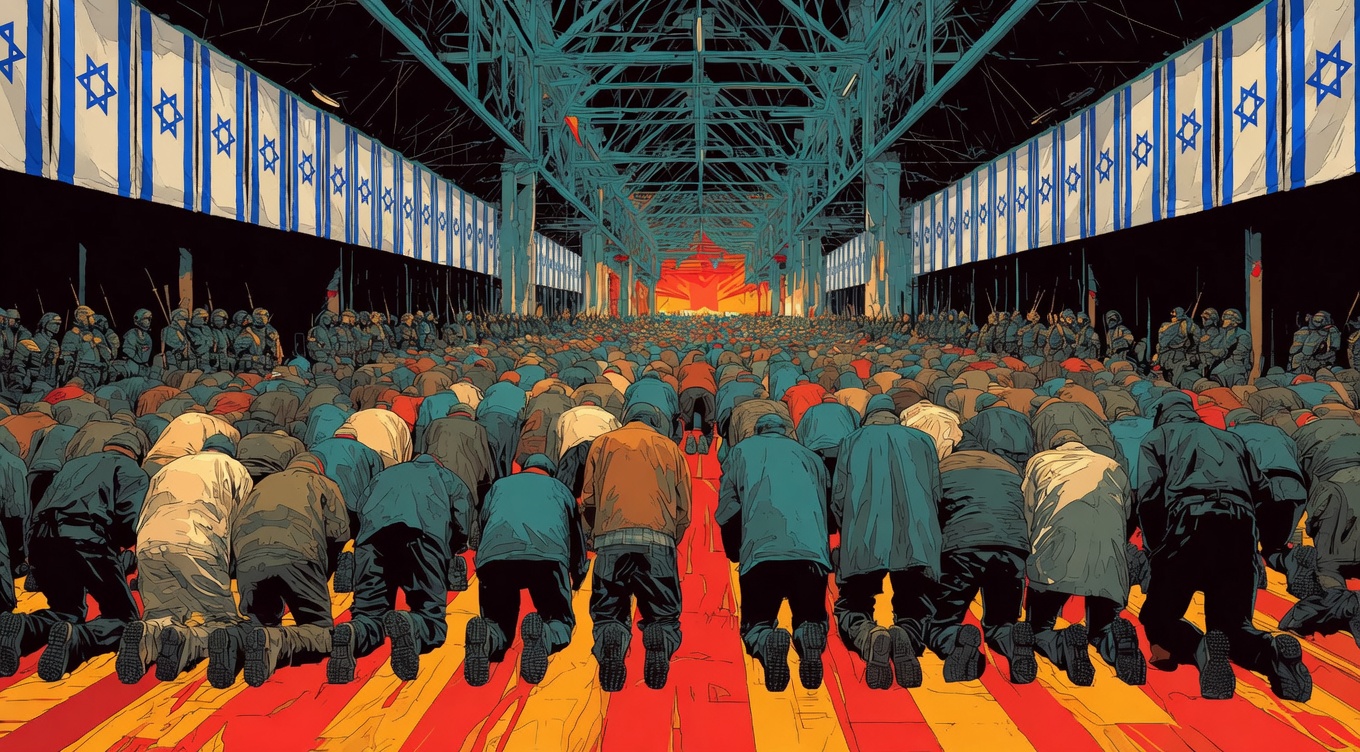
On 20 May 2026, Israeli National Security Minister Itamar Ben Gvir posted a video on X in which he is seen walking through the port of Ashdod whilst dozens of activists from the Global Sumud humanitarian flotilla kneel before him, hands bound behind their backs. Ben Gvir waves a large Israeli flag above them, shouts in Hebrew “Welcome to Israel, we are in charge here!” and smiles as a security agent shoves a handcuffed activist to the ground for crying “Free Palestine!”. The national anthem blares over loudspeakers. He published it himself, without concealment, as a political message that required no interpretation. What followed was the predictable international storm of condemnations and, finally, the most revealing piece of the episode, the “rebuke” from Benjamin Netanyahu.
The Flotilla and the Law Nobody Enforced
On 19 May 2026, the Israeli navy intercepted the fifty vessels of the Global Sumud flotilla approximately seventy nautical miles from the coast of Gaza, that is to say, in international waters, well beyond Israeli territorial waters. On board were some 430 activists from more than forty countries, including Italian, Spanish, French, Irish, South Korean and Latin American nationals, attempting to deliver humanitarian aid to the Gaza Strip, which has been subject to an Israeli naval blockade since October 2023. The flotilla had departed Turkey a few days earlier, in a renewed attempt to break that blockade.
To understand why the interception was, from the outset, legally contestable, one must know a basic framework of maritime law. The United Nations Convention on the Law of the Sea, known by its acronym UNCLOS, establishes that no state may interfere with the free navigation of civilian vessels in international waters, defined as those extending beyond twelve nautical miles from any country’s coastline. Israel is not a signatory to UNCLOS, but the international legal community regards its core principles as customary law, meaning a binding norm for all states even without treaty signature.
Seventy miles offshore, the Global Sumud vessels were sailing in a space where Israeli sovereignty does not exist. The flotilla’s spokesperson, Thiago Ávila, stated this precisely to the Israeli naval commander by radio, seconds before the boardings began. Only one of the fifty boats had crossed the twelve-mile line marking the start of Israeli territorial waters. The rest were intercepted on the high seas.
The Global Sumud flotilla was intercepted on 19 May 2026 at 70 nautical miles from the Israeli coast, well within international waters according to the UNCLOS definition. Only one of the fifty vessels had crossed the twelve miles marking the boundary of Israeli territorial waters.
Flotilla organisers reported that Israeli soldiers fired on at least five vessels before boarding them. The Israeli military denied this, stating that non-lethal means had been used as a warning. Images broadcast by the activists themselves during live streams show military speedboats approaching in the dark, blinding lights and water cannons. The four hundred and thirty detainees were transferred to Ashdod port, where they were to be processed and deported. None was charged with any offence under Israeli criminal law. They were detained, humiliated and expelled.
The Convicted Minister Who Governs Without Hindrance
Itamar Ben Gvir is fifty years old and has eight criminal convictions. This is not a secondary detail; it is the architecture of his political career. He was convicted of incitement to racism and of supporting the Kach movement, founded by Rabbi Meir Kahane. Kahanism, for those unfamiliar with it, is an ideology combining Jewish ultranationalism with the explicit advocacy of expelling Palestinians from all territories under Israeli control, and with the assertion that violence is a legitimate value. The State of Israel itself banned the Kach party in 1994, and the United States designated it a terrorist organisation. Ben Gvir was its youth coordinator. By the age of eighteen, his criminal record was already so extensive that the Israeli army rejected him as too extremist.
In 1995, a few weeks before the assassination of Prime Minister Yitzhak Rabin by a right-wing extremist, Ben Gvir appeared on television brandishing an ornament he claimed to have wrenched from Rabin’s car, and declared on camera, “We got to his car, and we’ll get to him too”. In 2007, a Jerusalem court convicted him of hate speech and of supporting the Kach movement, which the Israeli state had declared a terrorist organisation thirteen years earlier. None of these convictions slowed his ascent. Netanyahu brought him into government in 2022 because he needed the far-right bloc’s votes to remain in power. In 2025, Ben Gvir returned to the post of National Security Minister, which controls the Israeli police.
The Rebuke That Is Not a Rebuke
When the video went viral, the international reaction was swift. France, Italy, Spain, Canada, Portugal, the Netherlands and South Korea summoned their respective Israeli ambassadors. Italian Prime Minister Giorgia Meloni, until then among the most sympathetic European voices towards Israel, called Ben Gvir’s conduct “inadmissible” and demanded a formal apology. The South Korean president asked about the legal basis for the operation and whether the events had occurred in Israeli waters. European Council President Antonio Costa said he was “appalled” and demanded the immediate release of the detainees.
It was in this context that Netanyahu’s statement arrived. The Prime Minister asserted that Israel “has every right to prevent provocative flotillas of Hamas terrorism supporters from entering our territorial waters and reaching Gaza”, and added that “the way Minister Ben Gvir handled the flotilla activists is not in line with Israel’s values and norms”. Netanyahu instructed authorities to deport the activists “as soon as possible”. Foreign Minister Gideon Saar was more direct on X, telling Ben Gvir he had “deliberately caused damage to the state with this disgraceful performance”. Ben Gvir responded in the Knesset, Israel’s parliament, accusing Saar of “bowing to the terrorists”.
Benjamin Netanyahu condemned the “way” Ben Gvir treated the activists, but explicitly defended the interception of the flotilla in international waters as a “right of Israel”. It was Netanyahu who appointed Ben Gvir as National Security Minister in 2022, despite his eight prior criminal convictions.
What Netanyahu did was not a rebuke. It was an image-management operation in two movements. First, validate the substance of the matter (the interception, the detention, the deportation). Then, distance himself aesthetically from the staging. The problem Netanyahu identifies is not that foreign nationals were detained in international waters. The problem is that Ben Gvir filmed the humiliation and posted it on X. The difference between the two is not moral; it is one of optics.
The Double Standard That Sustains the System
The week of the video, the United States Treasury Department sanctioned the organisers of the Global Sumud flotilla, freezing their assets on the grounds that they represented a threat to national security. The following day, the US ambassador to Israel, Mike Huckabee, declared that Ben Gvir had “betrayed dignity” with his performance. Both things happened in the same week. Financial sanctions for those who organised the voyage; a verbal rebuke for the man who filmed the humiliation. It is the same double standard, executed without shame.
Europe fares no better. Several governments that summoned Israeli ambassadors in May 2026 are the same ones that, in the preceding months, had blocked sanctions against Israel in the European Union Council, or avoided recognising the genocide characterisation issued by the International Court of Justice. The outrage is genuine, but also selective; it is triggered when the humiliation has a European face, when those on their knees are citizens with recognisable passports. What happens to Palestinians detained in the very prisons Ben Gvir administers, under conditions documented as systematic torture, does not summon ambassadors. There are victims who have press coverage and victims who do not. The former produce diplomatic crises. The latter produce silence.
The Image That Should Have Surprised Nobody
What Ben Gvir did on 20 May has a name in international humanitarian law; it is called degrading treatment of persons in custody. Common Article 3 of the Geneva Conventions explicitly prohibits humiliating treatment of persons deprived of their liberty. The United Nations Convention Against Torture extends that prohibition to any form of detention. Forcing people to kneel with bound hands whilst a minister films them against the backdrop of the national anthem is not a matter of legal interpretation; it is a description that appears in the textbooks.
But the question no diplomatic statement thought to ask is the most elementary. How did a man with eight criminal convictions, including support for a terrorist organisation, come to control the police of a state that presents itself as a democracy? The answer does not lie in Ben Gvir. It lies in those who appointed him, in those who tolerated him, in those who continued signing trade and military cooperation agreements with the government that sustains him. Ben Gvir did not need to escalate anything; the system was designed to bring him to where he is. Next time a flotilla is intercepted, the minister in charge will be more discreet. The activists will remain kneeling in the same port, with the same bound hands, with no camera there to confirm it…
G.S.
Sources
- Ben Gvir posts video of himself taunting bound and detained Gaza flotilla activists, The Times of Israel, 20 May 2026
- Netanyahu rebukes Israeli security minister after video shows degrading treatment, CBS News, 20 May 2026
- Several nations summon Israeli envoys as Ben-Gvir taunts flotilla activists, Al Jazeera, 20 May 2026
- US condemns Israel’s Ben-Gvir while sanctioning Gaza flotilla organisers, Al Jazeera, 20 May 2026
- Ben Gvir taunts flotilla activists, highlighting Israel’s abuse of detainees, Truthout, 21 May 2026
- Ben Gvir exhibe lo que Europa tolera, Público, 22 May 2026
- El desprecio de Ben Gvir a la Flotilla provoca inusitada autocrítica en Gobierno Netanyahu, Infobae/EFE, 22 May 2026
- Itamar Ben Gvir: el genocida que acusa de terrorismo a los pacifistas, Mundo Abierto, September 2025
- Itamar Ben-Gvir, Biography, Encyclopædia Britannica
- Is Israel’s interception of the Gaza Freedom Flotilla legal?, The Conversation, February 2026
- Israel, the Gaza Flotilla and the violation of navigational rights under UNCLOS, Malay Mail, October 2025