Estimated reading time: 14 minutes ·
Since 1492, the Catholic Church operated in Latin America not as a spiritual institution but as the administrative arm of the conquest: it legitimised the extermination of between 50 and 56 million people, destroyed millennial temples to build churches on their foundations, imposed conversion by force and used sexual violence as a tool of domination. Five centuries later, the mechanism continues under other forms. In Colombia, more than 585 priests have been denounced for paedophilia and sexual abuse, of whom barely 51 were convicted. The institution enjoys total exemption from income tax, its worship properties pay no property tax, and the Concordat signed with the State in 1973 guarantees it a perpetual debt paid from public funds. The Church is not a historical relic. It is a structure of accumulation and impunity that continues to operate with full efficiency.
The Colonial Machine
In the year 1500, the Americas were home to between 50 and 80 million people. By the beginning of the seventeenth century, the population had fallen to less than 10% of that figure. Academics at University College London calculate 56 million deaths. The Spanish sword and epidemics performed the physical work; the cross provided the theological justification and the officials in the field.
The friars who landed in the New World were functionaries of the Crown, funded by the king and deployed with a precise commission, according to historian Antonio Rubial of the UNAM. The mission was not to save souls; it was to produce fiscally exploitable subjects. “We come to bring you salvation,” they told the indigenous peoples, “in exchange you must work for us.” The distance between that sentence and a contract of servitude is purely ceremonial.
The legal instrument of that order was the “requerimiento”, a document read aloud, in Castilian, to indigenous communities before attacking them. It informed them that the Pope had donated those lands to the kings of Spain and that if the natives did not immediately accept Spanish sovereignty and the Catholic faith, the war that followed would be their own responsibility. It was read before people who did not understand the language, in the jungle, often at night. It was legal theatre designed to produce the appearance of consent where none existed. The Church drafted the document. The Church blessed the procedure.
The massacres that followed that theatre are a matter of historical record. In the Massacre of Cholula (1519), Hernán Cortés and his allies killed between 3,000 and 6,000 people in a few hours. In the Massacre of the Temple Mayor, in May 1520, Pedro de Alvarado ordered the knifing of Mexica nobles who were celebrating a religious ceremony with the authorisation of the Spanish troops themselves. Similar massacres occurred throughout the geography of the continent over two centuries. Friar Bartolomé de las Casas was the only clergyman to document the atrocities in detail. That he was the exception and not the norm is, in itself, a datum about the institution. In the territory that is now Colombia, the same pattern was applied from the 1530s. The Muisca communities of the plateau saw their temples and huacas destroyed; the Achagua of the Llanos were subjected to forced conversions on mission haciendas where labour was obligatory.
Between 1500 and the early seventeenth century, the indigenous population of the Americas fell from between 50 and 80 million to fewer than 6 million people, according to estimates from University College London. Historians describe that process as the greatest genocide in human history in absolute terms. The Catholic Church not only did not prevent it but justified it theologically and participated in its direct administration through the encomienda system.
The Erasure of a World
The destruction of indigenous cultures was not collateral to the colonial project; it was its condition of possibility. To convert a people, one must first empty it of its references. The Spanish missionaries understood this clearly and acted accordingly. They burned codices, destroyed temples, persecuted indigenous priests and prohibited ceremonies on pain of torture or death.
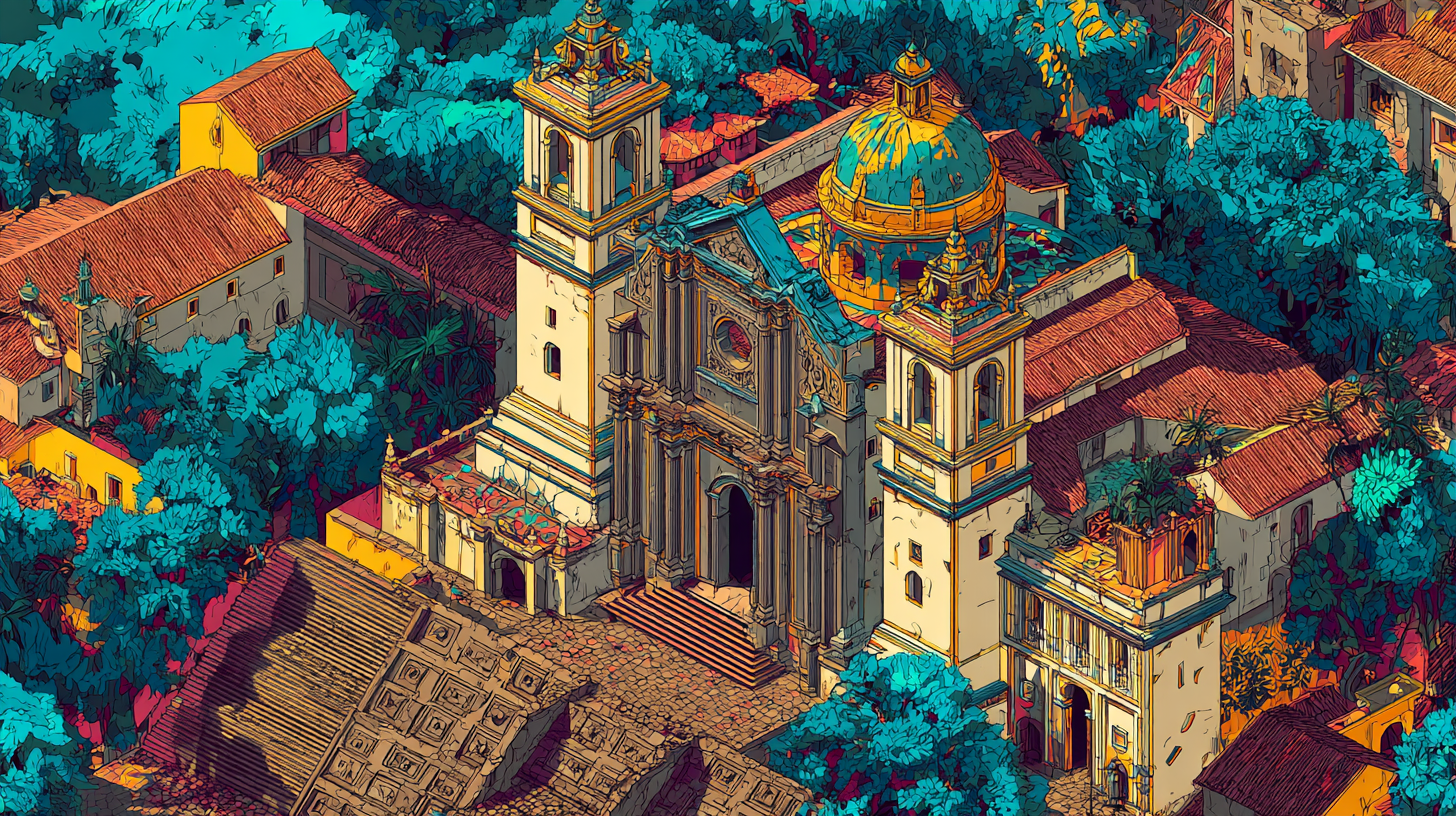
The architecture says everything. In Mexico City, the Metropolitan Cathedral stands exactly on the Temple Mayor of Tenochtitlan, the most important religious structure of the Mexica Empire. Its foundations used the stones of the dismantled pyramid. The choice of site was not practical; it was a statement of principles. In Honduras, the church of Santiago de Posta was built on a ninth-century Maya temple, reusing its sculpted blocks and covering them with stucco to conceal them. Throughout Mesoamerica, in the Andes, in the territories that are today Colombia and Venezuela, the pattern repeats without variation. The Christian temple on the destroyed huaca is not a geographical coincidence; it is a deliberate semiotic operation seeking to substitute the sacred referent in the territory and in collective memory.
“Colonialism is not satisfied with merely holding a people in its grip and emptying the native’s brain of all form and content. By a kind of perverted logic, it turns to the past of the oppressed people, and distorts, disfigures and destroys it,” wrote Frantz Fanon in The Wretched of the Earth (1961). The stones of the Temple Mayor in the foundations of the Cathedral are not a metaphor; they are the literal application of that principle.
In Colombia, the Truth Commission documented how the Capuchin and Jesuit missions in territories such as Tierradentro, the Putumayo and the Valle de Sibundoy used systematic control devices over local indigenous communities. The Camentsá of the Valle de Sibundoy were subjected to a conversion process that articulated, according to academic analyses catalogued on Dialnet, “actions of spiritual conversion and insertion into a different productive model, as two key fronts of their colonisation.” Religion and economic exploitation were not parallel activities. They were the same activity described with different vocabularies.
Bodies as Territory
Sexual violence is a structural part of every conquest, and the conquest of the Americas was no different. What distinguished it is that the Church, through its moral authority and the institution of ecclesiastical jurisdiction, guaranteed for centuries the impunity of that violence when its own members exercised it. Under the viceroyalty it was unthinkable to arrest captains, hidalgos or ecclesiastical authorities for acts of sexual violence against indigenous women, who enjoyed absolute impunity. The bodies of indigenous women were territory for conquest in the same way that the land was. The mestizaje produced by that process was not intercultural; it was forced. The consequences of that violent origin continue to structure the social hierarchy of Colombia, where the indigenous population constitutes the most impoverished and most stigmatised caste in the country.
What persists with institutional fidelity is not the crime but the mechanism that protects it. In Colombia, the journalistic investigation by CasaMacondo and journalist Juan Pablo Barrientos identified 585 priests denounced for paedophilia and sexual abuse. Of those 585, the Attorney General’s Office knew of 350 cases and filed away the majority as time-barred. Only 51 priests were convicted. In 2024, 160 of those denounced were still practising the priesthood, and three of them reoffended that same year. The total number of abusers could exceed 4,000 if the Church delivered the 87% of its archives it still retains under canonical reserve.
The case of Villavicencio illustrates the architecture of that impunity. In March 2020, 38 priests of the Archdiocese of Villavicencio were denounced for sexually abusing and inducing into prostitution the same man from the age of 14. Archbishop Óscar Urbina Ortega suspended the priests, waited for the media pressure to subside and reinstated them one by one. The Attorney General’s Office questioned the victim in the first days and questioned no one else. The vicar who organised the cover-up strategy, William Prieto Daza, was promoted to bishop of San Vicente del Caguán in 2024. Had this involved 38 doctors from the same hospital, the process would have taken a different course.
Of the 585 Colombian priests denounced by CasaMacondo, only 51 were convicted. The 137 bishops each covered up at least one case; the prelates voluntarily reported only 40 to the Attorney General. In 2024, three reoffenders were still in active ministry. The Constitutional Court had to rule twice before the Church surrendered just 13% of the information requested.
Privilege as Continuity
The Church did not accumulate power in the sixteenth century in order to lose it in the twenty-first. Its presence in Colombia today is that of a real-estate, financial and educational corporation with complete tax exemption and state protection guaranteed by international treaty.
The Concordat signed between Colombia and the Holy See in 1973 recognises the Church’s full legal personality, guarantees it the right to acquire, possess and manage movable and immovable property without restriction, and exempts from property tax all buildings used for worship, diocesan curias, episcopal residences and seminaries. Article 22 of the 1887 Concordat, reaffirmed in 1973, establishes something even more revealing: it recognises “in perpetuity” a debt of the Colombian State to the Church, as compensation for properties confiscated in the nineteenth century. The Colombian State has been paying a perpetual rent for more than 130 years to a private institution for having expropriated lands that the institution itself accumulated on territories seized from indigenous communities during the colonial period. The cycle of plunder closes perfectly upon itself.
The DIAN reported an aggregate patrimony of 9.7 trillion pesos for the totality of religious institutions registered in Colombia, with annual revenues exceeding 4 trillion pesos. The Catholic Church does not publish its own accounts. The Catholic Church shares no information whatsoever about its finances or its real-estate holdings. If the corporate income tax rate of 35% were applied, the additional revenue to the State would be approximately 2.8 trillion pesos annually, according to calculations by the Petro government in the context of its tax reform. That money is not collected. The official justification is the social function of the churches. The question Congress avoids is what percentage of that social function actually exists and how much goes to fund the lawyers that archbishops hire to block the journalists who ask questions about paedophile priests.
Conclusion
The history of the Catholic Church in Latin America is not the history of an institution that made mistakes in the past and then reformed itself. It is the history of an extraction mechanism that adapts formally while keeping its structural privileges intact. The forced evangelisation of the sixteenth century and the secret archive of paedophile priests in the twenty-first are different expressions of the same operational principle: the institution operates above the law because the State, for political convenience, tolerates that position.
The vocabulary changes. No longer are there “barbarians” in need of salvation; there is a “social function” that justifies the tax exemption. No longer are temples destroyed with picks and shovels; criminal causes are filed away as time-barred. The instruments modernise but the result is the same: sustained impunity, protected accumulation, institutional silence. That continuous thread between the cross planted in 1492 and the Concordat in force in 2026 is not history; it is infrastructure. What reproduces the marginalisation of indigenous communities is not forgetting but the legal and fiscal architecture that the Church continues to inhabit in perfect comfort…
G.S.
Sources
- “How the arrival of Europeans affected the Americas”, University College of London / The Conversation, January 2019
- “The Destruction of the Indigenous Peoples of Hispano América”, Scielo México, 2019
- “El amor predicado por la evangelización y la violencia ejercida por los conquistadores”, UNAM Global, Antonio Rubial, August 2019
- “Evangelización, encubrimiento y resistencia indígena” (Camentsá case), Dialnet, 2016
- Truth Commission of Colombia, section “Evangelisation”, comisiondelaverdad.co
- “El archivo secreto: la lista de curas denunciados por pederastia y abuso sexual en Colombia”, CasaMacondo / Juan Pablo Barrientos, 2023–2025
- “Pederastia en Villavicencio: 5 años de impunidad”, CasaMacondo, April 2025
- “Las víctimas de abuso sexual en ámbitos religiosos en Colombia pasan a la acción”, Ángel Villazón Trabanco, September 2025
- “La religión no paga impuestos, pero factura billones”, El Espectador, Salomón Kalmanovitz, February 2025
- Ley 20 de 1974, Concordato entre la República de Colombia y la Santa Sede, 1973
- Sentencia C-027/93, Constitutional Court of Colombia
Updated April 19, 2026