Julien Gracq published The Opposing Shore in 1951, when the European ruins were still smouldering and no one had finished counting the dead. The book was awarded the Prix Goncourt that same year. Gracq refused it, with the same cold consistency that had led him a year earlier to denounce the commercial compromises of the literary world in his pamphlet La Littérature à l’estomac. The gesture matters because it announces something about the book itself, a refusal to be absorbed by spectacle, to become a commodity of sensations. Seventy-five years later, that novel describes the world of 2026 with surgical precision, not because it is prophetic, but because it speaks of mechanisms that do not change, the way in which a fatigued civilisation can desire, without knowing it, its own collapse.
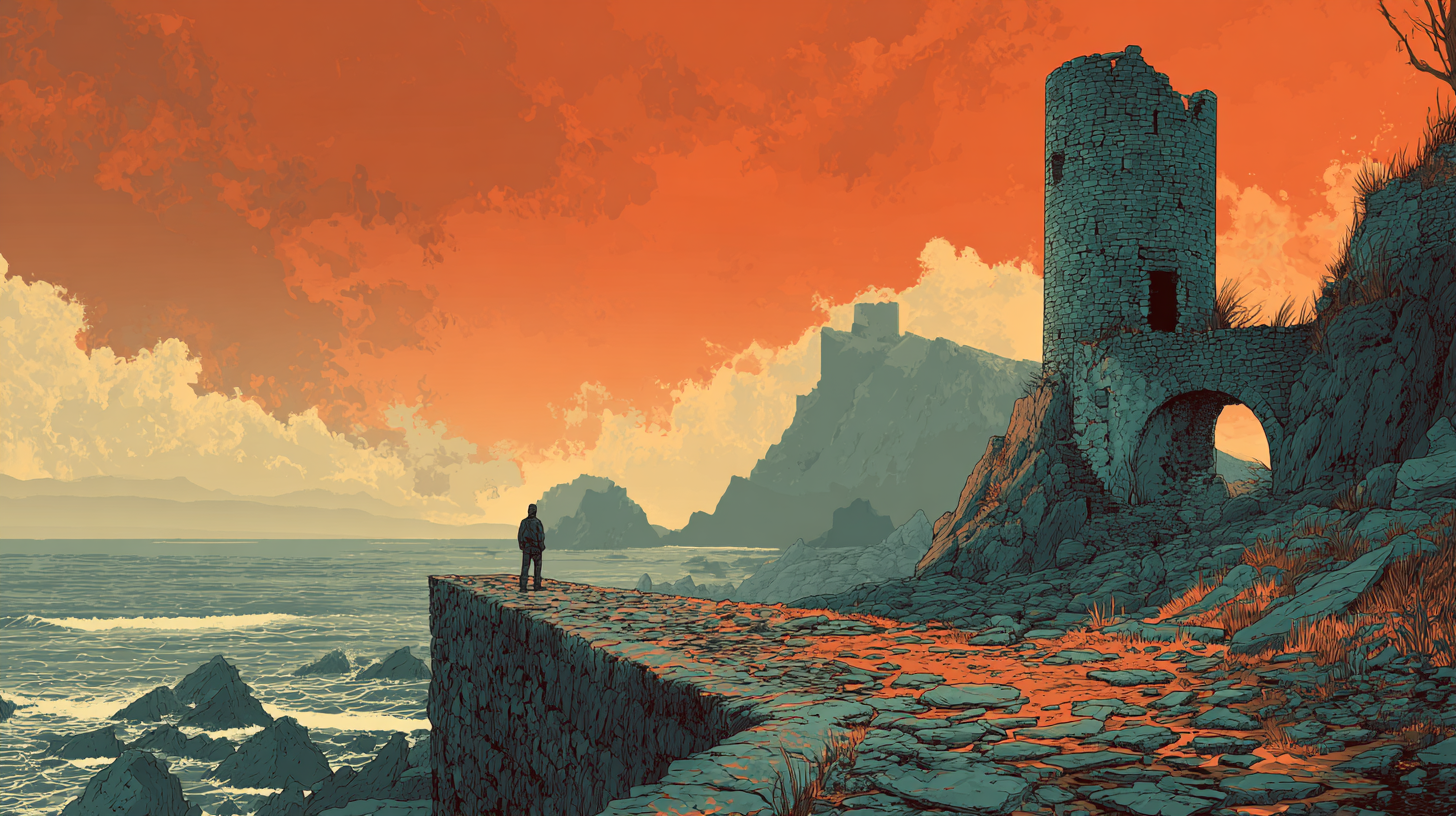
The plot is simple. Aldo, a young aristocrat from the fictional republic of Orsenna, an exhausted old power, is sent as an observer to a fortress at the southernmost edge of the territory, on the shores of the Syrtes, facing a mysterious country called the Farghestan. Technically, the two states have been at war for centuries. In practice, there are no battles. There is a peace of habit, a kind of armed drowsiness, a conflict that exists in the archives and in the rituals but that no one remembers having lived through. And it is there, in that zone of suspension, that Gracq installs his question. He does not ask what happens when war begins. He asks what happens before. Long before. In the silence where disasters are made.
The Sleeping Republic
Orsenna is a civilisation that has confused peace with boredom. Its institutions function. Its officials show up to their posts. Its archives are in order. But something essential has evaporated, the conviction that any of it serves a purpose. Military rituals continue because rituals do not need to believe in themselves to perpetuate. The frontier is watched without anyone quite knowing why. Hostility towards the Farghestan is maintained as one maintains the furniture of a house that nobody inhabits any more, out of inertia, to avoid having to decide.
What Gracq describes is not decadence in the grandiose sense, the epic fall of great empires, but something far more banal and far more dangerous. He describes the administrative fatigue of meaning. A society that keeps producing its internal procedures without being able to articulate what those procedures are for. That holds on to the maps of a forgotten war. That sustains an enmity that has become almost a piece of scenery. This state, which the narrator calls a “fever peace”, is not peace. It is peace emptied of its content, which is the permanent work of building it.
The V-Dem Institute at the University of Gothenburg notes in its 2025 report that the world now has 88 democracies and 91 autocracies, a reversal that had not occurred in more than twenty years. This is not only about declared autocracies, but about democracies that continue to hold elections, maintain parliaments, publish constitutions, while the real content of those institutions empties out. France has now gone two years without a budget passed within constitutional deadlines. The mechanisms keep turning. The conviction that they serve any purpose has evaporated.
Orsenna is that. And Orsenna appears on no map because it appears on all of them.
The Interior Frontier
Gracq’s second lesson is not geopolitical. It is psychological, and that is why it is harder to see. The frontier separating Orsenna from the Farghestan is not merely a line across the sea. It is an interior line, a discipline, a capacity for self-restraint in the face of the horizon. And the book shows, with hypnotic slowness, how that line shifts.
The process has a precise grammar. First, it would be interesting to know. Then, it would be useful to verify. Next, it would be courageous to go and look. And finally, one crosses. Not out of malice. Not out of plan. But because each previous shift has redefined the territory of the permissible, and the next step always seems modest compared with the one before. Aldo does not decide to provoke a war. He decides to do something that seems reasonable given everything he has already done. The transgression does not happen at once; it accumulates in layers so thin that none of them seems to be the last.
This grammar of slippage is one of the least studied mechanisms in contemporary politics, perhaps because it demands looking at oneself with an uncomfortable honesty. Military escalations rarely begin with a decision to escalate. They begin with a proportionate response to a prior provocation, which was itself a proportionate response to another prior provocation, until no one can say precisely when the line was crossed, because the line moved along with the steps. Economic sanctions that tighten. Arms limits that shift. Discourses that radicalise one degree at a time until what was unspeakable five years ago has become banal.
According to the V-Dem 2025 report, 40% of the world’s population today lives in countries undergoing active processes of autocratisation. The level of democracy experienced by the average citizen in the world has fallen back to 1985 levels.
Aldo, in the novel, is not a cynical strategist. He is something worse. He is an intelligent and available man. Availability is his danger. He is open to the call of the frontier because he has nothing else that anchors him with the same intensity. And around him, everything conspires to feed the fascination, the sea, the silence, the ancient tales, the idea that beyond lies an enemy, and therefore the ever-living possibility of an awakening.
The Lure of the Precipice
The third lesson is perhaps the most uncomfortable because it speaks not of tyrants or ideologies, but of something more diffuse and more universal. Gracq demonstrates that crises are not always triggered by hatred. Sometimes they are triggered by desire. The desire for something to happen. The desire to feel that one still exists. The desire for rupture as relief from the monotony of what is.
Aldo is not an agitator. He does not recruit, does not conspire, does not write manifestos. He is simply available, and that availability, in the context of a civilisation emptied of meaning, is enough for catastrophe to find its way. The mechanism is uncomfortable because it requires no villains. It requires only a combination of institutional boredom and fascination with the precipice, two conditions that the world of 2026 manufactures in series. Digital platforms, whose economy rests on attention time, have established that outrage, escalation and rupture generate more screen minutes than deliberation, complexity or nuance. The system of incentives governing political communication on a global scale rewards the Aldo who crosses the frontier, not the governor who holds the line.
The Reuters Institute’s Digital News Report 2025 documents that populist politicians have learnt to bypass traditional journalism in favour of personalities and influencers who rarely ask difficult questions, and who frequently participate in spreading disinformation. The language of rupture does not merely mobilise voters; it colonises the architecture of attention of entire societies.
The result is that the desire for rupture, which is human and understandable, ends up being amplified, organised and converted into electoral merchandise. This is not manipulation in the classical sense. It is something more systemic, an attention economy with its own laws, one that produces its own Aldos without the need for any centralised conspiracy. Gracq does not condemn his character. He observes him. With that clinical coldness that is the only honesty available when dealing with mechanisms that everyone, to some degree, recognises in themselves.
The Irreversible
The book’s final lesson is also its most brutal. Once Aldo sends a signal to the Farghestan, once the frontier has been crossed, there is no going back. The conflict that seemed dormant wakes. And the awakening is neither glorious nor liberating. It is simply the logical consequence of a chain of acts that no one, at any moment, thought would go so far.
Irreversibility is the most underestimated political concept of our era. There is endless debate about the intentions of actors, about their programmes, about their good or bad faith. There is far less debate about the point beyond which certain decisions cannot be undone. Britain’s exit from the European Union was voted for by a majority that did not fully understand its legal, economic and institutional consequences. Years later, the majority of British citizens consider it a mistake. But the mistake is permanent. The treaties were signed. The processes were activated. The supply chains reorganised themselves. The irreversible does not ask whether it was a good idea.
Catastrophe, in Gracq, does not require a grand conspiracy. It does not require a villain with a plan. It requires an accumulation of small displacements, of cultivated ambiguities, of bravado, of curiosities, of wounded pride. One gesture followed by another, each justified by the previous one, until the whole produces a result that nobody chose in its entirety but to which everyone contributed. This description is so exact that it seems almost obscene to apply it to the present, because it turns history into something with no clearly assignable culprits, no moments of clear choice, no possibility of pointing to the instant when everything could have been different.
Perhaps that is why it is easier to talk about Orsenna than about what Orsenna describes.
Peace as a Work
There is a sentence that the whole book implies without stating it. Peace is not an absence of events. It is a daily construction, a slow labour, a capacity to tolerate the unfinished, the complex, what produces neither thrill nor media coverage nor the feeling that history is moving forward. Orsenna had lost its taste for that labour long before Aldo crossed the frontier. The catastrophe was possible because the ground had been preparing for decades.
Contemporary democracies are not at war. They are in something that resembles it, the condition of those who maintain the forms of order without believing in their meaning. Who hold elections without trusting their results. Who sustain alliances whose content has emptied. Who hold on to maps of a world that no longer exists. And in that state of institutional torpor, the figure of Aldo, the available man, the man fascinated by the precipice, is not an anomaly. He is the natural product of the system.
Gracq offers no solutions. He never asked for any. But he leaves something more useful than a solution, a grammar of disaster precise enough to recognise its stages. The initial clumsiness that normalises. The first shift of the frontier that seems minor. The fascination that is mistaken for courage. The point at which the irreversible has already been set in motion without anyone having decided to set it in motion. Reading The Opposing Shore in 2026 is not a literary exercise. It is recognising in fiction a mechanism that operates without fanfare, without prior announcement, with the same hypnotic slowness with which the sea of the Syrtes erased, night after night, the footprints of the patrols in the sand…
G.S.
Sources
- Julien Gracq, The Opposing Shore (1951), Éditions José Corti
- V-Dem Institute, Democracy Report 2025. 25 Years of Autocratization, University of Gothenburg
- Reuters Institute, Digital News Report 2025, University of Oxford
- Elisa Chelle, La démocratie à l’épreuve du populisme. Les leçons du trumpisme, Odile Jacob, 2025
- François Brousseau, “Populisme, printemps 2026”, Le Devoir, May 2026
- Julien Gracq, La Littérature à l’estomac (1950), Éditions José Corti