There is a way of walking that has become suspicious, that of the one who hesitates. The faltering step, the one who stops halfway, the one who turns back to try the same path again, attracts today a distrust it perhaps did not attract before. We admire, instead, without much scrutiny, whoever moves fast and without visible cracks, as if speed were itself proof of competence. This text is not about morality or individual courage. It is about a fairly precise social mechanism, the way an entire society decides which bodily behaviours count as proof of worth and which as a sign of failure, without anyone having voted on it or discussed it anywhere visible. Better to say it upfront, with all possible clarity, there is no romantic praise of weakness here, only the dissection of a theatre that almost no one recognises as such while performing in it.
The choreography of confidence
Erving Goffman explained more than sixty years ago that social life works as a permanent stage, where each person performs for an audience that watches and judges them, even when that audience does not always do so consciously. Walking fast, speaking without faltering, making decisions without displaying the doubt that preceded them, are performances of that kind. They do not prove the decision was correct. They only prove that whoever made it knows how to play the role the situation demands.
The gesture convinces before the argument does.
Goffman distinguished between what he called the front stage and the back region, the visible space where one performs and the private space where one rehearses, corrects oneself, stumbles without witnesses. The correction, the hesitation, the discarded draft, belong almost always to the back region. What reaches the front stage is the already polished version of those doubts, presented as though no other version had ever existed. An executive who lays out a flawless plan generates more immediate trust than one who acknowledges margins of error, even when the second plan turns out, in time, to be sounder. The same happens with the doctor who diagnoses without nuance versus the one who asks for a second opinion, or the speaker who never says I don’t know. Contemporary society does not always reward accuracy, it rewards the staging of accuracy, which is a different matter, and considerably easier to fabricate.
Research on eyewitness testimony documented something similar, and rather uncomfortably so. The confidence with which a witness recounts what they saw predicts, across several studies, the credibility a jury grants them better than the actual accuracy of their account does. A confident witness convinces even when wrong. One who admits doubt raises suspicion even when right, and the system supposedly designed to separate truth from error ends up, at that exact point, rewarding the performance rather than the content.
Something similar happens in the classroom, in a far less dramatic but equally constant register. A teacher who answers any question without hesitation, even when they should point to a source or admit not knowing the exact figure, tends to be perceived by students as more competent than one who openly acknowledges the limits of their knowledge. Over time, the second teacher’s doubt often turns out to be the sign of more honest, better grounded knowledge. In the moment it happens, though, it is rarely read that way.
In the conformity experiments conducted by Solomon Asch in the early 1950s, close to seventy-five percent of participants aligned at least once with the unanimous, mistaken judgment of a group of actors, despite visual evidence contradicting that judgment. (Asch, Studies of Independence and Conformity, 1956)
The crowd that moves together
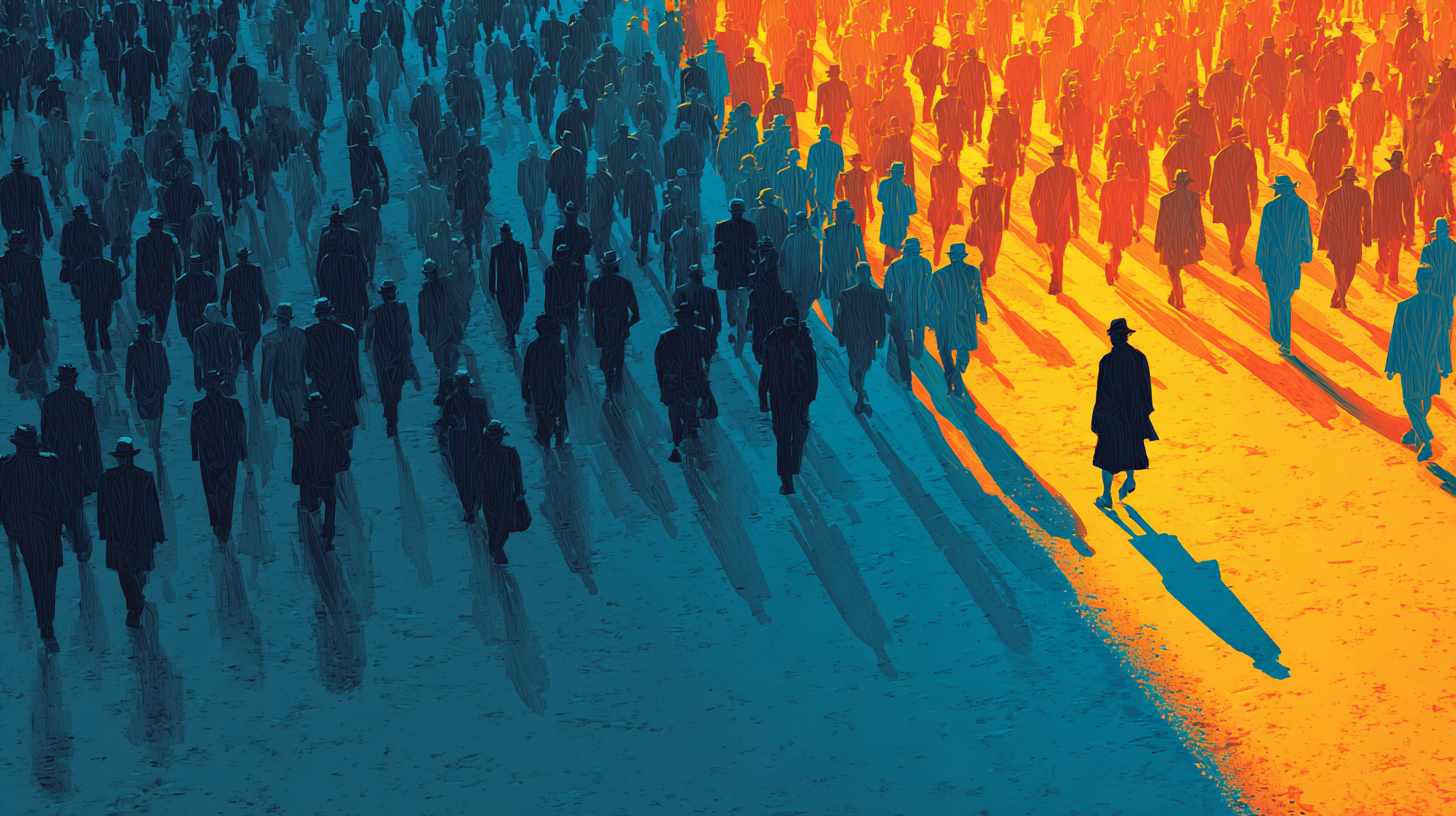
No one personally examines every path they take. Most everyday decisions are made through silent delegation, one does what others are already doing, trusting that a route travelled by many has, at some point, been checked by someone. It is a reasonable economy of cognitive effort. It is also, quite precisely, the mechanism Asch documented in his laboratory, transposed to the scale of an entire life.
The paved road does not prove it is the right road, it only proves it is occupied.
Something similar happens on a mountain trail. The official path, marked and maintained, is not always the shortest or the safest, but it concentrates most of those climbing, simply because it is already marked by the footsteps of those who climbed before. Every so often someone opens a better shortcut across open ground, and that shortcut becomes, over the years, the new official path, though no one remembers any more that it began as the deviation of a single person who chose not to follow the line.
Something similar is observed in emergency evacuations. Faced with a fire, a good number of people try to leave through the door they used to enter, even when a closer, less congested exit exists, simply because that route was already validated by prior experience, their own and that of the other bodies moving in the same direction. Familiarity replaces calculation. No one stops to compare distances while the building fills with smoke, and that same substitution, familiarity instead of calculation, operates every day in far less dramatic circumstances.
Sociologist Diane Vaughan documented a precise case of this same mechanism while reconstructing the decision to launch the Challenger shuttle in 1986. Several engineers held concrete doubts, already voiced before the launch, about how a component would behave at low temperatures. Those doubts were silenced meeting after meeting, not for lack of data but under the accumulated pressure of keeping to a schedule and an image of collective control that no one wanted to be the first to break. Vaughan called that process the normalisation of deviance, the organisational habit of treating a repeated warning sign as though it had already become part of normal procedure. No one needed to verify the route because the others did not seem to doubt it either. Individual doubt, in that context, is read not as prudence but as deviation, and deviation carries an immediate social cost that collective error, while the march lasts, does not yet carry.
The stigma of doubt
Goffman also used the word stigma to describe an attribute that socially discredits whoever carries it, not because it is objectively harmful, but because it breaks a shared expectation of how a body or a normal behaviour should present itself. Whoever hesitates in public carries, for as long as that hesitation lasts, a miniature version of that stigma. They are looked at differently. They are doubted more readily than they doubt their own path.
Doubting out loud is costly.
The cost is not always professional or financial, often it is barely a glance, a silence, the diffuse sense of having lost some authority in front of those listening. That is enough, however, for most people to quickly learn to hide doubt rather than expose it, to fabricate a confidence they do not feel rather than admit the uncertainty they do feel, and that learning passes from generation to generation without any institution needing to teach it explicitly. Whoever sustains that performance for years usually pays another price, less visible than the gaze of others, the private sensation of playing a role they never quite believed in, something rather close to what psychology later described as impostor syndrome, the intimate certainty of not quite deserving the confidence others attribute to them.
The trap closes on both sides. Exposing doubt costs an immediate loss of authority. Hiding it costs an intimate wear that accumulates in silence, because every successful performance demands the next one, without the real doubt ever disappearing, it simply lodges a little deeper inside.
The reputation of someone confident, once established, also demands constant upkeep. Every new occasion on which that person must decide something in public reactivates the same demand, appearing just as certain as the previous time, whatever the matter at hand or however scarce the available evidence. Reputation, in that precise sense, functions like a debt only ever repaid by performing, never by openly admitting its fragility.
Social psychology documented a further irony in all this. In the classic 1999 study by David Dunning and Justin Kruger, people with lower actual competence at a task tended to markedly overestimate their own performance, unable to recognise their own mistakes precisely because of the same lack of skill that produced them. The more competent participants, by contrast, showed considerably better calibration, and even a slight tendency to underestimate themselves. Displayed confidence, according to that finding, does not always accompany real competence, and at times is inversely proportional to it.
In his 1897 study of suicide, Émile Durkheim documented significantly higher rates among Protestant populations than among Catholic populations of the same European region, attributing the difference to each group’s degree of social integration rather than to individual temperament. (Durkheim, Le suicide, 1897)
Loose social bonds, according to Durkheim, do not forgive. Whoever steps away, even merely by hesitating out loud in front of others, pays a comparable price on a smaller scale, that same solitude of standing outside the shared choreography.
The limping man as mirror
Whoever walks with a limp does not choose that way of moving, most of the time they suffer it. But the social effect of that limp, involuntary and without any demonstrative intent, turns out identical to that of any doubt exposed in public, it reveals that the confident stride of everyone else is largely a construction, not a natural fact of the body or the mind. It takes only a body unable to fake the expected choreography for the choreography itself to become visible as choreography.
No one does it on purpose. The mirror works just the same.
Groups that will not tolerate visible doubt also tend to lose exactly the information that doubt would have contributed. Whoever suppresses an objection to avoid breaking the shared choreography withdraws from the group a piece of data no one else possessed. The whole group keeps moving forward, confident and wrong, with one piece of information less than it might have had if someone had allowed themselves to limp for a moment in front of the others.
Socrates asked one question at a time, unhurried, ready for the answer to force him to abandon the previous question. Montaigne corrected himself in the margins of his own texts, leaving the doubt visible rather than erasing it before publication, and he chose for that exercise a word that still says more than it seems to, essais, from the verb essayer, to try, to test, never to prove conclusively. Neither of them offered the choreography of certainty the rest of the room expected, and both, in their time, were accused of something like inconsistency. What reads today as philosophical method was, first, a social infraction, and the very name Montaigne gave his way of writing is, read today, almost a confession of that defiance.
None of this calls for a moral celebration of slowness, nor a condemnation of those who walk fast in good faith, most of them do so without calculating anything, carried simply by the same collective habit that carries everyone else. It calls only for noticing that displayed confidence and real competence are two distinct variables, which social life confuses far too easily, and that the hesitant step, far from being a flaw to correct, may be the only gesture capable of showing, by contrast, how much theatre lies in all the other steps…
G.S.
Sources
- Solomon Asch, Studies of Independence and Conformity: A Minority of One Against a Unanimous Majority, Psychological Monographs, 1956 (physical work, no link)
- Émile Durkheim, Le suicide, 1897 (physical work, no link)
- Erving Goffman, The Presentation of Self in Everyday Life, 1956 (physical work, no link)
- Erving Goffman, Stigma: Notes on the Management of Spoiled Identity, 1963 (physical work, no link)
- Pauline R. Clance and Suzanne A. Imes, The Impostor Phenomenon in High Achieving Women, Psychotherapy: Theory, Research and Practice, 1978 (physical work, no link)
- Michel de Montaigne, Essais, 1580 (physical work, no link)
- David Dunning and Justin Kruger, Unskilled and Unaware of It, Journal of Personality and Social Psychology, 1999 (physical work, no link)
- Diane Vaughan, The Challenger Launch Decision: Risky Technology, Culture, and Deviance at NASA, 1996 (physical work, no link)