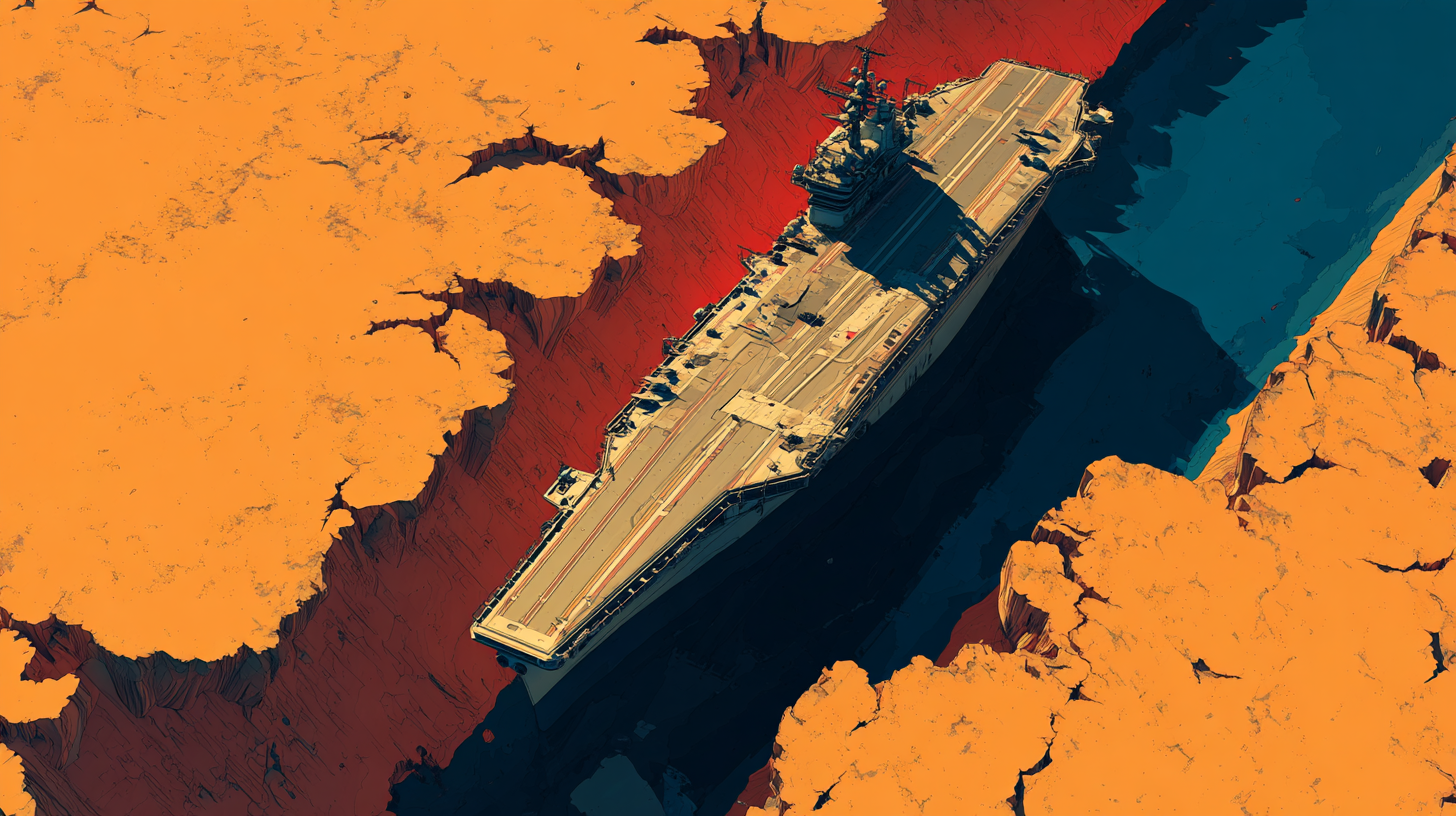
On February 28, 2026, Israel and the United States killed Iran’s supreme leader on the opening night of a war Washington had promised would be short and decisive, a deployment of aircraft carriers, fighter jets and tens of thousands of troops unmatched since the start of the century. Nearly five months later, his son governs from a quiet convalescence, the war continues, and the Strait of Hormuz remains blocked by an Iranian navy Washington had declared destroyed months earlier. The United States Secretary of Defense, Pete Hegseth, told the Senate on July 21 that the conflict now costs 37.5 billion dollars, a figure independent analysts consider understated by at least threefold. Seventeen American soldiers have died since the war began, a number that grows every week with no declared political objective, five months on, explaining why.
The war nobody decided to end
The sequence seemed closed back in June of last year. American stealth bombers struck the nuclear sites at Fordow, Natanz and Isfahan, and Donald Trump announced on national television that the United States had completely destroyed Iran’s atomic program. Eleven months later, on February 28, Israel and the United States struck again, this time in an operation named Epic Fury, and that second offensive ended with the death of Ayatollah Khamenei, the single most significant event of the conflict and also the one that has done the least to define what comes next.
A ceasefire signed in Versailles on April 8 never really held. Researcher Adel Bakawan, director of the European Institute for Middle East and North African Studies, put it bluntly, both sides signed the same document fourteen times and read it differently every single time. On July 7, the bombs fell on Iran again, and the Strait of Hormuz has stayed closed by Tehran ever since, which continues sinking tankers and firing on commercial vessels despite Washington’s earlier claim to have annihilated its naval capability. Analysts quoted by the Canadian press described this second phase in a sentence that could serve as an epitaph for the entire campaign, it has a new objective but not necessarily a clearer strategy.
Nobody in Washington has said, in five months, what winning this war would even mean.
The Iranian navy, in particular, keeps disproving Washington’s own account of its destruction. The Islamic Revolutionary Guard Corps claims to have struck the aircraft carrier USS Abraham Lincoln with four missiles, a claim American officials deny outright, and several tankers, including the Skylight and the MKD VYOM, have reportedly been damaged off the coast of Oman. Whatever the truth of any single strike, the broader picture is consistent, an Iranian fleet declared finished keeps finding ways to threaten one of the world’s most important shipping lanes.
Khamenei’s state funeral, held between July 4 and 9 in Tehran and Mashhad, offered an unintended measure of that continuity. As many as 35 million people took part, according to official Iranian figures, in a six day procession crossing five cities between Iran and Iraq before burial at the Imam Reza shrine. Mojtaba Khamenei, named successor by the Assembly of Experts just eight days after his father’s death, missed much of the ceremonies. Analysts attributed his absence to security concerns and to wounds sustained in the same strike that killed his father, a detail carried by several outlets but never officially confirmed by Tehran. The image Washington needed, a decapitated and disoriented regime, never materialized. What appeared instead was a state apparatus capable of organizing, in the middle of a war, a mass mobilization and an orderly succession within two weeks.
The numbers that do not add up
On July 21, before a visibly skeptical Senate committee, Hegseth offered the official figure, 37.5 billion dollars, a jump of nearly 30 percent from the May estimate of 29 billion. Democratic Senator Jeanne Shaheen reminded him the Pentagon still holds 75 billion dollars unspent from an earlier budget package, money Hegseth wants to add to an additional 67 billion request he called urgent. Analyst Stephen Semler, of Popular Information, broke the real spending down into three separate categories and arrived at a figure above 102 billion, nearly triple what was acknowledged at the hearing. CSIS, a strategic studies center with direct access to Pentagon sources, puts the floor at 40 billion without counting the indirect economic losses, which economist Kent Smetters estimates between 50 and 210 billion more for the United States alone.
The gap is not a technical disagreement between economists. It is proof, number by number, that the American government itself does not know, or will not say, how much this war costs.
The official cost of the war in Iran, declared by the United States Secretary of Defense before the Senate on July 21, 2026, stands at 37.5 billion dollars. Independent analysts at Popular Information put it above 102 billion.
There is also an older figure, documented since the Afghanistan war under the Obama administration, that rarely makes it into current official tallies. Keeping one soldier deployed in an active theater then cost, on average, one million dollars a year. Absent a published equivalent for the current Gulf deployment, that precedent alone suggests a meaningful share of the jump from 29 to 37.5 billion acknowledged by Hegseth has a simple structural explanation, more soldiers deployed for longer.
The July 21 hearing did not happen in a vacuum. Six months from midterm elections, with Republicans and Democrats fighting for control of Congress, polls favor the opposition, which has begun openly tying the cost of the war to the erosion of American voters’ purchasing power. Republican Senator John Kennedy, from Trump’s own party, ended up demanding clear answers from Hegseth about what would happen if Washington simply walked away from the strait. That the question came from his own political side says more about the real state of this war than any Pentagon figure.
What Washington does not want seen
On May 6, the Washington Post published an investigation based on satellite imagery analysis, with an uncomfortable conclusion for the Pentagon. At least 228 structures or pieces of military equipment were damaged or destroyed across 15 bases spread through Kuwait, Bahrain, Qatar, Jordan, Saudi Arabia and the United Arab Emirates, a figure far higher than what the government had publicly acknowledged. The paper reviewed more than one hundred images released by Iranian state media and verified the authenticity of 109 of them by cross checking them against the European Copernicus system and against commercial imagery from Planet.
What the Post documented next matters more than the damage count itself. Two American satellite imagery providers, Vantor and Planet, restricted or delayed the release of photographs of the war zone at the direct request of their largest client, the United States government. The practical consequence was that independent journalists had to turn to the public European system, over which Washington holds no authority, to document what its own government preferred to keep invisible. This is not one transparency problem among others. It is the very structure of how this war gets told, or silenced, to the public paying for it.
The Washington Post identified damage or destruction to at least 228 American military structures and pieces of equipment across 15 bases in the Persian Gulf, verified through the European Copernicus satellite system after the United States government itself requested restrictions on commercial imagery.
The heaviest damage concentrated at the naval base in Bahrain, home to the US Navy’s Fifth Fleet, and at three facilities in Kuwait, Ali al Salem Air Base, Camp Arifjan and Camp Buehring. Military experts consulted by the paper agreed on one unsettling detail, the precision of the strikes largely ruled out miscalculation. There were no scattered craters suggesting missed shots, specific structures had been hit with an accuracy that can only be explained by detailed prior intelligence on the internal layout of the bases. The war Washington describes as a demonstration of technological superiority left, in the very same satellite imagery, proof that the adversary knew exactly where to aim.
Thirty five years without a single victory
No country has ever accumulated, in recent history, military power comparable to what the United States now deploys over the Persian Gulf. Aircraft carriers, entire squadrons of fifth generation fighters, missile defense systems, a logistics network no other military on the planet can match. And yet, from Somalia in 1993 to Iran in 2026, through Iraq, Afghanistan, Libya and Syria, that material accumulation has never once translated into a clear, sustainable political victory recognizable as such. Force keeps getting mistaken for power, as if deploying more missiles automatically decided the fate of another nation.
Force destroys. Power organizes what comes after the destruction, and on that count Washington has been failing consistently and predictably for thirty five straight years.
Somalia, in 1993, left eighteen American soldiers’ bodies dragged through the streets of Mogadishu and a hasty withdrawal months later, without the warlord the intervention targeted ever losing real control of the territory. Iraq, in 2003, was justified by weapons of mass destruction that never existed, toppled a dictator, and handed the country over to two decades of sectarian civil war from which Washington eventually withdrew without having stabilized anything resembling a functioning state. Afghanistan, the longest war in American history, ended in August 2021 with images of people falling from airplanes at Kabul’s airport, as the very same Taliban movement the United States had gone to overthrow twenty years earlier retook power within days. Libya, bombed in 2011 under NATO mandate to protect civilians, fractured into a failed state with two rival governments and slave markets documented by CNN itself. Syria absorbed a decade of indirect American intervention without Washington ever managing to impose a political outcome to its liking, and the regime that finally fell in 2024 did so through internal dynamics unrelated to any strategy drawn up at the Pentagon.
Iran illustrates the pattern with near textbook precision. The supreme leader was killed, the hardest military objective to reach in the relationship between the two countries, and the regime did not fall. His son was named successor within eight days, wounded and recovering, and remains in charge. The nuclear program was declared destroyed last June and the war resumed months later. The Iranian navy was declared annihilated and the Strait of Hormuz remains closed. A ceasefire was set in Versailles and broke down in under three months. Every declaration of victory was followed, with almost mechanical regularity, by the fact that contradicted it.
The pattern is not new, what is new is the speed at which the contradiction now arrives, fed by a European satellite system Washington cannot silence and by a Senate that has begun asking uncomfortable questions of its own about bills that do not add up. Nobody in Washington has yet explained what winning this long war would actually mean, or at what human and budgetary cost they would be willing to call it a victory…
G.S.
Sources
– [Iran has hit far more U.S. military assets than reported, satellite images show](https://www.washingtonpost.com/investigations/2026/05/06/iran-us-bases-satellite-images/) – [Guerre d’Iran de 2026](https://fr.wikipedia.org/wiki/Guerre_d%27Iran_de_2026) – [Mort d’Ali Khamenei](https://fr.wikipedia.org/wiki/Mort_d%27Ali_Khamenei) – [State funeral of Ali Khamenei](https://en.wikipedia.org/wiki/State_funeral_of_Ali_Khamenei) – [La guerre en Iran a déjà coûté 37,5 milliards de dollars aux États-Unis, selon le Pentagone](https://www.zonebourse.com/actualite-bourse/la-guerre-des-etats-unis-en-iran-a-deja-coute-37-5-milliards-de-dollars-selon-le-pentagone-ce7f51d8dc81f72d) – [Guerre en Iran, 37,5 milliards déjà dépensés par les Etats-Unis](https://armees.com/iran-guerre-37-5-milliards-deja-depenses-etats-unis/) – [La guerre en Iran coûtera 37,5 milliards de dollars, estime le secrétaire à la Défense](https://www.ledevoir.com/monde/etats-unis/996392/guerre-iran-coutera-37-5-milliards-dollars-estime-secretaire-defense) – [Guerre en Iran, le coût vertigineux des opérations militaires américaines](https://www.publicsenat.fr/actualites/international/guerre-en-iran-le-cout-vertigineux-des-operations-militaires-americaines) – [Deux semaines après la reprise des hostilités, l’Iran intensifie ses attaques](https://www.lapresse.ca/international/moyen-orient/2026-07-21/conflit-au-moyen-orient/deux-semaines-apres-la-reprise-des-hostilites-l-iran-intensifie-ses-attaques.php) – [La guerre États-Unis–Iran entre dans une nouvelle phase](https://www.lapresse.ca/international/moyen-orient/2026-07-16/conflit-au-moyen-orient/la-guerre-etats-unis-iran-entre-dans-une-nouvelle-phase.php) – [Fin du cessez-le-feu en Iran, la probabilité de la reprise de la guerre est réelle, estime Adel Bakawan](https://www.franceinfo.fr/monde/iran/guerre-entre-les-etats-unis-israel-et-l-iran/fin-du-cessez-le-feu-en-iran-la-probabilite-de-la-reprise-de-la-guerre-est-reelle-estime-adel-bakawan_8099390.html) – [Les deux soldats américains tués en Jordanie par l’Iran ont été identifiés](https://www.noovo.info/nouvelles/international/conflit-moyen-orient/article/les-deux-soldats-americains-tues-en-jordanie-par-liran-ont-ete-identifies/)