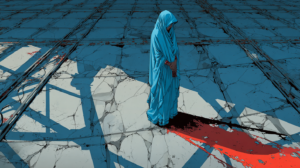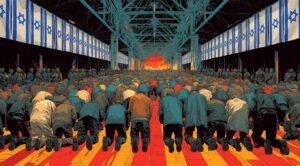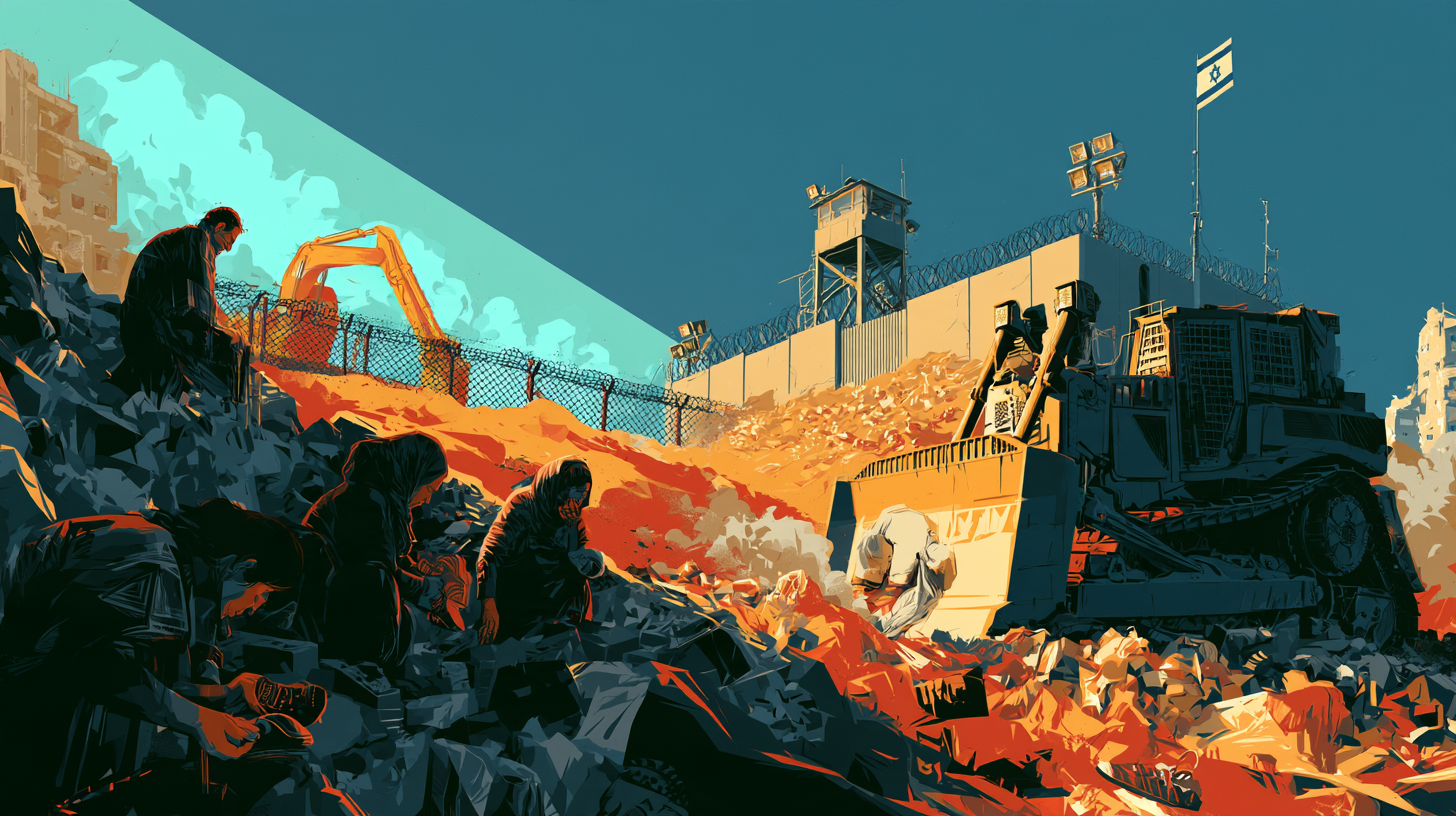
Dalal Faraj looked at satellite images of her old neighbourhood on a phone and asked where the houses had gone, and where her husband and son were. In Shuja’iya, in Gaza City, nothing remained of what she had left in October 2023, except an Israeli military base raised on the empty ground. Her husband Taha, 48, and her son Nasr, 16, have given no sign of life since a strike hit the house on 8 October of that year. A visual investigation by the Canadian broadcaster CBC, confirmed by the research agency Forensic Architecture, documents that the rubble of neighbourhoods like hers was removed and compacted with heavy machinery to make way for army positions. According to the UN High Commissioner for Human Rights, Israel is at the same time blocking the entry of the excavators Palestinian teams need to look for the missing. A dozen machines for more than 8,000 people whom Palestinian Civil Defence counts as missing under the ruins, and machinery to spare for levelling a neighbourhood when the aim is to raise a base.
What the satellite shows
CBC’s visual investigations team compared satellite images of several sites and reconstructs two cases in detail. In the Faraj family’s neighbourhood, an image from 10 March 2026 records eleven diggers and a truck north of the house. A month later, four machines are clearing ground to the west. By August, an Israeli base occupies the centre of what was a residential neighbourhood. The colour of the machinery, CBC notes, suggests it is not military but probably civilian subcontractors.
“Impossible … This is our area? Where did the houses go? Where are my husband and son?” Faraj told the broadcaster. Seeing the pictures broke the last of her hope, she said.
Shaher Mohamed Abu Ouda, 36, left the Swedish Village, a neighbourhood in Rafah governorate, in 2024, and Rafah was occupied by Israel in 2025. Fourteen members of his family have been missing since the house was destroyed. On 7 May 2026, six vehicles remove material from the centre of the neighbourhood to prepare the ground for the base. By August it is completely flattened, scored with the tracks of heavy machinery, with a military position on top. “I thought I would go back and see them, but after all these years, I won’t even find a blouse,” he said. “Even the rubble is not there.”
Júlia Nueno Guitart, of Forensic Architecture, a group based at Goldsmiths, University of London, that analyses spatial data to document human rights violations, confirmed the findings. Her team has gathered more than 2,000 incidents and confirmed 43 cases in which people remain under the rubble, through visual evidence, graffiti on walls or reports from Gaza’s Civil Defence, the Palestinian rescue service. Between one figure and the other lies the limit of what the satellite can verify. “What we are seeing after the ceasefire in Gaza is a new type of destruction, different to the one we have been documenting before the ceasefire,” Nueno Guitart said.
Forensic Architecture counted 48 Israeli military positions east of the so-called Yellow Line, the internal border left by the October 2025 ceasefire, which leaves Israel with around 53% of the Strip, thirteen of them built after the truce. With paved roads and watchtowers, according to Al Jazeera, they have stopped being temporary posts.
Two uses for the same machinery
On 15 September, in Geneva, High Commissioner Volker Türk reported that the remains of what appear to be entire families are being unearthed in places pulverised by Israeli strikes. Palestinian Civil Defence counts more than 630 bodies and remains recovered since November 2025 and estimates that more than 8,000 people are missing under the rubble. Türk feared that what had been found was only the tip of the iceberg, and accused Israel of continuing to bulldoze areas where its troops remain deployed, with no respect for the dead beneath the rubble.
Ajith Sunghay, who heads the UN human rights office for the occupied Palestinian territory, relayed that Palestinian Civil Defence says it has a single excavator and is sometimes forced to search by hand, and estimated that at this pace it will take at least ten more years. “Israel’s overall conduct makes any systematic, large-scale search, recovery, and identification nearly impossible,” he said.
Between 27 June and 27 August, local authorities in Gaza recovered 233 of the 407 bodies believed to lie under 20 destroyed buildings, mostly in Gaza City and almost all by hand. (UN News, 15 September 2026)
COGAT, the Israeli military body that controls civilian access to Gaza, has justified these restrictions by the risk of rearmament of terrorist groups. It did not respond immediately to the UN.
The result is measured in machines. Officials and operators told CBC that only about a dozen excavators are working across the whole Strip, and that families search with shovels, wheelbarrows and their hands. Civil Defence, according to Sunghay, has only one. Its chief, Raed al-Dahshan, told Al Jazeera that with the right equipment recovery could be completed in about ninety days, and that without it the work will take years. The Israeli army did not respond to CBC when asked about attacks on heavy machinery in the Strip.
Who operates the machines levelling the ground is only half documented. The Times of Israel reported in 2025 that civilian contractors hired by the Defence Ministry routinely carry out demolition, engineering and logistics in the middle of a war zone, including rubble removal. Euro-Med, a party to this debate, estimates at some 400 the machines operated by Israeli civilian firms under military protection and at no less than 10 million tonnes the rubble removed or crushed. The figure comes from a single actor and has not been independently confirmed.
The two series of facts, the ban on some excavators and the deployment of others, need no proof of intent to exist. It is enough to set them side by side. A family searching for its dead with bare hands and a base rising where human remains may lie describe, seen together, one and the same order of priorities. That is the reading defended here, and it is a reading, not a fact established by any court.
What the law demands of the living toward the dead
International humanitarian law is explicit, though it has limits. Rule 112 of the International Committee of the Red Cross (ICRC) study on customary law, the kind that binds States even without a treaty, requires each party, whenever circumstances permit, to take “all possible measures to search for, collect and evacuate the dead”. Rule 116 requires recording the available information before burial and marking the graves. Under Rule 117, the missing must be accounted for and their families informed. The ICRC itself makes clear that these are obligations of means, not of result. Israel’s High Court of Justice said as much in 2002, in the Jenin remains case, calling the search for the dead a humanitarian act of great importance.
Janina Dill, of Oxford, spelled out its scope to CBC. Levelling a bombed area is compatible with international law only if the dead are collected, identified and buried, and if the evidence needed to judge possible war crimes is preserved. “If [the rubble removal] is done without taking care of these two considerations, then it is absolutely prohibited and incompatible with Israel’s obligations under the Geneva Convention,” she said. The condition is verifiable, and the army has not said how many bodies have been returned.
There is also a court order. On 26 January 2024, the International Court of Justice (ICJ) indicated provisional measures in the case South Africa brought against Israel under the Convention on the Prevention and Punishment of the Crime of Genocide.
The State of Israel shall take effective measures to prevent the destruction and ensure the preservation of evidence related to allegations of acts within the scope of Articles II and III of the Genocide Convention. (ICJ, order of 26 January 2024, reaffirmed on 28 March and 24 May 2024)
The exact scope of that order needs measuring. It covers evidence linked to acts under the Genocide Convention, not all evidence of war crimes. It is a provisional measure, not a judgment, the Court has not ruled on the merits, Israel rejects the accusation of genocide and, as far as could be verified, no judicial ruling has found a breach of that measure. To say that Israel openly defies the ICJ is a conclusion no court has reached. What is established is the text of the order and a terrain that changes while the case stays open.
UN Special Rapporteur Francesca Albanese, sanctioned by the United States after criticising its policy on Gaza, warned on 7 September that rubble removal could erase the traces of atrocity crimes. “In devastated Gaza, rubble is not just construction waste. It is part of a crime scene, a graveyard, and the material record of what happened during a brutal and senseless bombing campaign that lasted two years,” she said. She warned the States and companies involved in the clearance that they could incur international criminal responsibility.
What the army answers and what it does not say
In a statement to CBC, the Israeli army said it clears structures and dismantles infrastructure in Gaza “based on tactical necessity” and to “reduce the level of risk posed” to its troops, and that it does so “in accordance with operational necessity, the provisions of international law, and IDF directives”. It rejected the accusations and said it “treats every body found in the area with respect and seriousness”. It did not answer the question of how many bodies found under the rubble since the ceasefire have been returned to Palestinians. The families interviewed by CBC say no one contacted them about the recovery of the bodies, before or after the rubble was removed.
HonestReporting Canada, a pro-Israel media watchdog, faults CBC for presenting Forensic Architecture as independent without mentioning that it is accused of bias. The objection targets one source. It does not refute the dated images the broadcaster’s team analysed on its own, nor the words of the UN officials.
Several points fall outside what is documented, and it would be dishonest to present them as established. No source consulted proves that the army omitted any search for bodies before levelling a site, or that it crushed bones under concrete with the intention of erasing them. CBC speaks of possible human remains and potential evidence, and the UN experts use the conditional. The identity of the firms that own the machines and the terms of their contracts are not established either. It is the most serious missing link in the file, because those firms could answer criminally.
What is documented is enough to fix the terms. There are dated images of neighbourhoods that probably hold the dead, levelled and then covered with military bases. A senior UN official holds Israel responsible for the ban on the machines able to look for those dead, and an army invokes tactical necessity and does not say how many bodies it has returned. Meanwhile a court order on the preservation of evidence is in force, and the Court’s timetable sets Israel’s rejoinder for May 2029, plenty of time for the plot of a house to become something else. A grave may be missing. What Faraj describes is having taken from her, on top of that, the place where it would have been, and with it the last reason to wait. Dalal Faraj asked where the houses had gone and where her husband and son were. To the first question, the satellite replied. The second is not yet in anyone’s file…
G.S.
Sources
- CBC News, Is Israel erasing evidence of alleged war crimes in Gaza? A visual investigation
- CBC News, full text reproduced by News Beep, 26 September 2026
- CBC News, Israeli clearance of Gaza rubble could destroy evidence of atrocity crimes, says UN expert
- CBC News, UN rights chief says uncovered remains in Gaza raise concerns of war crimes
- UN News, Gaza remains recovery points to possible war crimes, says UN rights chief, 15 September 2026
- Statement by the UN Special Rapporteur, 7 September 2026, reproduced by YubaNet
- AFP via France 24, Israeli rubble-clearing in Gaza could erase atrocity crimes evidence, UN expert
- bluewin, UN criticizes recovery of bodies from the rubble in the Gaza Strip, 15 September 2026
- JusticeInfo, Corps dans les décombres de Gaza, l’ONU réclame un accès pour des enquêteurs internationaux
- CBC News, They own 2 excavators in Gaza and can’t keep up with demand as families dig for remains
- Al Jazeera, Israel’s removal of Gaza rubble risk to war crimes evidence, UN rapporteur, 7 September 2026
- Al Jazeera, Satellite images reveal Israel expanding Gaza military sites, 19 April 2026
- The Times of Israel, Outsourced and exposed, civilian contractors are on the frontlines of the Gaza war
- Euro-Med Human Rights Monitor via Common Dreams, Israel destroying crucial evidence of genocide in Gaza
- International Court of Justice, order of 24 May 2024
- ICRC, Customary IHL, practice relating to Rule 112
- ICRC, Customary IHL, Rule 117
- University of Oxford, Professor Janina Dill
- HonestReporting Canada, CBC News article and video appear to imply without evidence Israel committed war crimes in Gaza