Between 1938 and 1947, the Western world practiced, with almost no exception, the same grammar of refusal, first toward the Jews fleeing persecution, then toward the survivors of an extermination already carried out. That grammar broke not through a change of conviction but through exhaustion, public opinion stopped tolerating what governments kept practicing. This episode reconstructs that shift, its figures, its documents and its internal logic, treating it not as a moral conversion but as what it was, a capitulation before accumulated evidence.
Évian, or refusal organized as a conference
In July 1938, thirty two countries met in Évian-les-Bains at the initiative of Franklin D. Roosevelt, convened to discuss the fate of Jewish refugees already seeking to leave Nazi Germany and recently annexed Austria. The conference lasted nine days. No participating country, with the partial exception of the Dominican Republic, expanded its admission quotas. The Australian delegate summed up the spirit of the gathering in a line historiography still quotes endlessly, his country had no “racial problem” and had no intention of importing one. Hitler, informed of the failure, read it exactly for what it was, a tacit license to proceed without the world intervening on behalf of Europe’s Jews.
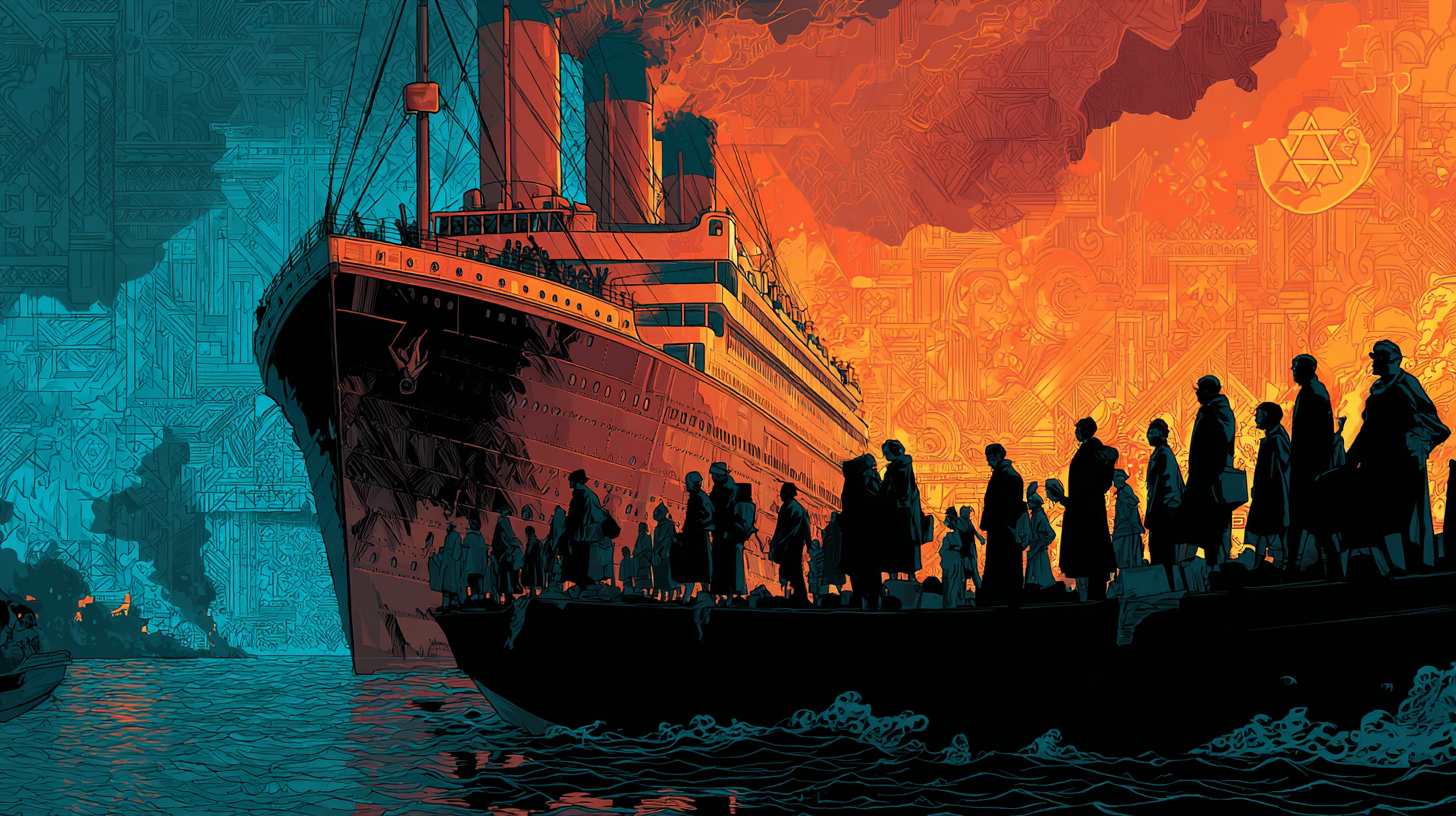
Confirmation arrived a year later with the case of the Saint Louis, the ocean liner that left Hamburg in May 1939 with more than nine hundred Jewish passengers, most holding Cuban visas that turned out invalid upon arrival in Havana. Turned away by Cuba, the ship sailed off the coast of Florida while Washington refused to authorize a landing, even though many passengers already had American visa applications pending. The Saint Louis returned to Europe. A quarter of its passengers would later die in the Holocaust, according to reconstructions by the United States Holocaust Memorial Museum. Neither Évian nor the Saint Louis were diplomatic accidents, they were the predictable outcome of immigration quotas fixed by American law since 1924 and never revised upward despite the emergency. The Dominican exception confirms that rule more than it disproves it. Rafael Trujillo offered up to one hundred thousand visas at Évian, a gesture that mainly served to launder his international image a year after the massacre of Haitians at the border, of which only about five thousand were ever actually issued. By the Holocaust Museum’s own count, six hundred forty five refugees actually settled in the agricultural colony of Sosúa between 1938 and 1945, other sources cite figures as high as seven hundred fifty, most emigrated again once the war ended, and today only a few dozen Jewish families remain there out of a total population of roughly fifty thousand. The one door declared open at Évian closed almost on its own, worn down, the moment international attention moved elsewhere.
Immigration organized outside the law
Faced with those closed doors, the Zionist movement answered with a clandestine infrastructure, Aliyah Bet, coordinated from 1938 by Mossad LeAliyah Bet, an arm of the Haganah, with the Palyam handling navigation. The figure consolidated by immigration historiography places at well over one hundred thousand the number of Jews who reached Palestine by illegal sea immigration before 1948, more than seventy thousand of them direct survivors of the extermination, with roughly nine thousand more crossing overland, among them thirteen hundred Syrian Jews. The exact number of voyages varies by source and by the cutoff chosen, somewhere between sixty two and sixty six depending on whether one counts from 1937 or from 1939, but more than ninety percent of the ships were intercepted by the British navy before reaching shore.
More than one hundred thousand Jews, including more than seventy thousand survivors of the extermination, reached Palestine through illegal sea immigration before 1948, with more than ninety percent of the boats intercepted by the British navy. (United States Holocaust Memorial Museum, Aliyah Bet)
British policy, a direct legacy of the May 1939 White Paper already covered in the previous episode, consisted of intercepting the boats at sea and confining those captured in detention camps in Cyprus, from which most would not emerge before the state’s proclamation in 1948. Between August 1946 and May 1948, London interned close to fifty two thousand people there, in tents and tin barracks the Holocaust Museum itself describes as unbearably hot in summer and freezing in winter, with no electricity, limited access to water, and poor sanitary conditions. Eighty percent of the internees were between twelve and thirty five years old, eight thousand were teenagers. Four hundred died during internment. Roughly two thousand were born there, in the Jewish wing of the British military hospital in Nicosia, the detail that best captures the nature of the place, a refugee camp that was also, for nearly two years, a maternity ward. London’s administrative logic treated survival of the extermination as just another immigration infraction, subject to quota, with no distinction between the refugee of 1938 and the survivor of 1945.
Biltmore, when ambiguity stops being possible
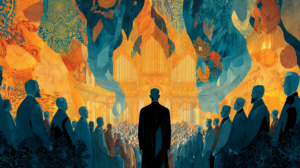
In May 1942, at the Biltmore Hotel in New York, roughly six hundred delegates from eighteen countries, among them David Ben Gurion, Chaim Weizmann and Nahum Goldmann, adopted a program that deliberately broke with Basel’s ambiguous formula. There was no more talk of a “national home”, the resolution demanded that Palestine be established as a Jewish Commonwealth, with free and unlimited immigration. The shift was not unanimous, some delegates objected on the spot that the immediate problem was saving lives, not founding a state, a tension that the movement’s historiography records without resolving it in favor of either position.
Biltmore also shifted Zionism’s diplomatic center of gravity, away from London, the mandatory power but increasingly hostile since the White Paper, toward Washington, where the American Jewish community and a public increasingly informed about the extermination offered political leverage Downing Street no longer did. The program was adopted while the figures for the European extermination were still discussed in terms of estimates, not settled certainty, which did not stop it from becoming, in hindsight, the point of no return toward explicit statehood.
The program never represented the whole of the Jewish field, nor even the whole of the Zionist field. Judah Magnes, president of the Hebrew University of Jerusalem, and the Ihud group he would soon found, had argued since before Biltmore for a binational position, a state shared between Jews and Arabs with no guaranteed demographic majority for either people, a position the official Zionist leadership marginalized ever more firmly as the war went on. Ratification came in August 1943, when the American Jewish Conference gathered five hundred delegates in New York representing two million two hundred fifty thousand American Jews grouped into thirty two national organizations. Rabbi Abba Hillel Silver pushed through the explicit adoption of the Biltmore program there as the official position of organized American Jewry, in a vote that drove the American Jewish Committee delegation to walk out in protest, opposed to a statehood goal replacing the defense of civil rights as the axis of American Jewish representation. The internal split did not stop Silver from emerging from that session as the movement’s new reference point on American soil.
After Auschwitz, the doors stay shut
The liberation of the camps did not immediately change admission policy. In August 1945, special envoy Earl Harrison delivered to Truman a devastating report on the conditions of Jewish displaced persons in the Allied camps in Germany, with a line the White House could not ignore.
We appear to be treating the Jews as the Nazis treated them, except that we do not exterminate them. (Earl Harrison, report to President Truman, August 1945)
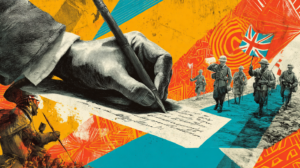
Truman, personally affected by the report, asked Clement Attlee to authorize one hundred thousand additional immigration certificates to Palestine. Attlee rejected the request and warned of serious damage to Anglo American relations. To ease the tension without conceding the substance, London agreed to form an Anglo American Committee of Inquiry, whose April 1946 report essentially confirmed Harrison’s conclusions and again recommended admitting the hundred thousand. London dismissed that too. Two convergent reports, one identical refusal, the closed door policy survived intact nearly a year after the world had seen the photographs of Bergen Belsen.
The Exodus, or the refusal that can no longer be hidden
In July 1947 the Exodus 1947 left Marseille with roughly four thousand five hundred passengers, most of them survivors of the extermination with no other destination left. The British navy intercepted it before it reached mandate waters and forced it to dock at Haifa, in a clash that left three dead and many wounded. Foreign Secretary Ernest Bevin, instead of interning the passengers in Cyprus as was the usual practice, ordered them sent straight back to the displaced persons camps in Germany, the same Germany where many had been prisoners only a few years earlier.
The passengers began a hunger strike aboard that the international press followed for weeks, photographed and filmed under British guard while still anchored in Haifa harbor. Bevin’s decision, meant to deter clandestine immigration, produced exactly the opposite effect, it turned four thousand five hundred people into visual proof that British policy no longer distinguished deterrence from administrative cruelty.
The case did not reach the United Nations by accident. A special committee of eleven countries, among them Sweden, the Netherlands, Guatemala, Peru, Uruguay, India and Iran, had been formed barely two months earlier, on May 15, 1947, to decide the mandate’s future. In August, as the Exodus was being sent back to Hamburg, a subcommittee spent a week touring displaced persons camps in the American and British occupation zones of Germany and Austria, and heard there the testimony of Reverend John Stanley Grauel, who had traveled aboard the Exodus itself as an observer. Other members witnessed the forced disembarkation at the port of Haifa firsthand. On September 3, 1947, the committee submitted its report, the door this episode has documented closing systematically for nine years now passed, from that date on, into the hands of an international assembly that could no longer treat the question as a minor administrative matter.
Closing
None of this strictly obligated the international community to back the creation of a state, still less to back it precisely in the form demanded at Biltmore, excluding the binational alternative Magnes kept defending from Jerusalem until his death in 1948, before the state he had argued against was even a year old. But after Évian, after the Saint Louis, after Cyprus, after Harrison dismissed twice, and after the Exodus sent back to Hamburg, continuing to refuse that outcome required a justification no Western government was any longer in a position to defend publicly. Legitimation did not arrive through sudden conviction, it arrived because the political cost of continuing to say no had become, in barely three years, unsustainable…
G.S.
Sources
- The Evian Conference, July 1938 (United States Holocaust Memorial Museum)
- “Exodus 1947” (United States Holocaust Memorial Museum)
- The Harrison Report (United States Holocaust Memorial Museum)
- Aliyah Bet, 1939-1948 (Jewish Virtual Library)
- Aliyah Bet (United States Holocaust Memorial Museum)
- Cyprus Detention Camps (United States Holocaust Memorial Museum)
- Dominican Republic Settlement Association, “Sosúa: Haven in the Caribbean” (Experiencing History, USHMM)
- United Nations Special Committee on Palestine (Wikipedia)
- American Jewish Conference (Wikipedia)
- Mossad LeAliyah Bet (Wikipedia)
- The Biltmore Conference (Wikipedia)
- Anglo-American Committee of Inquiry (1946) (Encyclopedia.com)
- The Real Story: Exodus (Yad Vashem)
- Segev, Tom, One Palestine, Complete (Metropolitan Books, 2000)
- Morris, Benny, Righteous Victims (Knopf, 1999)
Updated August 29, 2026