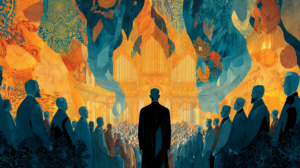
In August 1897, at the Stadtcasino in Basel, two hundred Jewish delegates from seventeen countries founded, in barely three days, a political organisation that still governs part of the Middle East a hundred and twenty-nine years later. What almost nobody remembers is that the project was born already divided. Against Theodor Herzl’s political Zionism, which demanded a state, and demanded it soon, rose the minority voice of Asher Ginsberg, known by his pen name Ahad Ha’am, who argued that no state would survive without a prior cultural regeneration, and that political haste would end up producing exactly the kind of violence it would later have to justify. He lost that argument in 1897. He lost it again, more brutally, to Vladimir Jabotinsky and his Iron Wall doctrine. What neither defeat fully explains is why the current that won both votes, the one that called itself moderate, ended up governing for decades exactly like the camp it claimed to have beaten.
The schism at Basel
Ahad Ha’am, a Hebrew pen name meaning “one of the people”, was born Asher Ginsberg in 1856 in what is now Ukraine, then territory of the Russian Empire. He did attend the Basel Congress, the only Zionist congress he would ever attend in his life, and he left it with a line that sums up his place in the movement’s history better than any later analysis, he felt, he wrote, like a mourner at a wedding. His disagreement was not a minor one. For Herzl, the Jewish problem was European antisemitism, and the solution was a sovereign territory where that antisemitism would cease to have any practical effect. For Ahad Ha’am, the problem was something else, the erosion of a Jewish cultural and spiritual identity that neither assimilation in Western Europe nor disorganised emigration to Palestine was solving. A state founded before that cultural regeneration, he argued, would be an empty shell, or worse, a power like any other, capable of the same violence the European states had inflicted on the Jews.
The two men’s own intellectual paths explain much of the clash. Herzl arrived at Zionism almost by accident, through the public degradation of Captain Alfred Dreyfus in 1894 before a Parisian crowd shouting antisemitic slogans. Ahad Ha’am needed no such external shock, he had already spent a decade writing about the internal erosion of Jewish culture in the Russian diaspora. For him, European antisemitism was a symptom, not the disease.
He lost the vote. He also lost the battle to define what kind of project had just been born in Basel.
Six years before the congress, Ahad Ha’am had already put his mistrust in writing. In 1891 he travelled to Palestine and published, in the St Petersburg daily Hamelitz, a series of articles known as Emet me-Eretz Israel, truth from the land of Israel. The text describes a disorganised colonisation with no central leadership, and contains what much later historiography regards as the first serious analysis of what was already being called “the Arab question” within the Zionist movement. Ahad Ha’am warns about the contempt some settlers of the first aliyah showed toward the local Arab population, and about the risk of building a national project while ignoring the existence of another people settled on the same land. The exact interpretation of those passages remains disputed among historians, some read an early moral critique into them, others a strictly tactical concern about the colonising project’s viability. What is not disputed is the date, nor the fact that the warning, tacit or explicit, changed nothing.
Ahad Ha’am did not stop at passing criticism. In 1889 he agreed to lead Bnei Moshe, a near-secret society founded in Odessa and devoted to forming a moral elite capable of driving the cultural regeneration he demanded, and in 1896 he founded the journal Hashiloah, which he edited for almost a decade and which became the main intellectual forum of cultural Zionism. His proposal was not to stop immigration to Palestine, it was to subordinate it to the prior creation of what he called a spiritual centre, a small but culturally solid demographic core capable of radiating renewal across the whole Jewish diaspora without absorbing the entire Jewish people into a single territory all at once. Chaim Weizmann, who would go on to preside over the World Zionist Organization and later the State of Israel itself, spent years trying to reconcile both visions under the label of synthetic Zionism. The synthetic experiment did not survive Jabotinsky’s rise.
The 1897 congress did not resolve that tension, it buried it under a deliberately ambiguous formula. The Basel Program speaks of a “home” for the Jewish people, not a state, an imprecision Herzl accepted out of diplomatic pragmatism toward the Ottoman Empire, and which Ahad Ha’am considered a hypocrisy necessary to win a vote, not a real solution to the underlying disagreement.
The Iron Wall thesis that Ben Gurion ended up applying
Vladimir Jabotinsky, born in Odessa in 1880, was not arguing with Ahad Ha’am over the need for a state, on that point he agreed with Herzl. He was arguing with the majority Zionist leadership, headed by Chaim Weizmann and David Ben Gurion, over the method for achieving it. In 1923, after the British government banned Zionist colonisation east of the Jordan river, Jabotinsky published in Russian a short essay that would become the founding text of Revisionist Zionism, known in its English translation as The Iron Wall.
Jabotinsky did not come to that essay as an armchair intellectual. During the First World War he had organised the Jewish Legion within the British army, convinced that only organised force would win Jews a seat at the table where Palestine would be divided after the Ottoman collapse. Churchill’s White Paper of 1922 separated Transjordan from the territory covered by the British promise of a Jewish national home, and banned Zionist colonisation there. For Jabotinsky, that concession was no administrative detail, it was proof that London would yield, sooner or later, to any sufficiently organised pressure, whether Arab or Jewish.
His central argument was uncomfortable even for his own allies. The Arab population of Palestine, he wrote, would never voluntarily accept becoming a minority under a Jewish state, whatever material benefits that state might offer, and no people in history had ever accepted such a thing peacefully. Jabotinsky also insisted on a nuance that much of his own following would later prefer to forget, that Arab resistance had nothing irrational or fanatical about it, it was exactly the reaction any people would have toward a project of foreign colonisation, and that treating it as a matter of bad faith was, by his own reasoning, as hypocritical as expecting the Arabs of Palestine to celebrate their own demographic displacement. Zionist colonisation, therefore, could only advance in one of two ways, stopping, or continuing against the will of the native population, protected by a force that population could not break.
“Zionist colonisation must either stop, or else proceed regardless of the will of the native population. This colonisation can, therefore, continue and develop only under the protection of a force independent of the local population, an iron wall which the native population cannot break through.” (Vladimir Jabotinsky, “The Iron Wall”, Rassvet, 1923, as reproduced by israeled.org)
Weizmann and Ben Gurion condemned the essay as soon as they learned of it, calling it militaristic and dangerous for Zionist diplomacy with London. Jabotinsky resigned from the Executive Committee of the World Zionist Organization that same year, 1923, and two years later, in 1925, formally founded the Revisionist movement as an organised current within Zionism. The break became total in 1935, when Jabotinsky and his followers left the World Zionist Organization altogether and created the New Zionist Organization, a complete institutional schism that would last until after the founding of the state.
None of this stopped the Labour current, the very one that had pushed Jabotinsky out of the movement’s centre, from ending up governing according to much of his own logic. That is the central thesis the Israeli historian Avi Shlaim develops in The Iron Wall, Israel and the Arab World (2000), one of the so-called New Historians who, since the nineteen-eighties, have revisited the state’s official history using recently declassified archives. For Shlaim, Israeli foreign policy under Labour governments, including Ben Gurion’s own, in fact operated according to the logic Jabotinsky had described thirty years earlier, colonisation sustained by military force, with no real negotiation with an Arab counterpart recognised as such, the refusal to allow the return of the population displaced in 1948, the doctrine of disproportionate retaliation adopted since the nineteen-fifties, the repeated refusal to fix borders while facts were being consolidated on the ground.
That reading is not unanimous, not even within the field of what might be called revisionist Israeli historiography in the academic, non-partisan sense of the word. The historian Efraim Karsh devoted an entire book, Fabricating Israeli History, The New Historians (1997), to challenging Shlaim’s method and that of historians close to him such as Ilan Pappé, accusing them of selecting the archive to fit a conclusion decided in advance. Benny Morris, the most cited member of that same group of New Historians, agrees with Shlaim on much of the documentary record concerning 1948, but has publicly defended, since the two-thousands, political conclusions almost opposite to those of Shlaim and Pappé about what those same facts justify. All three historians worked with comparable archives. None of the three reached the same moral conclusion.
From Betar to Likud, the institutional genealogy
Jabotinsky’s parliamentary defeat in 1923 did not stop his current from building, in parallel, an infrastructure that would outlive his death in 1940. That same December of 1923, in Riga, a group of Jewish students founded Betar, short for Brit Trumpeldor, in honour of Joseph Trumpeldor, who had fallen in 1920 defending the settlement of Tel Hai. Jabotinsky called the movement the crowning glory of his Zionist activity.
According to figures from the Encyclopaedia Judaica, Betar had close to 70,000 members by 1934, spread across Europe and Palestine, the largest number reached by any Zionist youth organisation of the period.
Betar’s internal code was summed up in a single Hebrew word, hadar, combining the ideas of dignity, discipline and physical pride, which Jabotinsky deliberately set against what he saw as the cultivated fragility of the diaspora Jew. Brown uniforms, paramilitary drilling and a rhetoric of national rebirth set Betar apart from rival Labour youth movements, which leaned more toward collective agricultural work than barracks discipline.
From Betar came, in 1931, the core of the Irgun Tzvai Leumi, known as Etzel, an armed organisation operating outside the official Haganah, which took the hadar principle, self-reliant force as the foundation of national dignity, from rhetoric to direct action. Menachem Begin, a Betar veteran from Poland, took command of it in 1943. Under his command, the Irgun carried out the July 1946 bombing of the King David Hotel in Jerusalem, seat of the British administration in Palestine, ninety-one dead, the most literal application that generation produced of the idea that only organised force, not negotiation, bends a colonial power. Begin later said the Irgun had telephoned warnings to the hotel, the French consulate and a local newspaper before the explosives went off, insisting the group had never sought civilian casualties. British inquiries and most subsequent historians concluded those warnings were either too late or never properly received, a discrepancy that itself became part of the movement’s founding legend. The Irgun formally disbanded after the founding of the State of Israel in 1948, and that same year Begin founded the Herut party, direct and explicit heir to Jabotinsky’s revisionism. Herut merged with the Liberal Party in 1965 under the name Gahal, and Gahal, joined by other minor forces, gave rise in 1973 to Likud, the “union” that has governed Israel intermittently ever since.
The four prime ministers Likud has brought to power, Menachem Begin, Yitzhak Shamir, Ariel Sharon and Benjamin Netanyahu, have each claimed, to varying degrees and with different nuances, to be heirs of Jabotinsky. Fifty-four years passed between Jabotinsky’s break with the Zionist leadership in 1923 and his political heir’s first electoral victory in 1977, nearly all of them under Labour governments. Jabotinsky, who died in New York in 1940, lived to see neither of the two dates that define that arc, not the founding of the state in 1948, nor the rise to power of the party that claims him as its own.
The inheritance was never linear nor free of contradiction. Begin, the man who first brought Likud to power, signed peace with Egypt in 1979 and returned the entire Sinai peninsula, a decision much of the revisionist movement itself considered a betrayal of Jabotinsky’s territorial vision. Sharon, another of the four, ordered the unilateral withdrawal of all Israeli settlements and troops from Gaza in 2005, and ended up breaking with Likud to found a new party. Both episodes show that the inheritance was always applied selectively, never as a closed dogma.
2026, the consensus Ahad Ha’am never wanted
Ahad Ha’am died in 1927, thirteen years before Jabotinsky, without seeing either defeat fully play out. He did not see the founding of the state in 1948, nor Likud’s first electoral victory in 1977, nor the long hegemony of Benjamin Netanyahu, the longest-serving prime minister in Israel’s history.
The Labour Party, direct heir of those who defeated both Ahad Ha’am at Basel and Jabotinsky in 1923, today holds a marginal place in the Israeli parliament, far from the broad majorities with which it governed much of the state’s first three decades. Israel’s political spectrum in 2026 is organised mostly between Likud and parties positioned even further to its right. The dispute of 1897, in that sense, has a verdict measured in seats, not only in doctrine.
What remains of Ahad Ha’am’s proposal in the Israel of 2026 is, above all, a vocabulary. The revival of Hebrew as a living language, one of his central goals, did happen, though not in the peaceful, gradual way he imagined. His conviction that no national project survives without prior cultural work also came true, in its own way, in a country with an educational, military and media apparatus that efficiently reproduces a coherent national narrative. But his deeper conviction, that political haste without moral regeneration would produce a state indistinguishable from the ones he had wanted to avoid, lies buried under nearly eighty years of history that this episode has only begun to trace.
Netanyahu, the longest-serving of Likud’s four prime ministers, invokes Jabotinsky in speeches and official ceremonies with the ease of someone quoting a founder, not a defeated dissident. No one in contemporary Israeli politics invokes Ahad Ha’am that way. His name survives in street names, cultural institutions, school curricula, not in the state’s security doctrine, which, without quite meaning to, he helped imagine…
G.S.
Sources
- Ahad Ha’am, Jewish Virtual Library
- B’nei Moshe, Wikipedia
- Vladimir Jabotinsky, “The Iron Wall,” 1923
- Avi Shlaim, The Iron Wall: Israel and the Arab World (W. W. Norton, 2000)
- Efraim Karsh, Fabricating Israeli History: The New Historians (Frank Cass, 1997)
- Alan Dowty, “Much Ado about Little, Ahad Ha’am’s ‘Truth from Eretz Yisrael,’ Zionism, and the Arabs”, Israel Studies 5, no.2 (2000), pp. 161-178
- Betar, Jewish Virtual Library
- Betar and Hadar, Jabotinsky Institute
- Herut, Wikipedia
- Likud, Wikipedia
- Menachem Begin, Encyclopaedia Britannica
Updated August 16, 2026