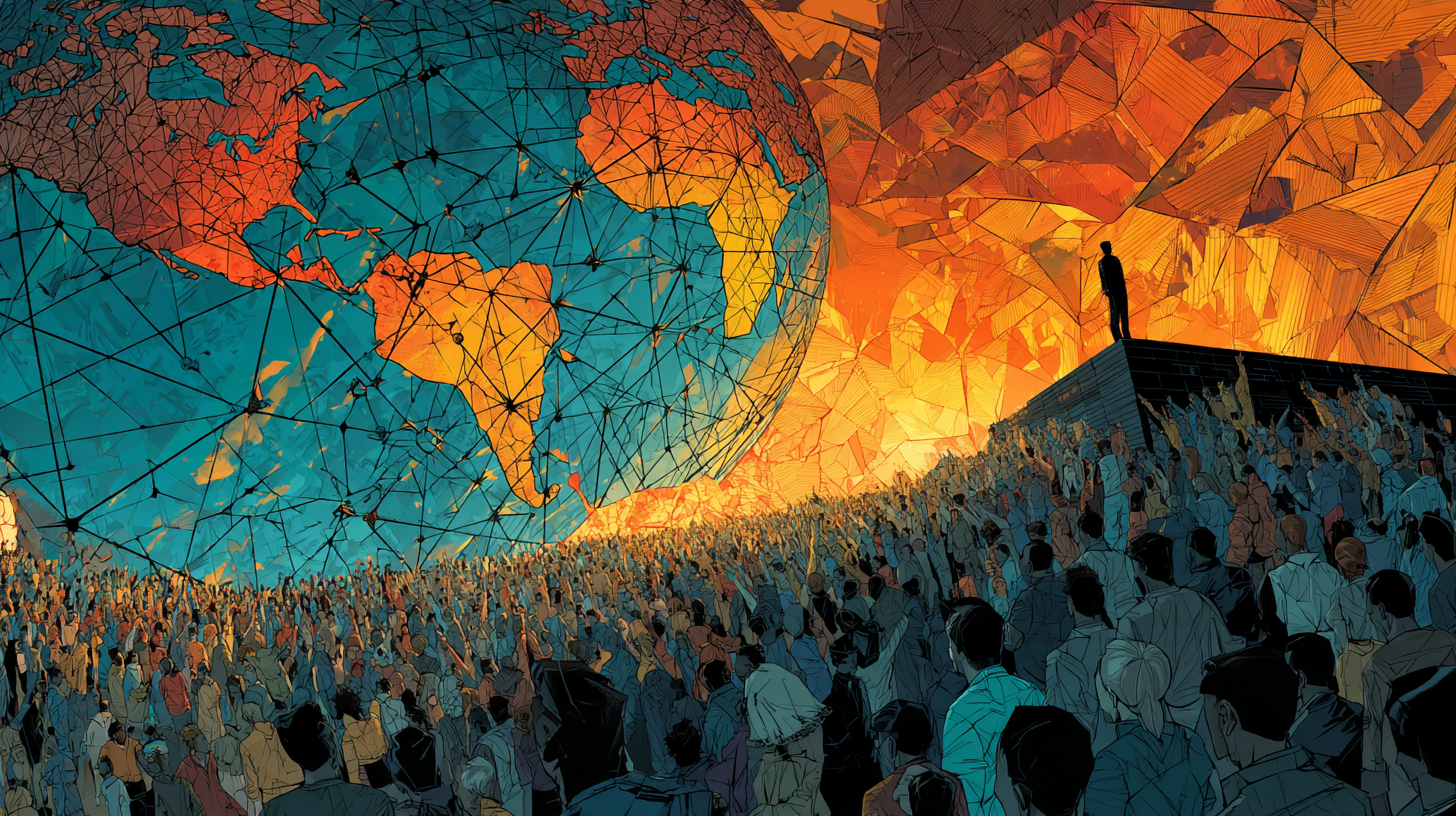
On September 4, 2026, the UN General Assembly voted 164 in favour, one against and six abstentions to adopt a resolution recommending that the Mercator projection be replaced by the Equal Earth projection as the reference map in education, international organisations and technology platforms. The country that brought the text to the floor was neither South Africa nor Nigeria, nor any of the African regional powers with the heaviest economic or military weight. It was Togo, a nation of nine million people governed since 2005 by the same family that has held power since 1967. The single vote against came from the United States, which branded the initiative an ideological agenda and said the resolution “mocks the work and purpose of this institution.” Behind the cartographic anecdote sits a diplomatic calculation far colder than the story of dignity and cognitive justice attached to it, and a contradiction neither side has any interest in naming.
A projection that taught the world its own size
Gerardus Mercator designed his projection in 1569 to solve a precise nautical problem, letting a navigator draw a straight line on the map and hold a constant compass bearing. The mathematics worked, and still works, for maritime and air navigation, so much so that September’s resolution does not even attempt to retire it from those uses. The trouble began when that tool of trade and colonial expansion turned, century after century, into the default image of the planet in classrooms, atlases and evening news. Mercator inflates landmasses the farther they sit from the equator, so that Greenland appears roughly the size of Africa when Africa’s real surface is about fourteen times larger.
No serious cartographer has been unaware of this distortion for decades. What was always missing was never the technical knowledge, but the political will to swap one inherited convention for another. A child who spends an entire schooling memorising a map where Europe and North America visually occupy the centre and a disproportionate share of the planet does not need anyone to spell out a hierarchy between continents in words, that hierarchy is already lodged in the retina before the child even knows what the word colonialism means. That silent lesson is probably more effective than any speech, because it never presents itself as an opinion open to debate. It presents itself as geography.
The argument is not new in its political form either. In 1973, the German historian Arno Peters unveiled, at a press conference in Bonn, an equal area projection explicitly built to correct that Eurocentric bias, and unlike Mercator, whose purpose was nautical, his was declaredly political.
According to New Internationalist, the map was adopted by the UN, aid agencies, schools and corporate trainers worldwide, selling more than eighty million copies. It never displaced Mercator as the default reference in most education systems, which shows that voluntary, scattered adoption without a centralised institutional mandate has a low ceiling. The 2026 vote tries precisely to break that ceiling, betting on a collectively voted recommendation rather than a country-by-country atlas sales campaign.
A campaign that was not born in a ministry
The official version speaks of a continental awakening. The real timeline is more precise, and more revealing. In May 2025, the South African organisation Africa No Filter, together with the Senegalese NGO Speak Up Africa, launched the Correct the Map campaign under the drive of Abimbola Ogundairo, a twenty-eight-year-old activist. The initial strategy was modest, an online petition and direct advocacy work aimed at governments and institutions. Ogundairo summed up the diagnosis in a line Al Jazeera quoted in May 2025, “we live in a world where size is often equated with power.” That organisation also brought prior experience from pan-African public health campaigns, an institutional advocacy know-how that proved more useful, when it came to knocking on doors in Addis Ababa and New York, than any fleeting social media virality. In August 2025, the African Union publicly backed the cause. In February 2026, the continental body formalised it at its summit. Seven months later, on September 4, 2026, the text reached the floor of the General Assembly.
Sixteen months between a citizen petition and a UN resolution is a pace no opinion campaign reaches on its own. Behind the narrative of popular indignation almost certainly lies sustained diplomatic groundwork by the African bloc inside the United Nations, coordinated long before the international press started talking about it. None of this takes away the legitimacy of the claim, which is factually sound, but it changes the nature of the story, from a spontaneous grassroots movement to a foreign policy operation carefully calibrated by a bloc of fifty-four countries that knew exactly where and when it wanted to win.
Why this vote, and not another
The choice of venue explains more than the choice of subject. The General Assembly carries no veto, every state weighs one vote, and that makes it the only UN body where a numerical Global South majority can inflict a public, countable defeat on the United States. At the Security Council, a single American veto would have been enough to bury the text before anyone voted on it. The Tunisian commentator Nizar Chaari called it, in an analysis published after the vote, a dress rehearsal, and the phrase fits. The adopted text does not ban Mercator, it only recommends the use of Equal Earth, which makes opposing it in public almost absurd without looking exposed, and explains why Washington ended up more isolated by its own statement than the text it tried to stop was weakened.
The General Assembly voted 164 countries in favour, one against (the United States) and six abstentions (Estonia, Georgia, Lithuania, Moldova, Serbia, Ukraine), on September 4, 2026.
Chaari explicitly links this vote to demands of far greater material weight that the African bloc has kept open for years, Security Council reform, the renegotiation of international financial institutions, climate finance.
The logic he describes is simple and cold. Prove first that a coalition of one hundred and sixty-four votes can be built and held on an issue that costs the established powers nothing, before attempting the same manoeuvre on issues where the bill would actually be steep for Washington. A map does not change the real distribution of world power. What it does allow is a precise measurement of how far that power can be publicly isolated without suffering any concrete consequence.
In its own analysis, the outlet Africa Briefing framed the mechanism in almost anthropological terms, “what people repeatedly see eventually begins to look normal,” and warned that the real test lies not in the vote’s outcome but in whether schools, publishers and technology companies actually change their default maps. Chaari, for his part, places this vote alongside other fronts where the African Union is trying to set its own terms rather than react to an agenda set elsewhere, among them the African Continental Free Trade Area and its attempt to rewrite the rules of the continent’s trade.
The contradiction neither side wants to name
Togolese Foreign Minister Robert Dussey was careful to clarify, to the press, that the initiative was not Togolese but continental. The precision is honest and convenient at once. Togo carries the banner of a cause of dignity and cognitive justice while its own government goes through, on its own soil, a process the international press describes in almost opposite terms.
The Gnassingbé family did not come to power through the ballot box. Gnassingbé Eyadéma seized power in a 1967 coup and ruled Togo for thirty-eight years, until his death on February 5, 2005. That same day, according to the UN humanitarian news service IRIN, the military high command suspended the Constitution and handed power to his son Faure Gnassingbé, then a government minister. The following day, a National Assembly under military control voted a constitutional amendment to legalise the move after the fact, and Faure was sworn in as president on February 7. The African Union branded the events a military coup, ECOWAS called an emergency summit and described the path taken as “the worst route they could take,” and diplomats from the UN, the European Union, France, the United States and Nigeria boycotted the inauguration. Under that pressure, Gnassingbé agreed to submit to an election on the following April 24, which he won with 60 percent of the vote amid fraud allegations. On the death toll from the repression that accompanied that process there is no single figure, the Togolese government acknowledged sixty-nine, Western diplomats spoke of more than a hundred, the Togolese Human Rights League reported seven hundred and ninety killed and four thousand three hundred and forty-five injured between late March and early May, and the UN High Commissioner for Human Rights, in a September 2005 report, spoke of between four hundred and five hundred dead.
In 2024, the Togolese parliament passed a constitutional reform that turned the country into a parliamentary system and created the post of President of the Council of Ministers, an office with no term limit. In May 2025, Faure Gnassingbé took that post. Outlets such as France 24 described the manoeuvre as a consolidation of power under a new institutional label, not as a democratic opening.
None of this invalidates the substance of the cartographic case, Mercator’s distortion is an established, documented fact regardless of who points it out. But it entirely changes the David versus Goliath story that international coverage repeated without nuance. A government that has just shielded itself with a power with no expiry date at home finds, in a low-risk continental banner, a source of international prestige its domestic politics can no longer produce on its own. The United States, for its part, loses a symbolic vote that costs it nothing to lose, and gains, for free, the role of imperial villain in an episode that does not even touch its material interests. The two central actors in this story each appear to get exactly what they needed from the narrative, and neither had much interest in the other actually losing anything.
Togolese Foreign Minister Robert Dussey told reporters the campaign “is not a Togolese initiative. It’s for the African continent.”
A rehearsal that guarantees nothing
The resolution obliges nobody to do anything. No government is forced to change its schoolbooks, no technology company must alter its default maps, and Mercator remains, legitimately, the reference for maritime and air navigation. The real work, the one that decides whether this vote leaves a mark or stays a diplomatic anecdote, is now playing out in school publishing houses, in the mapping teams at Google and geographic information systems, in education ministries that must decide, one by one and under no binding pressure, whether to adopt the recommendation or shelve it. Security Council reform, the restructuring of international financial institutions, climate finance, the fights where this dress rehearsal meant to prove something, remain exactly where they stood on September 3. The one thing that changed for certain is that one hundred and sixty-four countries learned, in one afternoon of voting that cost nobody anything real, that the United States can end up standing alone…
G.S.
Sources
- UN News, “UN tells the world: Stop making Africa look small” · archive
- Al Jazeera, “UN votes to adopt new world map that reflects Africa’s true size” · archive
- The Hill, “US only country to oppose UN resolution correcting Africa’s size on world maps” · archive unavailable (thehill.com blocks the Wayback Machine crawler, code 520, two failed attempts)
- Africa No Filter, “The Biggest Lie in Geography Is About Africa, And It’s Time to Correct It” · archive unavailable (africanofilter.org blocks the Wayback Machine crawler, code 523, two failed attempts)
- NPR, “African Union backs campaign to replace Mercator map that distorts Africa’s size” · archive
- Al Jazeera, “‘US, China, India can all fit into Africa’, on a quest to fix the world map” · archive
- Africa Briefing, “Africa redraws power, not just maps” · archive
- Africa Briefing, “Africa puts map distortion to UN vote” · archive
- African Newspage, op-ed by Nizar Chaari, “#CorrectTheMap, Why Resolution Matters for the Global South” · archive unavailable (africannewspage.net blocks the Wayback Machine crawler, code 520, two failed attempts)
- France24, “Longtime Togo leader Gnassingbe consolidates grip on power with title swap” · archive
- ConstitutionNet, “After constitutional change, Togo’s parliament appoints country’s leader to top position” · archive
- Al Jazeera, “Togo leader dies, son takes over” · archive
- IRIN/globalsecurity.org, “mil-050207-irin03”, contemporary account of Faure Gnassingbé’s installation (February 7, 2005) · archive
- ReliefWeb/IRIN, “Togo, human rights group says 790 killed, 4,345 hurt in election violence” · archive
- The New Humanitarian, “UN report says at least 400 people died in political violence” · archive
- New Internationalist, “Professor Arno Peters” · archive