Some gestures make no noise when they happen and yet shift the world. That of Rosa Parks, on 1 December 1955 in Montgomery, Alabama, belongs to that category. A Black woman refuses to give up her seat on a segregated bus. The mechanism of power expects her to stand. She does not stand. What follows is not a historical accident nor the spontaneous eruption of accumulated fatigue, but the logical consequence of a life built around a simple and uncompromising idea: dignity is not negotiable. This essay is not a hagiography. It is an attempt to understand what kind of political force is produced by a body that refuses to move, why that form of resistance proves more disturbing to power than any violence, and why the question Rosa Parks planted on that bus remains without a satisfactory answer seventy years later.
The gesture and the decision
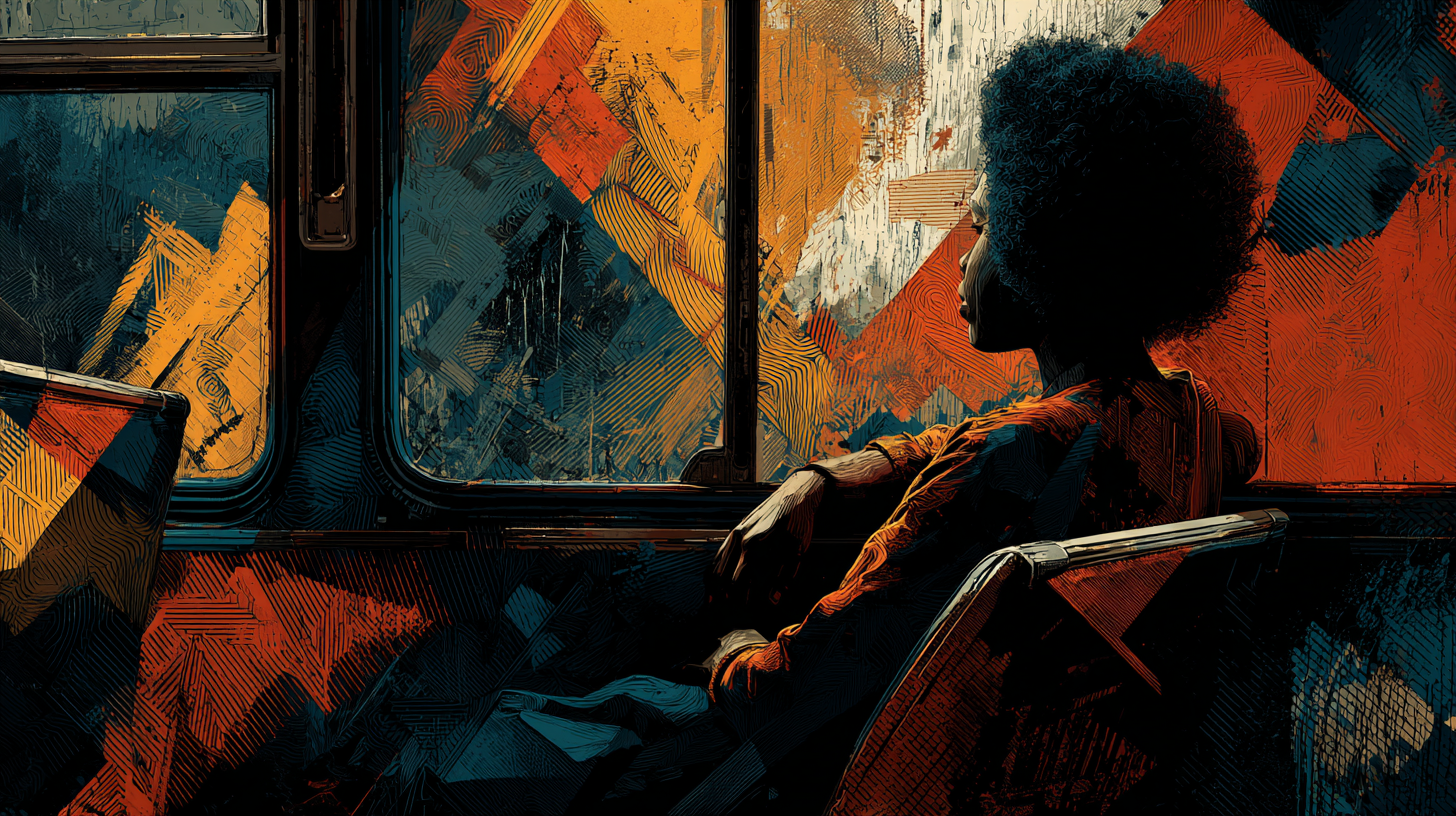
It is 1 December 1955. It is six o’clock in the evening on Cleveland Avenue. Bus 2857 of the Montgomery City Lines is full. The driver James Blake asks Rosa Parks to free her seat for a white passenger. Parks looks at him and says no. Blake calls the police. Parks is arrested, booked, prosecuted. The system does exactly what it was designed to do. What it had not calculated is what comes next.
Montgomery, Alabama, in 1955, is not a historical anomaly but a perfectly stable social configuration from the point of view of those who benefit from it. Racial segregation is not disorder, it is order, an order meticulously codified in laws, customs, architectures and daily routines that assign each body its place in public space. The city’s buses illustrate that order with an almost pedagogical clarity: Black passengers may board through the front door to pay, must alight and re-board through the rear door, and are obliged to give up their seats to white passengers when the vehicle fills. It is not the isolated abuse of a particularly aggressive driver. It is the norm. It is the intended functioning of the system.
Rosa Parks knows that system from the inside, from childhood, with the precision that comes from having suffered it in her body. But she also knows it as an activist. Since 1943 she has been a member of the NAACP, the National Association for the Advancement of Colored People, holding the post of secretary of the local Montgomery chapter. In the summer of 1955 she attends workshops on organisation and civil disobedience at the Highlander Folk School in Tennessee, a political training space where resistance is worked not as a spontaneous reaction but as a disciplined practice. When Parks refuses to rise from her seat on 1 December, she is not improvising. She is applying a decision already taken, in a context already analysed, with a clarity about the consequences that very few of her contemporaries possess.
“The only tired I was, was tired of giving in.” Rosa Parks, Rosa Parks: My Story, Dial Books, 1992.
Power has a prepared response for bodies that resist: detention, legal proceedings, a fine, public exposure as a deterrent example. Parks is arrested that evening, booked, prosecuted. The system does exactly what it was designed to do. What it had not calculated is that this legal process, rather than silencing the act, amplifies it. Because Parks is not alone, and what follows is not the story of one individual but of a community that had been waiting for years for the right moment and the right person.
The Montgomery bus boycott lasted 381 days, from 5 December 1955 to 20 December 1956. Approximately 40,000 African-American people took part, representing 75 per cent of the regular users of the city’s public transport. The bus company lost between 30 and 40 per cent of its revenues during that period, according to the Montgomery Advertiser. The Supreme Court declared segregation in public transport unconstitutional on 13 November 1956.
Disobedience as method
There is a persistent confusion between civil disobedience and transgression. Transgression seeks to break the norm in order to affirm the individual freedom of the transgressor, frequently without an explicit political agenda beyond that gesture. Civil disobedience does something entirely different: it accepts the legal consequences of the act, precisely in order to render visible the injustice of the law. It does not flee the sanction, it faces it. That acceptance is not resignation, it is tactics. When Rosa Parks is arrested, when Martin Luther King is imprisoned, when civil rights movement demonstrators are beaten on the bridges of Selma in front of television cameras, what occurs is not a defeat but a demonstration. The system reveals its nature.
Henry David Thoreau had formulated this in 1849 with an economy of language that remains difficult to surpass: under a government that imprisons unjustly, the only place for a just man is also a prison. The formulation is individual, voluntarist, almost romantic. What Gandhi does with that intuition is to industrialise it, transform it into organisation, into mass action, into a replicable method. Satyagraha, the force of truth, is not a philosophy of personal resistance, it is a political technology. It supposes training, discipline, coordination, and above all the capacity to sustain non-violence when the adversary applies violence, which is exactly the moment when the system most needs the response to be violent in order to justify its repression.
Rosa Parks does not cite Gandhi in her autobiography with the frequency that Martin Luther King does. But the logic she applies that evening on the bus is the same: do nothing that justifies the adversary’s narrative. Do not shout, do not attack, do not flee. Simply remain. Stillness as a political act has a potency that violence can never possess, because violence can always be returned, multiplied, used as an argument. Stillness has no possible response that does not expose the system.
The boycott that follows Parks’s arrest illustrates that logic with precision. For 381 days, 40,000 people organise their daily lives around a single principle: not to finance with their money and their presence a system that degrades them. They walk miles, organise car pools, endure the cold and the rain, withstand threats, job losses, attacks on their homes. And they do not respond with violence. Not because they are incapable of it, but because they understand that violence would shift the axis of the conflict: it would no longer be a city maintaining an illegal system of segregation against citizens who refuse to participate in it, but a city defending public order against a community causing disturbances. Language matters. The form of the act matters. That is what makes civil disobedience a method and not simply an attitude.
Gandhi, King and the discipline of non-violence
There is a dimension of Gandhi’s thought that popular versions generally omit because it is uncomfortable: non-violence, in its original formulation, is not a pacifist position in the modern sense of the term. It does not say that violence is always wrong. It says that non-violence is more effective than violence as an instrument of political transformation under certain conditions, and that it demands more courage, not less. Gandhi writes in 1920 that if the only alternative is between cowardice and violence, he would choose violence. The non-violence he proposes is not that of someone who cannot fight, but of someone who chooses not to fight because they have understood that the battlefield proposed by the adversary is a trap. And its effectiveness rests precisely on that calculation: every act of repression against a non-violent resister costs the system more than it costs the resister. Satyagraha does not seek to defeat the adversary by force but to render them unsustainable in the eyes of their own allies and of outside opinion.
Martin Luther King receives that inheritance and reworks it in the specific context of the American South, where State violence against the Black population is daily, documented and unpunished. His reformulation has a theological component that Gandhi’s does not, but the political logic is the same: non-violence works because it forces the adversary to show itself. When Bull Connor unleashes dogs and fire hoses against peaceful demonstrators in Birmingham in 1963, the images travel the world and decisively accelerate the passage of the Civil Rights Act of 1964. The system reveals what it is when it encounters someone who refuses to play by its rules.
“Non-violence is a powerful and just weapon, which cuts without wounding and ennobles the man who wields it. It is a sword that heals.” Martin Luther King Jr., Why We Can’t Wait, Harper and Row, 1964.
What unites Gandhi, King and Rosa Parks is not a shared ideology in every detail but a common understanding of the mechanics of power. Power needs justification. It needs its acts of repression to appear as proportionate responses to real threats. Civil disobedience denies it that justification. It places power in the position of repressing what any outside observer can see does not merit repression: a woman seated on a bus, a column of people walking in silence, a man who refuses to move from a lunch counter. The visible asymmetry between State violence and the resister’s stillness is the most powerful political argument that exists, and it cannot be fabricated, only sustained.
Between 1955 and 1968, the central period of the civil rights movement in the United States, the FBI maintained systematic surveillance of Martin Luther King under the COINTELPRO programme. Declassified files, available at the National Archives, document telephone tapping, infiltration of organisations and personal discrediting campaigns. Director J. Edgar Hoover described King in internal documents as “the most dangerous Negro in America”. King was assassinated on 4 April 1968 in Memphis, Tennessee.
The currency of no
Seventy years after the Montgomery bus, the mechanisms that produce systematic humiliation have not disappeared: they have been refined. In Colombia, Afro-descendant communities on the Pacific coast have for decades been resisting forced displacement, the militarisation of their territories and the legal invisibilisation of their collective land titles, with a consistency that reproduces, at local scale and with infinitely fewer resources, the same logic as the Montgomery boycott: refusing to collaborate in the process of their own dispossession. In Chile, the student movement of 2019 demonstrated that the mass withdrawal of consent, sustained for weeks in the face of documented repression, can force constitutional reforms that decades of institutional negotiation had failed to produce. The method changes, the principle remains.
What the analysis of the civil rights movement shows clearly is that Rosa Parks was not exceptional by nature but by preparation, by consistency, by the sustained decision not to normalise the unacceptable. That preparation requires no special talent. It requires a discipline that anyone can develop, and a community capable of sustaining it. The most frequent error in reading that historical period consists in fetishising the individual figures, Parks, King, John Lewis, and losing sight of the fact that each of those figures functioned because there was an organisation behind them, years of silent work, networks of material solidarity, a long-term political culture. Without the NAACP, without the Highlander Folk School, without the Baptist churches as coordination infrastructure, Parks’s gesture on the bus would have been an isolated incident filed away in a Montgomery courthouse.
Civil disobedience in the sense that Parks, Gandhi and King give it has precise conditions of possibility: it needs a clearly identifiable injustice, a community capable of sustaining coordinated action, a willingness to accept the legal consequences of the act, and the capacity to maintain non-violence under pressure. Without those conditions, what is produced is not civil disobedience but something else, sometimes legitimate, sometimes not, but with a different logic and different consequences. What can be generalised is the principle underlying Parks’s gesture: the refusal to consent. Power needs some form of participation from the dominated in order to function efficiently. The withdrawal of that participation, when it is massive and sustained, is one of the most disturbing forms of political action that exists, precisely because it requires no access to the mechanisms of power in order to be exercised.
The force that does not destroy
Daily resignation is a form of unpaid political labour. Every time someone yields when they could refuse to yield, when they silence what they could say, when they normalise what they know to be unacceptable, they are doing work for the system, work that is indispensable to the functioning of domination. Systems of exclusion are maintained not only by the brute force of those who impose them, but also by the daily and silent effort of those who endure them and learn to behave as though they were inevitable.
What Parks does that evening is not simply to refuse to move. It is to refuse to continue performing that labour. And that, multiplied by forty thousand people over three hundred and eighty-one days, produces what no violence could have produced: a legal, symbolic and cultural transformation that redefines what is possible in a society. The calculation is cold and precise. Power does not transform because it is persuaded it is wrong. It transforms because maintaining it becomes too costly. Well-applied civil disobedience operates precisely on that cost calculation: it asks nothing of the adversary other than to show what it already is, it requires no victory on the adversary’s own terrain, it requires only that the dominated cease to bear the costs of their own domination.
Rosa Parks left no manual. She left something more useful: a demonstration. A body that refuses to move is harder to refute than any argument. And in a world that manufactures with growing sophistication the reasons to yield, to look away, to accept the unacceptable because that is how things work, that still body on an Alabama bus remains, seventy years later, a question without a comfortable answer…
G.S.
Sources
- Parks, Rosa (with Jim Haskins). Rosa Parks: My Story. Dial Books, 1992.
- Brinkley, Douglas. Rosa Parks: A Life. Viking Penguin, 2000.
- King, Martin Luther Jr. Why We Can’t Wait. Harper and Row, 1964.
- Thoreau, Henry David. Resistance to Civil Government (later Civil Disobedience). 1849.
- Gandhi, Mohandas K. Non-violent Resistance (Satyagraha). Schocken Books, 1951.
- Branch, Taylor. Parting the Waters: America in the King Years 1954-63. Simon and Schuster, 1988.
- Federal Bureau of Investigation. Declassified COINTELPRO files. National Archives, Washington D.C.
- Montgomery Advertiser. Coverage of the boycott, December 1955 to December 1956. Digital archive.
- Inter-American Commission on Human Rights. Afro-descendant Communities in Colombia. IACHR, 2021.