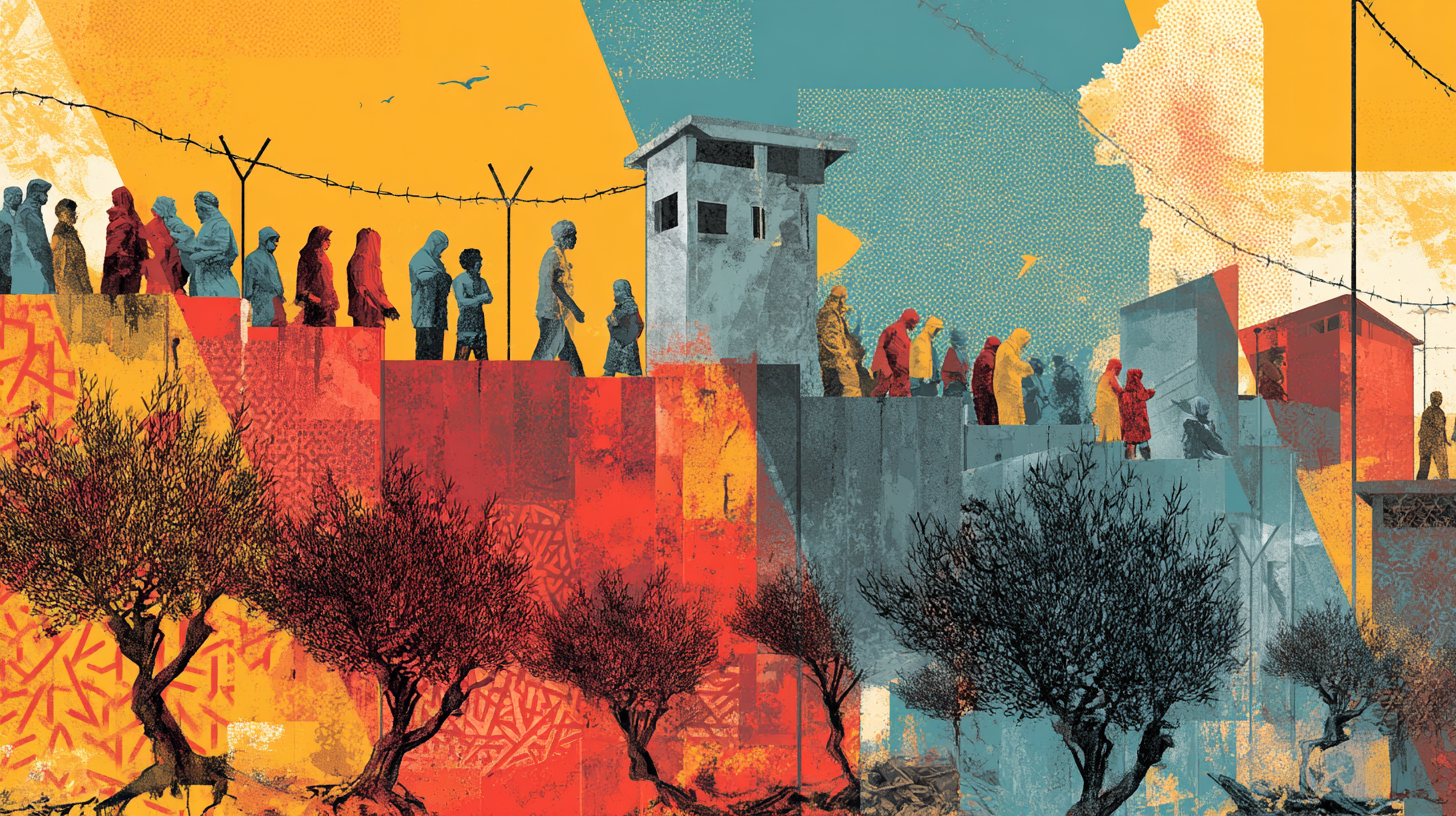
In February 1974, four months after the Yom Kippur War had come close to annihilating the Israeli state, a group of disciples of Rabbi Zvi Yehuda Kook met in Haim Drukman’s living room and founded a movement they called Gush Emunim, Hebrew for Bloc of the Faithful. They were not aiming to build a charity or another political party. They meant to colonise the West Bank as a religious act and as a political answer to what they read as a structural weakness in Labour Zionism, the same Labour Zionism whose electoral exhaustion the previous episode already established. Half a century later, the legal architecture that project ended up building has been described, independently, by three human rights organisations and, in July 2024, by the International Court of Justice, as a violation of the principle that bans racial segregation and apartheid. This episode reconstructs how a movement of religious settlers became, over fifty years, the administrative scaffolding of a regime that must now answer before international law.
The year redemption turned into urban planning
For the founders of Gush Emunim, disciples of a rabbinate that read the territorial victory of 1967 as an eschatological sign, the trauma of October 1973 did not contradict that reading. It confirmed it. If Israel had come within days of losing the West Bank, Sinai and the Golan Heights, then colonisation stopped being one strategic option among others and became a religious emergency. The reasoning was simple and, within its own logic, airtight.
The organisation moved from theology to institutional engineering at a speed that surprised its own political opponents. In late 1974, an internal Gush Emunim group called Garin Elon Moreh, led by rabbis Menachem Felix and Benny Katzover, tried to establish a settlement beside the ruins of the Ottoman railway station at Sebastia, near Nablus. The army evacuated the site on several successive occasions over the following months, until, in 1975, the still-Labour Israeli cabinet formally rejected the attempt by 17 votes to 2, with 3 abstentions. The negotiation that ended the standoff allowed 25 families to settle in Kadum, a military camp southwest of Nablus, a compromise that would give rise to the town of Kedumim and that was read, inside and outside the movement, as the turning point that multiplied settlements across the northern West Bank in the following years. In 1976 Amana was born, the movement’s construction arm, which turned improvised occupation into a permanent building enterprise.
The Likud’s electoral victory in 1977 gave that project something no previous Labour government had been willing to offer without reservation, explicit state funding and unambiguous political backing. Menachem Begin visited Kedumim on 19 May that year and, two months later, his government granted full legal status to that settlement, then home to barely a hundred people, along with Ofra and Maale Adumim. What the Labour cabinet had forcibly evacuated three years earlier, the new cabinet legalised by decree.
The demographic outcome of that alliance between theology, institutional engineering and state power is measured today in figures. From a settler population close to zero in 1974, the West Bank now counts more than 500,000 Israeli settlers, a figure that approaches 700,000 if one adds the Jewish population settled in East Jerusalem, though no single recent source offers that combined total with official precision. Growth has not stopped even in recent years, at a rate that continues to outpace by far that of the Israeli Jewish population as a whole.
The map that never stopped being provisional
Since 1967, the West Bank was governed by an Israeli military administration that, in 1981, took the name Civil Administration without ever ceasing to answer to the Ministry of Defence. Two overlapping legal regimes coexisted from the start, the settler subject to Israeli civil law through an extraterritorial application mechanism, the Palestinian, to military courts and orders.
The Oslo II accords, signed in September 1995, the second interim agreement between Israel and the Palestine Liberation Organisation that followed the original 1993 Oslo Accords, did not fix that duality. They administered it. The territory was split into three zones, Area A under Palestinian civil and security control, covering 18 percent of the territory, Area B under Palestinian civil control and shared security, covering 22 percent, and Area C, more than 60 percent of the West Bank, under full Israeli control, both civil and military. The agreement described that division as a five-year interim arrangement, pending a final status that was never actually negotiated. Thirty years later, the provisional map of 1995 remains the real map of the West Bank.
Human Rights Watch documented that, between 2016 and 2018, fewer than 1.5 percent of building permit applications filed by Palestinians in Area C were approved, while Israeli settlement construction on the same land moved forward through a separate and systematically more permissive administrative track.
That figure does not describe a bureaucratic accident. It describes a function. The two-hundred-and-thirteen-page report published by Human Rights Watch in April 2021 documented, beyond the gap in building permits, the confiscation of more than two million dunams of land in the West Bank and four and a half million within Israel itself (a dunam is roughly a quarter of an acre, the standard land unit across the former Ottoman Levant), roughly six hundred permanent obstacles to movement inside the West Bank, and an internal policy formulation, quoted verbatim by the report itself, that defined the system’s demographic goal as maximising the Jewish population and minimising the Palestinian one.
Three organisations, three methodologies, one shared conclusion
B’Tselem, the Israeli human rights organisation founded in 1989 with the longest record of field investigation in the occupied territories, published a declaration on 12 January 2021 whose title left no room for ambiguity, a regime of Jewish supremacy from the Jordan River to the Mediterranean Sea, this is apartheid. B’Tselem’s formulation is the broadest of the three. It is not confined to the West Bank or Gaza. It holds that a single regime governs the entire territory between the river and the sea, including Israel proper before 1967, and that it is this single regime that must be assessed, not its internal administrative borders.
Human Rights Watch, the New York-based organisation, four months later, framed its analysis differently. It applied the definitions of both apartheid and persecution set out in the Rome Statute, the 1998 treaty that founded the International Criminal Court, and concentrated its evidence on the occupied Palestinian territories, East Jerusalem included, without extending the finding to pre-1967 Israel the way B’Tselem did. Amnesty International, the global human rights organisation founded in 1961, in February 2022, following an investigation begun in 2017 and interviews carried out between 2020 and 2021, applied both the 1973 International Convention on Apartheid and the Rome Statute, and reached the geographically broadest formulation of the three organisations, a single system of domination affecting all Palestinians under effective Israeli control, inside Israel, in the occupied territories and among the refugee population.
None of the three organisations cited the other two as evidence for its own conclusion. Each built its own documentary case, with its own legal framework and its own geographic scope. That is what turns the coincidence into real corroboration rather than an echo repeated three times.
The Hague did not say apartheid, it said something more uncomfortable still
On 19 July 2024, the International Court of Justice issued an advisory opinion, a non-binding but highly authoritative legal assessment, on the legal consequences of Israeli policies and practices in the occupied Palestinian territory. In paragraph 229 of that opinion, the Court concluded that Israeli legislation and measures constitute a violation of Article 3 of the International Convention on the Elimination of All Forms of Racial Discrimination, owing to the near-total separation that Israel imposes and maintains, in the West Bank and East Jerusalem, between the settler community and the Palestinian community.
Here it is worth resisting the temptation to simplify what the Court actually said. Article 3 of that convention bans, in the same clause and without distinguishing between them, racial segregation and apartheid. The Court did not specify which of the two applies to the Israeli case, and the judges’ own separate opinions confirm this as a point deliberately left open. Judge Dire Tladi read the ruling as a finding of apartheid. Judge Georg Nolte argued, to the contrary, that the Court explicitly left unresolved whether Israeli practices amount to racial segregation, apartheid, or both at once. There is, moreover, a technical difference the Court itself acknowledged, apartheid as a crime under international criminal law, defined by the 1973 convention and the Rome Statute, requires a specific intent to maintain the regime of domination, a threshold the racial discrimination convention’s framework does not require in the same way. Anyone citing this ruling as a definitive judicial conviction for apartheid is claiming more than the Court, separate opinions included, chose to say.
Two months later, on 18 September 2024, the United Nations General Assembly, convened in an emergency special session under its 1950 Uniting for Peace procedure, adopted a resolution welcoming the Court’s opinion and demanding that Israel end its presence in the occupied Palestinian territory within twelve months, evacuate the settlers, dismantle the separation wall and make reparation for the damage caused since 1967. The resolution passed with 124 votes in favour, 14 against and 43 abstentions. Among the fourteen votes against was the United States, and among the abstentions, most Western European governments, the same bloc of allies whose unconditional backing this series’ editorial line identifies as a structural condition of the impunity.
Peace Now, the Israeli watchdog group that has monitored settlement construction since the late 1970s, recorded in 2025 the approval or legalisation of 54 settlements, the creation of 86 new illegal outposts, a record figure against an annual average of barely 6 between 1991 and 2022, and planning approval for 27,491 new housing units, nearly double the previous record set in 2023.
None of this slowed the pace of colonisation. The year following The Hague’s opinion was, according to the very organisation that has documented these figures for more than three decades, the biggest year of settlement expansion ever recorded, with the E1 plan, blocked for nearly three decades by its capacity to split the West Bank into two geographically disconnected halves, finally approved with a state investment close to a billion dollars. An advisory opinion, however authoritative, carries no mechanism of forced enforcement. The system it described in July 2024 kept, twelve months later, expanding in exactly the opposite direction, with none of the fourteen governments that voted against the General Assembly resolution choosing to turn that opinion into a concrete consequence…
G.S.
Sources
- Gush Emunim
- Kedumim
- What are Area A, Area B, and Area C in the West Bank?
- A regime of Jewish supremacy from the Jordan River to the Mediterranean Sea: this is apartheid
- A Threshold Crossed: Israeli Authorities and the Crimes of Apartheid and Persecution
- Israel’s apartheid against Palestinians: Cruel system of domination and crime against humanity
- Advisory Opinion of 19 July 2024, Legal Consequences arising from the Policies and Practices of Israel in the Occupied Palestinian Territory, including East Jerusalem
- Racial Segregation and Apartheid in the ICJ Palestine Advisory Opinion
- Resolution ES-10/24, General Assembly, 18 September 2024
- 2025 was record year for settlement expansion, construction and planning, NGO finds
- Settlement & Annexation Report, March 6, 2026