Gérard de Nerval lived from 1808 to 1855, but it is worth setting aside from the start the image of the harmless dreamer that posterity pinned on him. During the winter of 1839 to 1840 he spent several months in Vienna, sent on a vague semi-diplomatic mission that he himself took seriously, at least for a while. That winter produced an unfinished novella, Pandora, published only in fragments and never completed when the author died, fifteen years later, hanged from the grating of a Parisian alley that no longer exists, the rue de la Vieille-Lanterne. The text recounts a precise social humiliation, which took place in a salon of the French embassy, and the way a man chooses not to confess it but to turn it into literature. Read today, in 2026, it reveals a mechanism that no social network invented, only perfected.
The Viennese social theatre
The mission that took Nerval to Vienna was never entirely clear, not even to him, and 1839 had given him little reason for lightness. His relationship with the actress Jenny Colon, which shaped much of his emotional and literary life, had closed for good, she had just married a flautist and was stringing together successes that no longer included him. The bankruptcy of the magazine Le Monde dramatique, which he believed settled, had come back to haunt him with new lawsuits, and Alexandre Dumas, whom he considered a friend, had also failed to hold up his end of the deal for the play Léo Burckart, which Nerval ended up writing alone. Vienna, then, was not the whim of an idle traveller. It was the last card of a man who urgently needed proof that he was worth something in the eyes of his father and the world.
A year earlier he had written to his father from Frankfurt that French men of letters received a welcome there they would never find in Paris, and that a contact was promising him a recommendation to Metternich. The so-called Eastern Question kept every European chancellery on edge, and Vienna, seat of the chancellor, was its nerve centre, so the Ministry of the Interior granted him a semi-diplomatic assignment with an allowance of six hundred francs, and on 20 November 1839 Nerval arrived determined to prove he deserved the money. He translated a pro-Russian propaganda pamphlet to prove his seriousness, dined at the embassy, sat one evening beside the Duke of Ragusa, and wrote to his father with an enthusiasm that today reads with a certain sadness, telling him he was finally living what his father had lived in 1809, in the great moment of his life. He was received, fêted, invited to the best tables. What he failed to calculate was the exact price of that welcome.
None of it was false, and yet all of it was an illusion carefully built by others. Ambassador Sainte-Aulaire’s family received him with a warmth Nerval read as intimacy, when it was in fact the routine courtesy Viennese aristocracy reserved for any well-recommended young man.
It was in those salons that he met Marie Pleyel, a virtuoso pianist who shared with Liszt and Bériot the finest moments of the Viennese musical season, and whom Nerval would turn, thirteen years later, into the Pandora of the story. Born Camille Moke in 1811, married to and later divorced from the piano maker Camille Pleyel, her reputation as a virtuoso was already European when Nerval met her, and the Viennese critic Saphir, editor of the newspaper Der Humorist, published reviews of her concerts so glowing that Nerval himself translated one. The text installs her from the outset in the register of enigma, neither man nor woman, neither chaste nor mad, all of it at once, according to the Bologna inscription that opens the story. One should not look in her for a love story but for a figure, something that both attracts and humiliates, without the reader ever quite knowing which of the two dominates.
On 20 November 1839 Nerval arrived in Vienna invested with a semi-diplomatic mission from the French Ministry of the Interior, with an allowance of six hundred francs, documented in his correspondence with his father.
The charade as the mechanics of the world
Humiliation, in Pandora, never arrives as a grand scene. It arrives in the details, the outfit demanded, the place one is assigned, the glance that appraises before a word is spoken. In a real letter dated 10 January 1840, Nerval tells his father that the ambassador good-naturedly complains he has not been seen in three days, that comedies were read the previous week before princes and ambassadors, that Metternich attends the great evenings. He writes it as a victory. It is, in fact, the exact description of a gilded cage where every gesture of familiarity is calculated to keep him grateful and obedient.
Into this setting comes the order to take part in a brilliant performance before the court and the diplomatic corps. He is to play charades. Nerval takes the part with irritation, having barely studied it, and walks through Vienna rehearsing his lines, crossing taverns, markets and a failed meeting with a chorus girl who demands ten florins he does not have.
The day of the charade itself began badly. Nerval went to the post office hoping his uncle had sent him money, and received instead a letter loaded with moral maxims and thrifty advice, without a single money order. He had to borrow from a friend, a somewhat eccentric doctor of philosophy who lived off a guitar and his mistress’s leftovers, two Austrian coins he promised not to spend before the next day. He crossed Christmas markets full of Nuremberg toys and tin drums, dined on cutlets washed down with cheap Tokay wine, and only then, stomach full and purse nearly empty, presented himself at the palace where the princes, the ambassadors and his half-learned part awaited him.
The charade, that game of miming, suggesting, hiding and making others guess, functions as the exact miniature of the salon around it. Every aristocratic society operates by the same logic, it guesses at people, classifies them, reduces them to a role others decide for them. Nerval knows this without quite saying so, which is why he writes, at the start of the story, that Pandora means telling everything, because he does not want to tell everything. The line is not a stylistic whim. It is the composition rule of the whole text.
The folding screen comes down
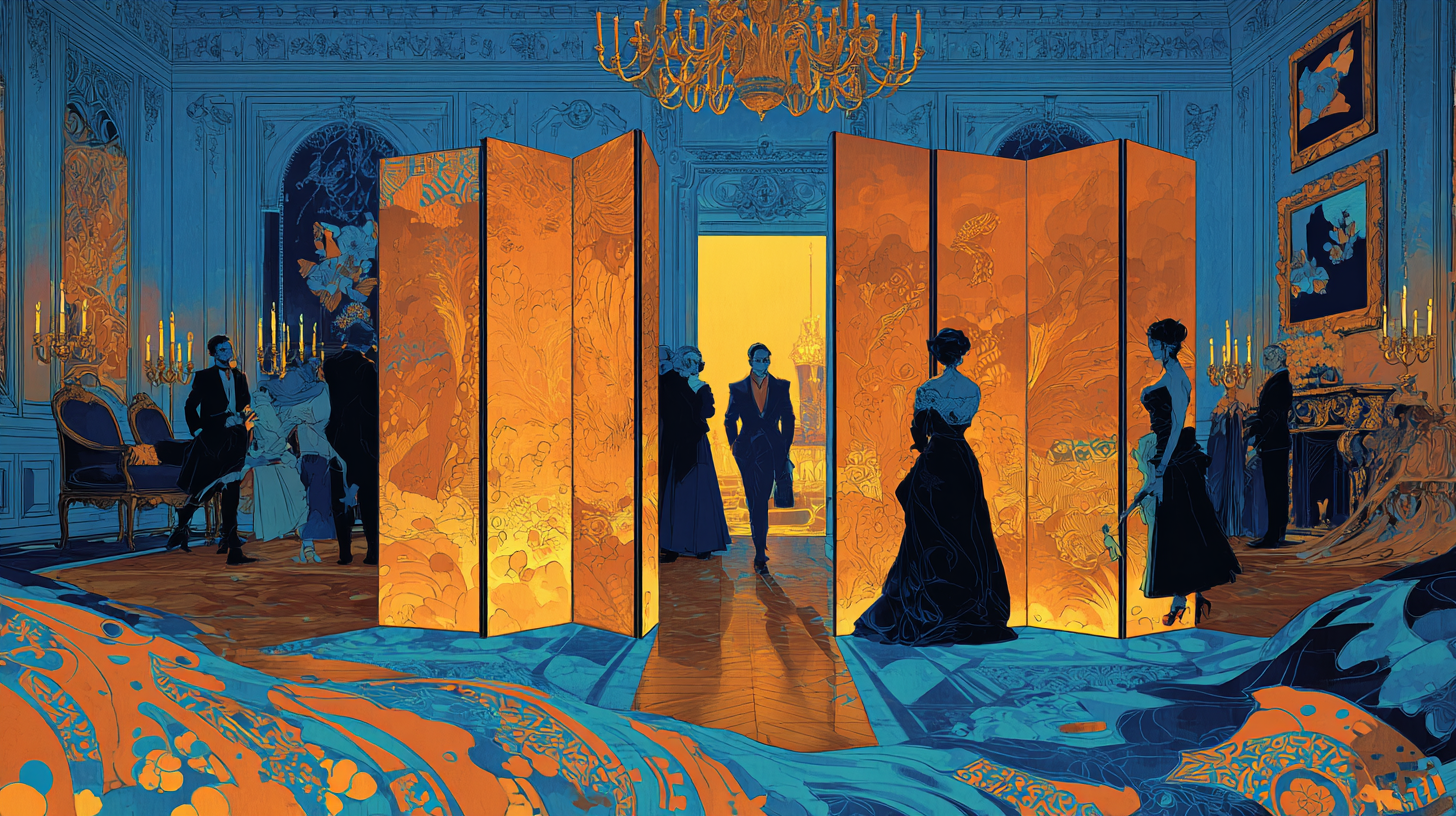
What happens next is documented in the manuscripts of Pandora itself, beyond the incomplete fragment Alexandre Dumas published in Le Mousquetaire on 31 October 1854. In anger, Nerval writes, I knocked over the screen standing in for a country salon. What a scandal. I fled the salon at a run, shoving my way past crowds of ushers with silver chains and braided heyducks down the stairs, and took shameful refuge in the hunters’ tavern.
A folding screen, in a Viennese salon of 1840, is no ordinary piece of furniture. It serves to conceal, to preserve appearances, to hold up the set that makes life in society possible without anyone having to look straight at what is really happening behind it. To knock it over is to bring down the whole set. It is to let show, for one unbearable second, that all of it rested on painted panels and nothing more. That is why the cry of scandal answers not to the clumsiness of the gesture but to its truth. That man has just been, for an instant, too real in a world that demands precisely the opposite, absolute control over every emotion, every word, every calculated silence.
The flight that follows, among ushers and heyducks, has something of comedy and something of nightmare about it, and Nerval writes it that way, without pathos, with the ironic distance of someone who already knows the episode will mark the rest of his Viennese stay. Months later he will return to France, as he confesses to a friend, threadbare, forced to return humbly to literature. The diplomatic mission, the promise of a stable position he never obtained, all of it closed on the night the screen came down, or perhaps well before, and the gesture only made it visible.
The manuscript does not stop there. In the pages that follow, reconstructed by scholars from autograph fragments, the narrator goes back to look for Pandora and runs into a rival, a prince who boasts of his skill with a sword, and ends up going down the stairs alongside both men, contesting every inch of ground without yielding a single one. A year later, the final scene plays out in Brussels, again on New Year’s Eve, and Nerval describes himself as an eternally tormented Prometheus. The writing of Pandora, meant to work as catharsis for the double Viennese humiliation, fails to close it entirely. That work of repair will continue, a year later, in the opening pages of Aurélia, the story of dream and life Nerval began writing that same season in Brussels.
The fragment of Pandora appeared incomplete in Le Mousquetaire on 31 October 1854, interrupted before the charade scene. Nerval died three months later, on the night of 25 to 26 January 1855, without having finished the story.
Transfiguring instead of confessing
This is where the rule stated at the start of the story is fulfilled. Telling everything and not wanting to tell everything are not two contradictory gestures in Nerval, they are the same gesture seen from two angles. Secrecy, in his literature, is not the opposite of truth. It is, quite often, its condition of possibility. The court and the diplomatic corps watched every word in those salons, a confidential letter could end up read by the Viennese police, as indeed happened, and speaking without a code amounted to disappearing. That is why, when he can no longer narrate the humiliation head on, Nerval transfigures it, moving from salon to myth, from fact to symbol, from personal shame to literary destiny. Pandora stops being Marie Pleyel and becomes a figure no biographical detail fully exhausts.
This gesture is not an ornament. It is a way of staying upright. Those who long reduced him to the shadow of madness missed the exact opposite, an almost clinical lucidity about the mechanisms of humiliation, about the masks power demands, about what a society does to souls unable to feign enough indifference.
Read from 2026, the mechanism has not changed in nature, only in setting. The Viennese salon became a screen, the charade became a post, and the fallen screen now has the exact size of a badly judged comment or a photo circulating where it should not. Exposure is permanent, judgment is instant, and social humiliation, digital or in person, still operates by the same logic Nerval described, people are not judged for what they are worth but for what they represent. The lesson Pandora leaves is not to avoid scandal at any cost, which is impossible anyway, but to tell the set apart from life, to keep a fair secret to protect what matters, and to turn humiliation into lucidity rather than letting it rule.
No one needs a Viennese salon or a letter intercepted by Metternich’s police to feel that surveillance anymore. A work group is enough, a family party filmed without permission, a comment kept for months to use at the right moment, quietly, against someone who has since let their guard down. The difference with 1840 is not one of intensity but of scale, and above all of speed, what once took an entire season in Vienna to become a scandal now takes a minute to become one anywhere in the world.
Nerval did not write to decorate the world. He wrote to teach how to walk through it without getting lost…
G.S.
Sources
- Pandora
- Un hiver à Vienne
- Pandora, Le Mousquetaire (full text of the fragment)
- (print edition) Gérard de Nerval, Pandora et autres nouvelles, edited by Jean-Luc Steinmetz, Gallimard