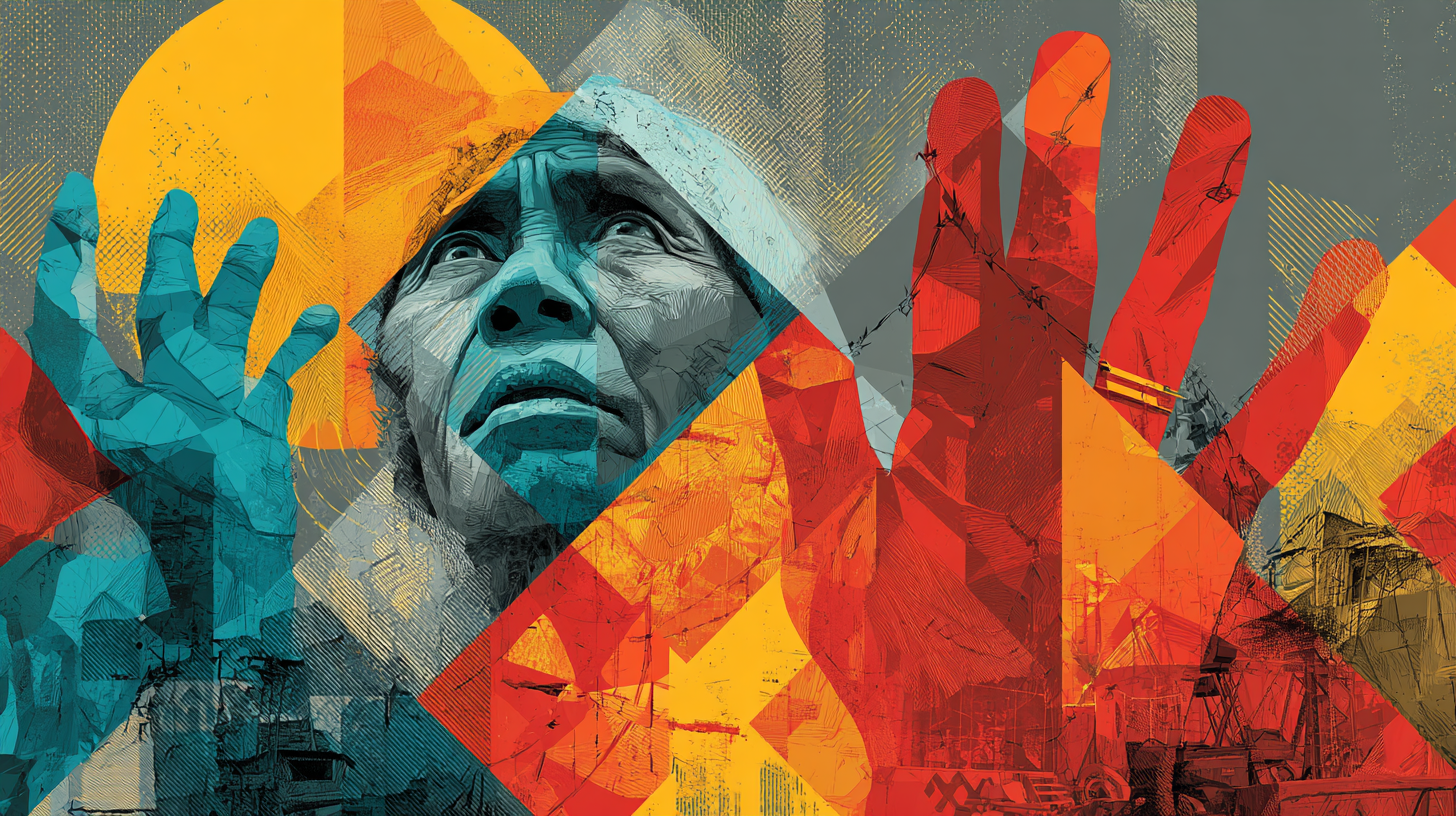
Latin America is the continent where the rights of indigenous and Afro-descendant peoples are most recognised in positive law, and where their defenders die most often for exercising them. Since 1989, ILO Convention 169 has required states to consult those communities before authorising any project that affects their territories. Fifteen Latin American countries have ratified it. Over four decades of implementation, the consultation has become the most efficient mechanism for extracting legitimacy without transferring power. What that period has demonstrated is not that the law arrived late or remained incomplete. It is that it arrived on time and functioned exactly as designed.
The Engineering of Consent
Convention 169 was born as a revision of Convention 107, which assumed that indigenous peoples should be assimilated into the modern nation-state. The 1989 revision recognised them as collective subjects with their own rights over their territories. It was also the product of a negotiation between three incompatible interests. Governments did not want to cede sovereignty over their resources. Indigenous organisations demanded a right of veto. Employers, represented within the ILO through tripartism (the mechanism of equal representation between workers, employers, and governments), needed extraction to continue. What emerged was “free, prior and informed consultation” (FPIC), a mandatory procedure that does not require consent.
The distinction between consulting and consenting is not semantic. It is the difference between a process the state can declare fulfilled even if the community objects, and one that requires agreement for the project to proceed. Convention 169 establishes the first option. The state must conduct the consultation in good faith; but if it ultimately determines that national public interest exists, it may authorise the project regardless. This escape clause is not a drafting error. It is the deliberate architecture of the instrument, negotiated so that countries with mining and energy interests would agree to ratify it. Free, prior and informed consultation was, from its original design, a valve that channels resistance without halting extraction.
The United Nations Declaration on the Rights of Indigenous Peoples used the term “consent” and established that states must obtain it when projects involve the displacement of communities or the storage of hazardous materials on their territories. But the Declaration is not a binding treaty; it is a political declaration without an enforcement mechanism. Its adoption initially produced international pressure that some communities exploited in national litigation. That momentum was absorbed by corporate language. Companies incorporated “FPIC consultation” into their ESG filings (the sustainability metrics used to evaluate investments). Free and informed consent became a tick-box.
Anatomy of a Procedure
To understand how free, prior and informed consultation works in practice, it is instructive to follow its real sequence. The state or private company identifies a project (a mine, a pipeline, a hydroelectric dam). Technical and environmental studies are conducted and the file assembled. And then, in that order, the consultation begins. In Colombia, Decree 2613 of 2013 stipulates that it must take place before any definitive decision. In practice, definitive decisions already have dates, financiers, and contracts prepared before the process starts. The community does not deliberate over whether the project should exist; it negotiates the terms of its implementation. That is not FPIC. It is conflict management after the decision has been taken.
The selection of interlocutors is another point of systematic vulnerability. The state defines who the legitimate representatives of the consulted community are. In territories fragmented by decades of armed conflict or forced displacement, this definition is almost always political. Leaders who oppose the project are characterised as non-representative or as acting under third-party influence, an elastic category that can include international environmental organisations as well as armed groups. Those who agree to negotiate are elevated to valid interlocutors and their agreements are presented as the community’s consent. The procedure thus produces its own consultable subject.
The Waorani case in Pastaza, Ecuador, is one of the few in which a community succeeded in demonstrating before a tribunal that the process had been fraudulent from the outset. In 2012, the state conducted a consultation to authorise oil exploration in Block 22, ancestral Waorani territory, without translation into local languages, without comprehensible information, with meetings lasting hours rather than months. In 2019, the Provincial Court of Pastaza annulled that consultation. The victory circulated as proof that the system could correct itself from within. What followed was more revealing. The state appealed, and in parallel, exploration advanced in adjacent blocks. The legal victory did not halt the extractive logic. It displaced it.
The Ecuadorian referendum of August 2023 on petroleum extraction in the Yasuní National Park recorded a turnout of 74.3% and a majority of 58.9% in favour of the definitive suspension of operations in Block 43. President Daniel Noboa’s government respected the result and initiated the closure process. The estimated compensation cost to the affected companies, including state-owned Petroecuador, exceeded 1 billion dollars, charged to the public budget, that is, to the same citizens who voted for the suspension.
The Green Turn
The global energy transition has added a new dimension to this structural conflict. Lithium, copper, cobalt, and rare earth elements (the scarce minerals required to manufacture batteries, solar panels, and wind turbines) are distributed through the earth’s crust in a way that no colonial cartographer would have mapped with greater convenience for those who extract. The Lithium Triangle, spanning northern Chile, north-western Argentina, and south-western Bolivia, holds more than 60% of known global reserves. The Atacama Salt Flat, ancestral territory of the Atacameño communities (also known as Lickanantay), is the most productive extraction site on the planet, where Chilean SQM and American Albemarle operate.
The extraction process requires pumping brine from the salt flat’s underground aquifers, evaporating it in artificial ponds, and processing the residue to obtain lithium carbonate, all within a high-altitude desert ecosystem with minimal water recharge. The Atacameño communities have spent over two decades documenting aquifer impacts, warning of threats to the highland agriculture and camelid herding on which their livelihoods depend. Reports from Chile’s Environmental Assessment Commission have recorded declining water levels in the salt flat. Companies have signed “relationship agreements,” funded local infrastructure, and incorporated the language of cultural respect. Free, prior and informed consultations have been carried out. And extraction continues.
Bolivia attempted a different variant. From 2008, Evo Morales declared lithium a strategic national asset and created Yacimientos de Litio Bolivianos (YLB) as a model of resource sovereignty. But state sovereignty over the resource and community sovereignty over the territory are two different things. In 2011, the Morales administration pushed a road through the TIPNIS (Isiboro Sécure National Park and Indigenous Territory), an Amazonian reserve of 64 indigenous communities. The communities responded with the Eighth Indigenous March to La Paz. Morales retreated and enacted Law 180 to protect the TIPNIS. In 2017, Law 969 repealed it and authorised construction. Plurinationalism revealed its limits. It applies when there is no infrastructure at stake.
The difference between the classical extractivism of the twentieth century and the green extractivism of the twenty-first is not structural. It is rhetorical. The first presented itself as a necessity of national development; the second presents itself as a global climate necessity. In both cases, the cost is territorialised, falling on specific communities, frequently ethnic ones, whose ecosystems are transformed to produce goods whose value is captured elsewhere. The battery of the electric car manufactured in Europe or North America is produced from Atacameño lithium extracted from a salt flat that local communities cannot halt, despite the existence of an international convention stating that they should be able to.
According to Global Witness’s annual report for 2022, Latin America accounted for more than 50% of the documented killings of land and environmental defenders worldwide. More than one third of global victims belonged to indigenous peoples or Afro-descendant communities, groups representing less than 5% of the world’s population. Colombia, Brazil, and Mexico headed the list of countries with the highest number of cases.
What Changes and What Does Not
The ethnic minorities of Latin America have accumulated, over four decades, a legal patrimony without historical precedent. The 1991 Colombian Constitution recognised the collective land ownership of Black and indigenous communities. The 2009 Bolivian Constitution declared the country a plurinational state, acknowledging 36 indigenous originary nations and their own normative systems. The 2008 Ecuadorian Constitution granted rights to nature as a legal subject, adopting a historic demand from Amazonian organisations that had long insisted that ecosystems are not properties but living territories. No other continent possesses a comparable constitutional corpus in this field.
But the two normative layers (constitutional recognition and the executive authorisation of extractive projects) are not in contradiction. They operate in distinct spaces and depend upon one another. Constitutional recognition flows through the judicial system, slow, costly, case by case. Extractive authorisations flow through the executive licensing system, expeditious, producing facts on the ground before any legal appeal can succeed. By the time a community wins an injunction, the road is open, the drilling has begun, the aquifer has been compromised. The coexistence of both layers is not a failure of the system. It is its normal functioning.
The Latin American state learnt, after 1991, to need both architectures simultaneously. Without constitutional recognition, indigenous and Afro-descendant resistance becomes ungovernable, without institutional channels, without the possibility of negotiating agreements. Without extractive licensing, the state loses the fiscal capacity that funds its operations and its redistributive legitimacy. What FPIC resolves is the problem of articulation between the two layers. It produces a document certifying that the community was heard, that the state acted in good faith, that the process was followed. That document does not change the outcome of the decision. It changes its legal status. And that, for the purposes of the state and the market, is sufficient.
What indigenous and Afro-descendant peoples obtained from four decades of legal struggle was not the power to halt extraction. It was the power to make it more costly in terms of procedure, visibility, and conflict. That is a real power, but it operates within a logic they do not control. The state decides how much that procedure costs it, how much visibility it tolerates, how much conflict it manages. When the cost rises too high, it changes the law. As in Bolivia in 2017. As in Ecuador, when the billion-dollar Yasuní compensation was presented not as the price of respecting a right, but as the unreasonable cost of having exercised one…
G.S.
Sources
- Convention on Indigenous and Tribal Peoples, No. 169, International Labour Organization, 1989
- United Nations Declaration on the Rights of Indigenous Peoples, UN, 2007
- Latin American Mining Conflicts Observatory, OCMAL, 2023
- Waorani ruling, Provincial Court of Justice of Pastaza, Ecuador, 2019
- Yasuní referendum results, National Electoral Council of Ecuador, August 2023
- Mineral Commodity Summaries. Lithium, U.S. Geological Survey, 2024
- Global Witness, A Deadly Decade for Land and Environmental Defenders, 2023
- Decree 2613 of 2013, inter-institutional coordination protocol for prior consultation, Ministry of the Interior of Colombia
- El modelo de industrialización del litio en Bolivia, Centro de Estudios para el Desarrollo Laboral y Agrario (CEDLA), 2022
- VIII Marcha Indígena / TIPNIS. Conflict chronology, CEDIB, 2012
- Political Constitution of the Plurinational State of Bolivia, Constituent Assembly, 2009
- Land and Territory. The Rights of Indigenous Peoples in Latin America, ECLAC, 2020